
Commercial Wastewater Treatment in Ireland: A Guide to Compliance and Maintenance
- chenviro2
- 1 day ago
- 11 min read
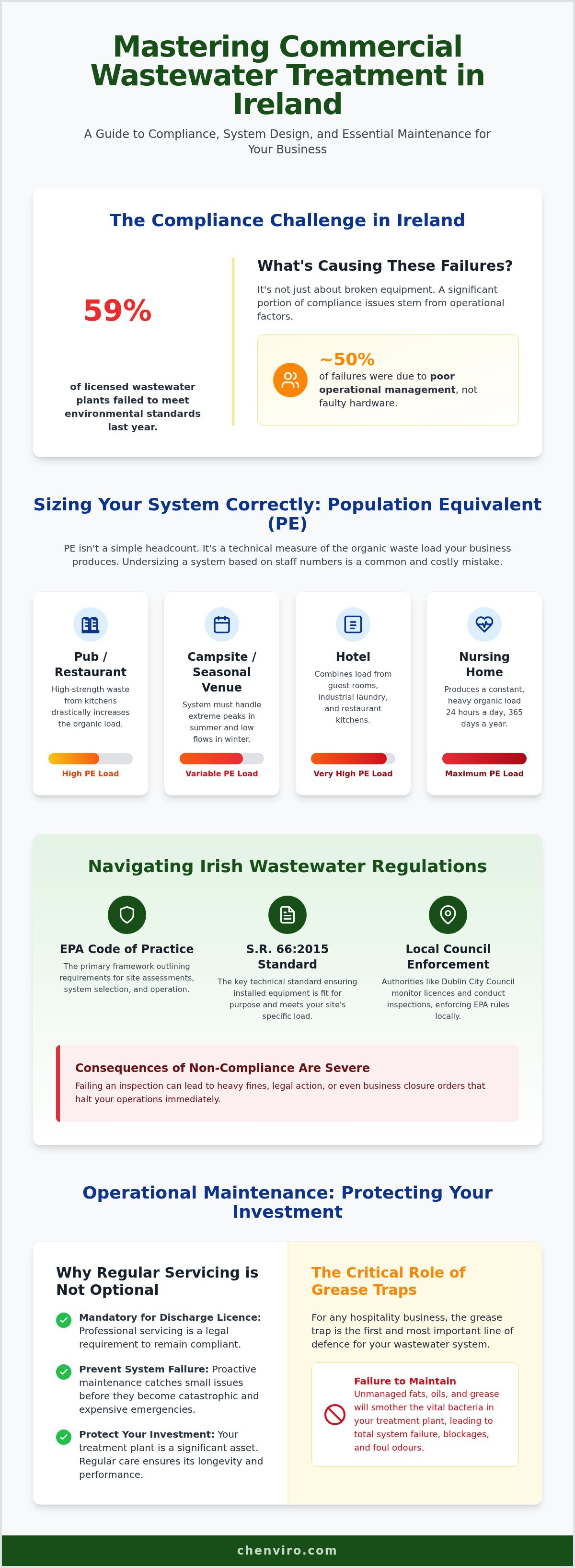
Did you know that 59% of licensed wastewater treatment plants in Ireland failed to consistently meet their environmental standards last year? It's a sobering figure, especially since nearly half of those failures were down to poor operational management rather than faulty hardware. You likely feel the pressure of staying compliant with commercial wastewater treatment Ireland regulations while trying to avoid the high costs of emergency repairs. It's difficult to focus on your daily operations when you're worried about local council fines or the technical jargon in the EPA Code of Practice.
We know you want a system that works quietly in the background without causing odours or legal headaches. This guide will help you master these complexities, from understanding the new 2026 trade effluent charges to implementing a reliable maintenance programme. We'll explore how to keep your Dublin or Leinster-based facility fully compliant, ensuring your pump stations and grease traps remain efficient and your business stays protected from avoidable environmental penalties.
Table of Contents
What is Commercial Wastewater Treatment and Why Does Your Business Need It?
Commercial wastewater treatment involves more than just managing high volumes of water. It is a specialised process designed to treat "grey" water from sinks and "black" water from toilets at a scale and chemical strength that domestic units simply cannot handle. For businesses operating off the public sewer network, a high-performance wastewater treatment process is a legal and operational necessity. Unlike a standard home, a commercial site produces effluent with significantly higher concentrations of fats, oils, detergents, and organic matter.
Standard domestic septic tanks usually provide primary treatment, where solids settle at the bottom of a tank. However, commercial wastewater treatment Ireland regulations typically require secondary treatment. This involves using active biological processes to strip out pollutants before the water is discharged. Because businesses produce much larger quantities of waste, failing to treat it properly would quickly saturate the ground, lead to foul odours, and result in catastrophic environmental damage to local water tables.
Calculating Population Equivalent (PE) for Irish Businesses
The baseline for any commercial design is Population Equivalent (PE). This isn't a simple head count of your staff. It's a technical measurement of the organic biodegradable load your business produces daily. One PE represents the organic load of one person. If your business involves food preparation or 24-hour residency, your PE will be much higher than your actual occupancy.
Hotels and nursing homes face the biggest challenges here. A hotel's PE must account for guest rooms, industrial laundry services, and busy restaurant kitchens. Nursing homes produce a constant, heavy load 24 hours a day, 365 days a year. Campsites and seasonal venues in Leinster must handle extreme peaks during summer whilst remaining functional during quiet winter months. It's not just about the flow of water; it's about the "strength" of the waste, measured as Biochemical Oxygen Demand (BOD). If you undersize your system when planning a business expansion, you risk system failure and heavy fines from the local council. It's a costly mistake that's easily avoided with the right technical advice.
Common Applications Across the Leinster Region
Different industries require different configurations. In rural Meath and Kildare, pubs and restaurants rely on robust secondary treatment plants to manage high-strength kitchen waste. For these hospitality businesses, integrating proper grease trap maintenance is the first line of defence for your treatment plant. Without it, fats and oils will smother the "good" bacteria in your system, leading to total failure.
Schools and community centres in Wicklow have different needs. They require systems that can handle sudden surges during the day followed by long periods of inactivity. Industrial sites with heavy-duty washdown areas need even more durable solutions to manage high levels of suspended solids. Getting the design right for your specific site prevents the need for emergency drain unblocking and keeps your facility running without interruption.
Navigating Irish Wastewater Regulations and EPA Compliance
Understanding Irish wastewater regulations is the first step toward avoiding legal trouble and environmental damage. The Environmental Protection Agency (EPA) Code of Practice serves as the primary framework for commercial wastewater treatment Ireland. It outlines strict requirements for site assessments, system selection, and ongoing operation. For any Irish business owner, the technical standard to discuss with your engineer is S.R. 66:2015. This standard ensures that the equipment installed is fit for purpose and capable of meeting the specific hydraulic and organic loads of your site.
Local authorities, such as Dublin City Council, Meath County Council, and Kildare County Council, act as the primary enforcers of these rules. They monitor discharge licences and carry out inspections to ensure businesses aren't polluting local watercourses. If your system fails an inspection, the consequences are severe. You could face heavy fines, legal action, or even closure orders that halt your business operations immediately. Compliance isn't a one-time event; it's a continuous requirement of your facility management.
Discharge Licences and Environmental Protection
Most commercial sites operating off-mains require a Section 4 licence. This legal document permits you to discharge treated effluent to groundwater or surface water under specific conditions. To maintain this licence, you must perform regular effluent testing. These tests provide the data needed to prove your system is achieving the required treatment standards. Keeping a clear, organised log of these results is vital. If a council inspector arrives for a surprise visit, having your documentation ready shows you take your environmental responsibilities seriously. If you're unsure about your current status, you can organise a compliance audit to identify any gaps in your records.
Planning Permission for New Wastewater Infrastructure
Planning permission for new commercial developments often hinges on your wastewater strategy. A site suitability assessment is the mandatory first step. This process involves trial holes and percolation tests to see how the local soil handles treated water. During the pre-planning phase, it is highly effective to integrate CCTV drain surveys. These surveys identify existing pipework conditions and help engineers design a system that fits your site's unique layout. Local councils in the Leinster region have specific regional soil requirements that must be met before they grant approval. Getting these technical details right at the start prevents expensive delays and redesigns later in the project.
Comparing Commercial Treatment Technologies: SAF vs. SBR
Selecting the right hardware is a critical decision for your facility management. It determines how easily you will meet the conditions of your Trade effluent licence. While traditional septic tanks are suitable for small domestic loads, they cannot provide the high-quality effluent required for modern commercial wastewater treatment Ireland. You need a system that can handle high-strength waste without constant supervision. Most Irish businesses choose between two primary technologies: Submerged Aerated Filter (SAF) and Sequencing Batch Reactor (SBR).
The main difference between these technologies is how they manage the biological treatment process. Traditional tanks rely on gravity, but commercial systems use mechanical aeration to speed up the breakdown of waste. This makes them more compact and much more efficient at removing pollutants. The best choice for your site depends entirely on your business flow pattern and the sensitivity of your local environment.
SAF Systems: The 'Workhorse' of Irish Hospitality
Pubs, hotels, and restaurants across the Leinster region often face "shock loads." This happens when a quiet Tuesday is followed by a fully booked Saturday night or a busy wedding weekend. SAF systems are ideal for this type of volatility. They use a media bed where a thick biofilm of beneficial bacteria grows. This biological layer is remarkably resilient. It stays active during low-flow periods and reacts quickly to sudden surges in waste. Maintenance is straightforward. It usually involves regular checks on the air blowers and internal components to ensure the bacteria receive enough oxygen to do their job. This reliability makes SAF a favourite for businesses that need a "fit and forget" solution.
SBR and Advanced Filtration Options
SBR systems operate differently. They treat wastewater in timed batches within a single tank rather than a continuous flow. This allows for incredibly precise control over the treatment process. If your business produces a consistent, 24/7 load, like a nursing home or a large industrial facility, an SBR might be the better fit. These systems are highly efficient but involve more complex control panels and sensors.
For sites located near sensitive rivers or protected lakes in Wicklow and Meath, you might also need tertiary treatment. This involves adding sand filters or UV units to further purify the water before discharge. While this increases technical complexity, it ensures the highest possible treatment quality. The trade-off is between the simple, robust nature of SAF and the precise, high-performance capabilities of SBR. Both technologies represent a significant upgrade over traditional tanks, ensuring your business remains compliant and odour-free.
Operational Maintenance: Protecting Your Investment
Installing a high-quality system is only the first step. Protecting that investment requires a commitment to regular, professional servicing. For any business using commercial wastewater treatment Ireland infrastructure, maintenance isn't a luxury; it's a legal requirement. Without a documented service history, you will likely void your manufacturer's warranty and fail to meet the conditions of your discharge licence. Most systems fail not because of poor design, but because of neglected components that could have been fixed during a routine inspection.
Developing a preventative maintenance schedule is the most effective way to avoid the high costs of emergency call-outs. Most commercial failures occur at three specific points: the air blowers, the pumps, or the blocked inlets. If an air blower fails, the biological process stops, leading to foul odours and non-compliant effluent. If a pump fails, the system can quickly overflow, causing a health hazard on your property. Regular checks ensure these mechanical parts are lubricated, clear, and functioning at peak efficiency.
The Role of Grease Traps in Commercial Wastewater
In the hospitality sector, the biggest threat to your treatment plant is FOG (Fats, Oils, and Grease). If these substances enter your treatment unit, they "blind" the filter media and kill the beneficial bacteria. This leads to a total system failure that is both expensive and messy to resolve. It is vital that restaurants and pubs separate kitchen waste from sanitary waste at the source. Implementing a strict grease trap maintenance programme ensures these contaminants are captured before they can damage your primary wastewater plant. Regular cleaning prevents the build-up of rancid fats that cause pipe blockages and attract vermin.
Pump Station Maintenance and Repairs
Many commercial sites in the Leinster region rely on pump stations to move wastewater to the treatment area, especially when the topography doesn't allow for a gravity-fed system. These pumps work under heavy pressure and require specialised care. You should watch for signs of trouble, such as high-level alarms on your control panel or fixtures that drain slower than usual. If structural issues are detected in your pipework during an inspection, modern no-dig drain repair techniques can fix the problem without the need for disruptive excavation across your car park or grounds. To keep your facility running smoothly, you can book a professional maintenance contract that covers every aspect of your wastewater infrastructure.
Expert Commercial Wastewater Services with CH Enviro
Managing a facility requires a partner who understands that you don't have time for technical jargon or avoidable delays. CH Enviro provides comprehensive maintenance contracts designed specifically for the demands of commercial wastewater treatment Ireland. We specialise in keeping your infrastructure operational and compliant, moving beyond simple tank sales to provide a full-service solution. Our team handles everything from specialised pump station repairs to the regular desludging of large-scale treatment plants across the Leinster region. By consolidating your wastewater needs into one professional contract, you eliminate the confusion of dealing with multiple contractors.
When things go wrong, a fast response is essential to prevent business closure or environmental fines. We provide emergency drain unblocking and rapid diagnostics for system failures. Our technicians use high-definition CCTV surveys to pinpoint structural issues or blockages deep within your pipework. This data-driven approach ensures that we find the root cause of a problem the first time, rather than just treating the symptoms. Whether it's a failed blower in a SAF unit or a high-level alarm in a pump station, we have the tools and the experience to resolve the crisis quickly.
Why Choose a Local Specialist for Your Facility?
Working with a local expert provides a distinct advantage when dealing with regional regulations. We have a deep understanding of the specific requirements set by local authorities in Dublin, Kildare, and Meath. This local knowledge helps us ensure your documentation is always ready for a council inspection. Our "straight-talking" approach means you get clear, honest advice on the state of your system without any unnecessary marketing fluff. We focus on minimising business disruption, scheduling essential maintenance during off-peak hours whilst ensuring your site remains environmentally responsible.
Getting Started with CH Enviro
The best way to protect your business is to understand the current health of your infrastructure. You can book a comprehensive site audit where our team evaluates your entire system, from the grease traps in your kitchen to the final discharge point. This audit identifies potential failure points before they become expensive emergencies. Our approach to drainage services in Dublin and the surrounding counties is built on transparency and efficiency. We provide you with a clear roadmap for compliance and a maintenance schedule that fits your operational budget. Don't wait for a system failure to find out your plant is non-compliant; organise a professional assessment today to keep your business running smoothly.
Take Control of Your Facility's Environmental Future
Running a successful business in the Leinster region requires focus, and you shouldn't have to spend your time worrying about environmental penalties or system failures. You now understand that effective commercial wastewater treatment Ireland depends on more than just installing the right tank. It requires a clear strategy for meeting EPA standards, selecting the correct technology for your specific flow patterns, and committing to a rigorous maintenance schedule. Proactive care for your grease traps and pump stations is the only way to prevent the high costs associated with emergency call-outs and legal non-compliance.
By shifting from reactive repairs to a structured facility management plan, you protect your discharge licence and your professional reputation. Whether you require expert pump station repairs or a reliable Dublin-based emergency response, having a dependable partner makes the process straightforward. We provide full facility maintenance contracts that take the complexity out of environmental law. Secure your commercial wastewater compliance with CH Enviro today. Our team is ready to help you keep your Irish business running smoothly, efficiently, and responsibly.
Frequently Asked Questions
How often does a commercial wastewater treatment plant need to be serviced in Ireland?
A commercial plant typically requires a professional service at least every six months. However, the exact frequency is often dictated by the specific conditions of your discharge licence or the manufacturer's warranty. Larger systems handling high-strength waste or fluctuating loads may need quarterly inspections to ensure the mechanical blowers are functioning and the biological media remains healthy.
What is the difference between a septic tank and a commercial sewage treatment plant?
The main difference lies in the level of purification provided. A septic tank only offers primary treatment through basic settlement, whilst a commercial sewage treatment plant uses mechanical aeration for secondary treatment. This active biological process is essential for commercial wastewater treatment Ireland because businesses produce much stronger waste that a simple settlement tank cannot safely process.
Does my business need a discharge licence for its wastewater system?
Yes, most businesses discharging treated effluent to the ground or surface water require a Section 4 discharge licence from their local authority. If your business discharges trade effluent into the public sewer network, you must instead hold a licence from Uisce Éireann. These licences specify the volume and quality of water you are legally allowed to discharge.
What happens if my commercial wastewater system fails an EPA inspection?
Failing an inspection usually results in an improvement notice or a formal warning from the council. If the identified issues aren't resolved within the stated timeframe, you could face heavy fines or even a closure order. Since nearly 60% of licensed plants failed to meet standards in 2025, the EPA has increased its focus on enforcing strict maintenance and record-keeping.
Can CH Enviro repair an existing commercial pump station?
Yes, we provide specialised repairs for all types of commercial pump stations across the Leinster region. We handle mechanical failures, electrical faults, and structural pipework issues. If your station's high-level alarm is triggered or you notice slow drainage, it's vital to organise a professional repair immediately to prevent a total system overflow and potential environmental contamination.
How do I know what size (PE) wastewater system my business requires?
Your system size is determined by the Population Equivalent (PE) calculation, which measures the maximum daily organic load and hydraulic flow your business generates. An engineer will use the EPA Code of Practice guidelines to calculate this figure. It is based on your specific business type, staff numbers, and guest capacity to ensure the system handles peak loads without failing.
Is grease trap maintenance required by law for Irish food businesses?
Yes, all food businesses are legally required to manage fats, oils, and grease (FOG) to prevent them from entering the drainage network. This involves installing and maintaining a grease trap that meets European Standard EN 1825. Regular cleaning is mandatory to ensure your business stays compliant with building regulations and the conditions of your trade effluent licence.
What are the common signs that my commercial drain is blocked or failing?
Common signs include persistent foul odours, slow-draining sinks, or gurgling sounds from your internal pipework. You should also check your treatment plant's control panel for high-level alarms or warning lights. If you notice these symptoms, a high-definition CCTV survey is the most efficient way to diagnose the problem accurately without the need for disruptive excavation on your site.


Comments