
Blocked Outside Drain in Dublin: A Homeowner’s Guide to Solutions and Responsibility
- chenviro2
- Jun 30
- 11 min read
Updated: Jul 18
What if the rising wastewater pooling in your garden isn't actually your legal responsibility to fix? Dealing with a blocked outside drain Dublin homeowners often face is a stressful experience, usually accompanied by fears of property damage and high emergency costs. It's frustrating to stand over an overflowing gully, unsure whether you should be calling the council, your neighbours, or a private contractor.
You aren't alone in your confusion, as the lines between private pipes and public sewers can feel incredibly blurred when a crisis hits. This guide will help you identify the root cause of the blockage, clarify exactly who is liable for the repairs under Irish law, and explain the professional methods used to restore your drainage system. We will break down the differences between private and shared drains whilst exploring how modern CCTV surveys and no-dig repairs provide a permanent solution without the need for messy excavation.
Table of Contents
Common Causes of a Blocked Outside Drain in Dublin
Understanding why your drainage has failed is the first step toward a permanent fix. In Dublin, we see a specific pattern of issues ranging from environmental factors to the simple reality of ageing infrastructure. Many residents struggle with a blocked outside drain Dublin weather has exacerbated, but the root cause is often a combination of several factors. These range from everyday household habits to structural vulnerabilities inherent in older properties.
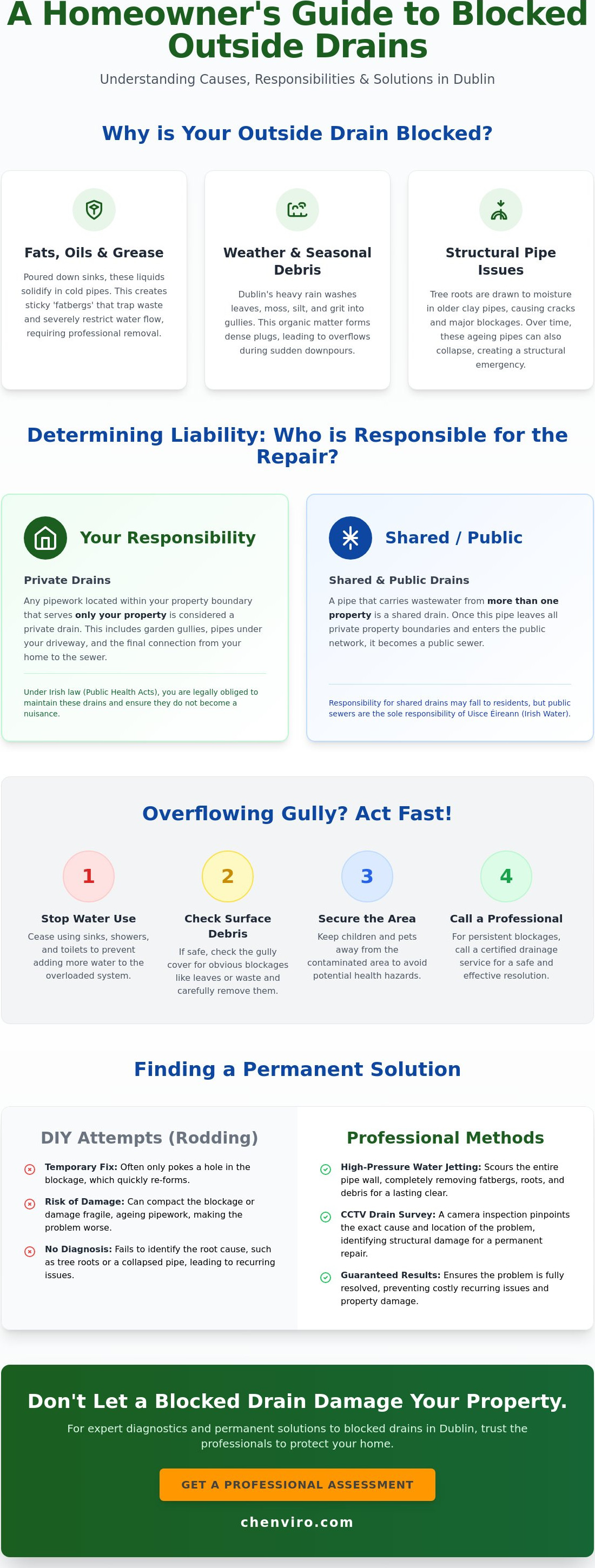
Grease and fat poured down kitchen sinks remain a primary concern. Whilst these substances are liquid when hot, they solidify rapidly once they reach the cold external pipework. This creates a sticky foundation that traps hair, wipes, and other common drain blockages, eventually forming a "fatberg" that restricts water flow. Unlike a simple clog, these hardened deposits require professional equipment to scour the pipe walls clean.
The Impact of Dublin Weather and Seasonal Debris
Dublin's climate presents unique challenges for external drainage. During the autumn months, the leafier suburbs see a massive influx of organic matter. Leaves, twigs, and moss from roofs wash into gullies during heavy Irish rain, creating a dense plug that stops water from entering the system. Surface water drains often struggle during sudden summer downpours because they are already partially restricted by grit and silt washed from driveways and roads.
Flash flooding is increasingly common in the Dublin region. When a large volume of water hits the system at once, any minor existing restriction becomes a major problem. If your garden gullies overflow during a storm, it is a clear sign that the system's capacity is compromised by accumulated debris or silt. This isn't just a nuisance; it's a risk to your property's foundation.
Structural Issues: Tree Roots and Collapsed Pipes
Many Dublin homes, particularly those from the Victorian or mid-century eras, still utilise clay pipes. These pipes are durable but have mortar joints that weaken over time. Tree roots are naturally drawn to the moisture inside these joints. Once a tiny root hair finds a gap, it expands, eventually filling the pipe or causing it to crack. This is a common reason for a recurring blocked outside drain Dublin homeowners encounter.
Structural failure is another reality for older systems. If you notice a sudden sinkhole in your lawn or a blockage that returns just weeks after rodding, the pipe itself may have collapsed. A collapsed pipe isn't a clog; it's a structural emergency that prevents any water from passing through. Identifying this early prevents raw sewage from saturating your garden soil and causing long-term damage.
Identifying Responsibility: Is Your Blocked Drain Private or Shared?
Determining who pays for a fix is often more stressful than the blockage itself. In Ireland, the law is straightforward but can feel complex when you're standing over a puddle of wastewater in your garden. Under the Public Health Acts, you are legally obliged to maintain any drainage that serves your property alone. If a blocked outside drain Dublin residents encounter is located within your boundary and doesn't carry waste from other homes, the repair falls to you. This includes the responsibility to ensure your drainage doesn't become a public health nuisance to your neighbours.
Private Drains and Homeowner Liability
A private drain is any pipework that serves only your individual building. This includes the gullies in your garden, the pipes under your driveway, and the section of pipe that connects your home to a shared sewer or the public main. You must keep these clear of debris to prevent flooding. Before a small issue turns into a garden-wide disaster, you should recognise the signs of blocked drain Ireland homeowners often overlook. If the blockage is confirmed to be on your property, arranging a professional drain unblocking service is the fastest way to protect your home and restore order.
Shared Drains and Uisce Éireann Boundaries
The situation changes in many Dublin housing estates where shared drainage systems are common. A shared drain is a pipe that carries wastewater from more than one property. In these cases, the responsibility for maintenance is usually shared amongst all the residents who connect to that specific line. However, once that pipe leaves your property boundary and enters the public network, it becomes the responsibility of Uisce Éireann (Irish Water).
Distinguishing between a private problem and a public one is vital. If your neighbours are also experiencing slow drainage or garden flooding, the issue is likely in a shared or public line. You should contact the national utility to report a public sewer blockage. If the problem is unique to your home, it's almost certainly a blocked outside drain Dublin professionals need to clear. Knowing these boundaries saves you from paying for a repair that isn't yours to handle, or waiting for a utility company to fix a pipe that is actually your responsibility.
Professional Methods for Unblocking Outside Drains
When you are faced with a blocked outside drain Dublin homeowners often find that standard DIY attempts fall short. Whilst manual drain rods are available in most hardware stores, they are designed for simple, soft blockages near the surface. For external systems, where the pipes are wider and the clogs are often composed of hardened grease or compacted silt, a more robust, professional approach is required to prevent the problem from returning. Professional intervention ensures the pipe is actually cleaned, rather than just temporarily poked through.
High-Pressure Water Jetting vs. Manual Rodding
High-Pressure Water Jetting (HPWJ) is the industry standard for clearing external blockages. Unlike manual rodding, which often only creates a small hole in the debris, water jetting uses a high-velocity stream to scour the entire internal circumference of the pipe. This is vital for removing the "fatbergs" and grease deposits discussed earlier. Rodding carries significant risks; rods can easily become stuck or snap inside the pipe, turning a simple unblocking job into an expensive excavation project. Jetting is safer, faster, and ensures the pipe is restored to its full flow capacity by stripping away years of internal buildup.
CCTV Surveys for Diagnostic Accuracy
A professional unblocking service doesn't just guess where the problem is. By utilising a CCTV drain survey Dublin experts can see exactly what is happening inside your pipes in real-time. This camera technology identifies structural issues like tree root ingress or collapsed sections that no amount of jetting can fix. It provides the visual evidence needed to settle disputes regarding Uisce Éireann pipe maintenance responsibility, proving whether a fault lies in your private line or the public sewer. This transparency is essential for insurance claims and shared liability discussions.
Beyond simple clogs, professional methods are essential for removing stubborn obstructions like heavy calcification or invasive tree roots. Specialised cutting heads can be attached to jetting units to mill away these hard materials without damaging the pipe itself. This diagnostic-led approach ensures that once your blocked outside drain Dublin is cleared, the underlying cause is addressed. You gain the peace of mind that comes from seeing the clear footage, confirming the structural health of your drainage system.
Immediate Steps to Take When You Spot an Outdoor Blockage
Seeing wastewater rising from a garden gully is an alarming sight. Your first action must be to stop using all internal water sources immediately. Every toilet flush, shower, or running tap adds volume to the backup. This increases the risk of wastewater entering your home or saturating your garden soil. By cutting off the flow at the source, you buy yourself time to assess the situation without making the flooding worse.
Once you have stopped the water, perform a visual inspection of the gully grate. Often, a blocked outside drain Dublin residents encounter is simply restricted by surface-level debris like leaves, moss, or silt. If you can see the obstruction at the top of the grate, clearing it manually might provide instant relief. If the water remains high despite the grate being clear, the problem is deeper within the pipework.
Try to identify which manhole is overflowing. Locating the specific point of failure helps narrow down whether the issue is in your private line or a shared sewer. Document the water levels and the specific location with clear photos. This visual evidence is invaluable for a drain unblocker near me. It allows the technician to understand the scale of the problem before they even arrive at your property.
Safe DIY Checks Before Calling a Professional
Removing visible silt from the top of a gully is a safe, effective first step. You should also consider if why does my drain smell Ireland was a question you were asking recently. Foul odours are often the first warning sign of a developing block amongst external pipes. However, safety is paramount. Never attempt to enter a manhole or reach deep into a pipe yourself. Manholes can contain toxic gases and physical hazards that only trained professionals should handle.
Preventing Recurring Blockages and Property Damage
Prevention is far more cost-effective than emergency repairs. Adhering to the "Think Before You Flush" campaign is essential; only human waste and toilet paper should enter your system. Installing leaf guards or gully covers is a simple way to protect your drains from Dublin's seasonal debris. Regular maintenance is also a wise investment. Scheduling a periodic drain unblocking service ensures that small build-ups of grease or silt are cleared before they cause a total system failure. This proactive approach keeps your property safe and avoids the stress of a sudden outdoor flood.
Expert Drainage Solutions with CH Enviro
CH Enviro approaches every blocked outside drain Dublin job with a commitment to transparency and fairness. We understand that a drainage crisis is stressful. You need a technician who arrives on time, explains the problem without jargon, and provides a fixed solution. Our straight-talking philosophy means we focus on results rather than sales pitches. Whether you are dealing with a residential gully overflow or a commercial system failure, our priority is to restore your property's safety and hygiene as quickly as possible.
Dealing with wastewater is never pleasant, but our professional presence is designed to instill confidence. We believe in providing a service that is grounded, dependable, and free from hidden costs. By combining years of on-site experience with modern diagnostic tools, we ensure that your drainage issues are resolved on the first visit whenever possible. We take pride in being a reliable local expert that remains unfazed by even the most challenging blockages.
After the stress of a drainage emergency has passed and your property's hygiene is restored, you may wish to refresh your home's atmosphere with a luxury fragrance from Maison Ephyr.
Why Dublin Homeowners Trust CH Enviro
Our reputation is built on decades of experience amongst our skilled drainage engineers. We provide more than just a quick flush; we offer comprehensive drainage services Dublin property owners rely on for long-term reliability. Our team doesn't just work in the city; we provide local expertise across Meath, Kildare, Wicklow, and the greater Dublin area. This regional presence allows us to understand the specific ground conditions and pipework styles common to each locality, ensuring our solutions are tailored to your specific environment.
Emergency Response and No-Dig Repair Options
When a blockage reveals a structural fault, we don't leave you with a temporary fix. We specialise in no dig drain repair Dublin, which allows us to fix collapsed or cracked pipes without digging up your garden or driveway. This trenchless technology is the most efficient way to resolve recurring issues identified during our CCTV surveys. Our rapid emergency response ensures that sewage ingress is stopped before it causes permanent damage to your home or business. If you are struggling with a blocked outside drain Dublin, contact CH Enviro today for a dependable, local solution that solves the problem for good.
Take Decisive Action to Protect Your Property
Managing a blocked outside drain Dublin properties frequently experience requires a balance of quick thinking and technical precision. You now understand how to distinguish between private and shared responsibility, whilst recognising that DIY rodding often fails to address the root cause of a clog. By choosing a diagnostic-led approach, you ensure that grease, silt, and tree roots are removed completely rather than just shifted further down the line. Proactive maintenance is the most effective way to prevent the stress and property damage associated with wastewater flooding.
CH Enviro stands ready to assist with a 24/7 emergency response and comprehensive CCTV diagnostic surveys included in our process. As no-dig trenchless repair specialists, we provide permanent fixes for structural faults without the need for disruptive excavation. Contact CH Enviro for professional drain unblocking in Dublin to restore your drainage system to full capacity. Our team is here to provide the expert reassurance you need to keep your home running smoothly. You don't have to face a drainage crisis alone.
Frequently Asked Questions
Is a blocked outside drain an emergency?
Yes, a blocked outside drain is often considered an emergency. If wastewater is overflowing into your garden or backing up toward your home's foundation, you face immediate risks of property damage and health hazards. Standing sewage attracts vermin and creates unsanitary conditions. It's best to address the issue before the liquid enters your internal plumbing system or causes structural dampness.
How much does it cost to unblock an outside drain in Dublin?
The cost of clearing a blocked outside drain Dublin homeowners face depends on the complexity of the job. Factors such as the location of the block, the need for CCTV diagnostic tools, and whether high-pressure water jetting is required will influence the final price. Most professional providers offer transparent pricing based on the specific work involved. You should always request a clear breakdown of costs before work begins.
What is the most common cause of outside drain blockages in Ireland?
Accumulated organic debris and household grease are the primary culprits in Ireland. Dublin's frequent heavy rainfall washes silt, leaves, and grit into gullies, whilst kitchen fat solidifies in external pipes. This combination creates a dense, stubborn plug. Over time, these materials bond together to form "fatbergs" that restrict water flow and eventually lead to a complete system failure during sudden downpours.
Can I use boiling water or chemicals to unblock an outside drain?
You should generally avoid using boiling water or harsh chemicals for external blockages. Boiling water can warp or damage modern PVC pipework, and it loses its heat too quickly to melt deep grease clogs. Liquid chemicals are rarely powerful enough to clear the large-scale obstructions found in outside drains. These substances can also be hazardous to the environment and the technician who eventually clears the block.
Who is responsible for a blocked drain in a shared driveway?
Liability for a shared driveway drain usually rests with the homeowners whose properties connect to that specific line. This is often a joint responsibility where costs are divided amongst the neighbours. If the blockage occurs in a lateral drain outside your property boundary or in a public sewer, Uisce Éireann is typically responsible. Determining the exact location of the block via a CCTV survey is the only way to confirm liability.
What happens if I ignore a blocked outside drain?
Ignoring a blockage will inevitably lead to property flooding and expensive structural repairs. Standing wastewater can seep into your home's foundations, causing damp and mould issues that are difficult to resolve. Additionally, stagnant sewage poses a significant health risk to your family and pets. What starts as a slow drain will eventually become a total backup, often at the most inconvenient time possible.
How do I know if my outside drain is blocked or just slow?
Standing water in the gully grate is the most obvious sign of a total blockage. If the water drains away but takes several minutes, your system is "slow" and likely partially restricted by silt or grease. You might also notice foul odours or gurgling sounds coming from your sinks and toilets. These are early warning signs that a complete blocked outside drain Dublin crisis is imminent and requires professional inspection.
Does home insurance cover blocked outside drains in Dublin?
Home insurance coverage for drainage issues depends entirely on your specific policy and the cause of the problem. Most insurers cover "accidental damage," such as a pipe being crushed by a heavy vehicle, but they rarely pay for blockages caused by leaves, fat, or general lack of maintenance. It's vital to check your policy documents or speak with your provider to see if "drainage cover" is included as a standard or optional extra.


Comments