
Commercial Kitchen Drain Smell in Dublin: Causes, Compliance, and Professional Fixes
- chenviro2
- Jul 14
- 12 min read
Updated: Jul 16
What if that persistent commercial kitchen drain smell in your Dublin premises is actually a diagnostic signal of structural failure rather than a simple cleaning issue? You have likely tried every chemical flush and DIY remedy, yet the scent returns every time the dinner rush starts. It is a stressful position to be in, especially when a single negative review or an unannounced inspection can jeopardise everything you have built. With Dublin City Council and Uisce Éireann increasing oversight through the FOG programme, ignoring these odours is a risk your business cannot afford.
We understand the urgency of keeping your kitchen operational and compliant. This article provides a clear path to eliminating foul smells by identifying their root causes and navigating the legal requirements of the Irish hospitality sector. We will outline the impact of the new trade effluent tariffs arriving in October 2026, explain how to stay on the right side of inspectors, and show you how professional no-dig solutions can fix your drainage issues without the need for costly excavation or kitchen closures.
Table of Contents
Identifying the Source of Foul Odours in a Dublin Commercial Kitchen
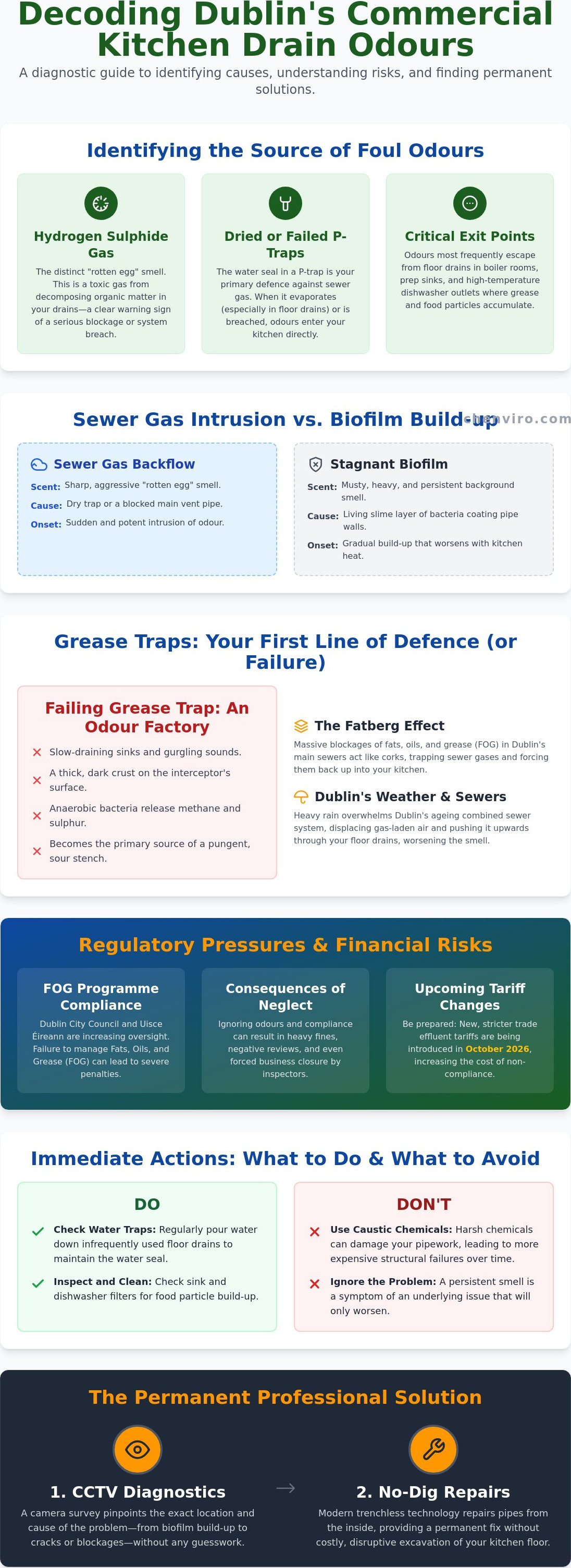
A persistent "rotten egg" scent in your kitchen is rarely just a sign of a missed cleaning shift. This specific odour is usually hydrogen sulphide, a toxic gas produced by the anaerobic decomposition of organic matter within your drainage system. In the confined spaces of a busy Dublin basement kitchen, these gases can accumulate quickly. While the smell is the first warning sign, the underlying cause usually involves a breach in your plumbing's primary defence: the P-trap.
Sewer Gas vs. Stagnant Biofilm
It is vital to distinguish between a sharp, sulphuric sewer gas backflow and the musty, heavy scent of stagnant biofilm. Sewer gas is a sudden, aggressive intrusion that occurs when a trap is dry or a vent pipe is blocked. Biofilm, however, is a living layer of bacteria and slime that coats the internal walls of your pipework. High-volume kitchens are particularly susceptible to this because the constant flow of warm, nutrient-rich wastewater provides the perfect breeding ground for these microbes. Over time, this buildup restricts flow and creates a permanent baseline odour that worsens as the kitchen heats up during service.
Why Dublin Kitchens Smell Worse After Heavy Rain
Many restaurant managers in the city centre notice that drainage smells intensify just before or during a downpour. This is due to Dublin's aging combined sewer system, where foul waste and surface water often share the same pipes. When sudden rainfall enters the network, it displaces the air inside the sewers. This displaced air, laden with gases, is forced back up through any available opening, including your kitchen's floor gullies. If your grease trap is already struggling with a blockage, this pressure can even cause gurgling sounds in your sinks.
The formation of large-scale blockages in the city network also plays a role. Understanding What is a Fatberg? helps explain why gases become trapped and redirected toward your property. Low atmospheric pressure in Dublin reduces the effectiveness of traditional vent stacks, allowing sewer gases to linger at floor level rather than dispersing safely into the air. Identifying whether your issue is a local biofilm or a city-wide pressure problem is the first step toward a permanent fix.
The Role of Grease Traps and Fatbergs in Kitchen Stench
When you are dealing with a commercial kitchen drain smell Dublin, the culprit is often found within your grease management system. Dublin's sewer network is under constant pressure from fatbergs, which are massive, solidified masses of fats, oils, and grease (FOG) mixed with non-biodegradable items. These masses act like a cork in the city's pipes. They don't just cause physical blockages; they trap sewer gases and force them back up into your kitchen through floor drains and sinks. This is particularly common in areas with older Victorian pipework where the capacity to handle modern catering volumes is limited.
Modern high-temperature dishwashers often complicate the issue. While they are essential for hygiene, the hot water emulsifies grease, allowing it to bypass your grease trap in a liquid state. Once this grease travels further down the line and cools, it solidifies and coats the interior of your pipes. This creates a secondary source of odour that sits well beyond the reach of daily surface cleaning. Ensuring your system meets FOG discharge licence requirements is the best way to prevent these city-scale blockages from impacting your specific premises.
When Grease Traps Become Odour Factories
A grease trap is designed to be a filter, but without regular attention, it becomes a reactor. You can tell your trap is failing if you notice slow-draining sinks or a thick, dark crust on the surface of the interceptor. At this stage, anaerobic bacteria take over, breaking down the trapped waste and releasing methane and sulphur. Instead of protecting your business, an overloaded trap becomes the primary source of a pungent, sour stench that permeates the dining area. To prevent this, following a strict grease trap maintenance Dublin schedule is essential for both odour control and regulatory compliance.
Rodents and Drainage Defects
If the smell in your kitchen is musky rather than sulphuric, you may be dealing with vermin. Rats are highly opportunistic and use the smallest structural cracks in Dublin's aging pipework to gain access to the warm environment of your kitchen voids. Traditional pest control often fails in these scenarios because it only addresses the animals, not the entry point. A bad smell often indicates a compromised pipe where sewer air and rodents are entering simultaneously. Our approach at CH Enviro combines integrated vermin control with drainage repairs to seal these breaches permanently. By identifying the defect through a CCTV survey, we stop both the infestation and the odour at the source.
Dublin Regulatory Pressures: Grease Traps and FOG Licensing
Regulatory oversight in Dublin is stricter than ever. A persistent commercial kitchen drain smell Dublin is no longer just a nuisance for your customers; it is a red flag for environmental health officers. Dublin City Council (DCC) and Uisce Éireann have intensified their focus on the Fats, Oils, and Grease (FOG) programme. By 2026, every food service establishment in the city must hold a valid Trade Effluent Discharge to Sewer Licence. If an odour leads to an unannounced inspection and a blockage is discovered, your business will be held liable under the "Polluter Pays" principle. This means you could be charged for the specialist machinery and personnel required to clear the public sewer network.
Compliance requires more than just having a grease trap installed. You must maintain a rigorous maintenance log that documents every service and cleaning event. Uisce Éireann inspectors typically require at least one year of documentation to prove your kitchen isn't contributing to the city's fatberg crisis. With new trade effluent tariffs taking effect on 1 October 2026, the financial cost of non-compliance will only increase. Keeping your drainage system odour-free is the most effective way to ensure your facility remains below the radar of regulatory enforcement.
FOG Licensing and Compliance in Dublin
When an inspector arrives, they will ask for your FOG documentation immediately. Persistent smells are often viewed as the first sign of a licence violation, suggesting that your grease management system is overloaded or bypassed. To stay compliant, your management team should maintain a folder containing your current discharge licence, waste disposal certificates from authorised contractors, and a cleaning schedule tailored to your kitchen's volume. A quick internal audit can prevent a forced closure; check that your grease trap is sized correctly for your current equipment and that your staff aren't "shocking" the system with boiling water or unauthorised chemicals.
Landlord vs. Tenant: Who Fixes the Smell?
Determining who is responsible for a commercial kitchen drain smell Dublin can be a complex issue in Dublin's multi-use buildings. As a general rule, the tenant is responsible for the "internal" pipework and the operational maintenance of grease traps. However, many smells in the city centre originate from structural collapses or root ingress in shared sewer stacks. These are typically the landlord's responsibility. To avoid a stalemate, you need objective evidence. We advise using a CCTV drain survey Dublin to pinpoint the exact location of the defect. If the footage shows a collapsed pipe outside your demised area, you have the proof needed to request that the landlord handles the repair costs.
Troubleshooting and Immediate Actions for Kitchen Managers
When a commercial kitchen drain smell Dublin first appears, your immediate priority is to determine if the issue is a simple maintenance lapse or a structural failure. Start by performing a "Deep Flush" on all floor gullies and prep sinks. In high-temperature Dublin kitchens, the water seal inside P-traps often evaporates, especially in drains located near ovens or under-counter refrigeration units. Without this water barrier, sewer gases have a direct path into your workspace. Simply pouring a few litres of water into every drain point can often resolve the issue instantly by restoring the trap's integrity.
You must resist the urge to use caustic soda or heavy bleach as a primary solution. While some suggest these for domestic issues, they are largely ineffective against industrial-grade grease and can cause severe damage to your pipework. Caustic chemicals often react with fats to create a hard, soap-like substance through a process called saponification, which actually strengthens a fatberg rather than dissolving it. These substances also pose a risk to your staff and can lead to environmental fines if they reach the city's main water treatment system in high concentrations.
Check your Air Admittance Valves (AAVs) and vent stacks if the smell persists after flushing the traps. These components are designed to regulate air pressure within your plumbing. If an AAV becomes stuck or a vent stack on the roof is blocked by debris, it creates a vacuum that "siphons" the water out of your traps as other appliances drain. This leaves your kitchen vulnerable to gas backflow every time a sink is emptied. If you suspect a mechanical failure in your venting system, it is time to seek professional drainage services Dublin to avoid ongoing disruption.
The Bucket Test for Dry Traps
To identify a dry trap, perform a systematic bucket test. Pour 5 to 10 litres of clean water into every floor drain that is not used daily. This is particularly important for drains located in walk-in fridges or storage areas where the air is dry. Whilst you are there, inspect your dishwasher discharge lines. Food debris often settles in the flexible hoses of commercial dishwashers, creating a stagnant biofilm that produces a musty odour even when the machine is off. Ensuring these lines are clear and have a proper "high loop" can eliminate many common kitchen scents.
When to Stop DIY and Call the Professionals
If the foul odour returns within 24 to 48 hours of flushing your traps, you are likely dealing with a deep-seated fatberg or a structural pipe collapse. A recurring smell is a clear indicator that gas is escaping through a crack in the pipework or that a blockage is forcing air back through the system. DIY methods cannot reach these areas. If your staff report headaches or if the smell is accompanied by gurgling sounds in the pipes, stop troubleshooting and contact an expert. You can book a professional inspection to identify the exact cause and prevent a total kitchen shutdown.
Professional Solutions: How CH Enviro Eliminates Kitchen Odours
When basic troubleshooting fails to resolve a commercial kitchen drain smell Dublin, the issue is likely embedded deep within your structural pipework. At CH Enviro, we move beyond surface-level cleaning to address the biological and structural causes of drainage scents. Our approach begins with High-Pressure Water Jetting (HPWJ). This is not a standard unblocking service; it is a methodical scouring of the pipe's internal diameter. By using specialised rotating nozzles, we strip away the bacteria-laden biofilm and hardened fat deposits that act as a reservoir for foul odours, restoring your pipes to their full flow capacity.
For Dublin businesses, the primary concern is often the fear of disruptive excavation. Traditional repairs involve breaking through kitchen tiles, which leads to dust contamination and forced closures. We prioritise trenchless technology to ensure your service remains uninterrupted. By combining precision diagnostics with modern lining techniques, we provide a permanent seal against sewer gases without the need for a single shovel. This "first-time fix" mentality is designed specifically for the high-pressure environment of the Irish hospitality sector.
CCTV Surveys and Precision Fixes
Effective odour elimination requires seeing the problem clearly. We insert high-definition, waterproof cameras into your main drainage lines to conduct a comprehensive inspection. This process allows us to pinpoint the exact location of structural breaches, such as hairline cracks or displaced joints, that allow sewer gas to seep into your prep areas. A CCTV drain survey Dublin also identifies vermin entry points and root ingress that typical cleaning cannot resolve. You receive a full report and video evidence, which is essential if you need to prove a structural fault to a landlord or local authority.
No-Dig Drain Repair: Minimising Kitchen Downtime
If a structural defect is identified, we utilise the "pipe-within-a-pipe" method to seal it. This involves inserting a resin-impregnated liner into the damaged section, which then cures to form a new, seamless internal wall. Choosing no-dig drain repair Dublin means you avoid the cost and chaos of digging up your kitchen floor. The new liner is resistant to the high temperatures and fats common in commercial settings, effectively locking out odours and rodents for decades. Most repairs are completed in a single shift, often scheduled outside of your peak service hours to ensure your kitchen never misses a booking.
The most cost-effective way to maintain a smell-free environment is through a preventative maintenance contract. Regular grease trap servicing and scheduled line flushing ensure you stay compliant with Uisce Éireann standards whilst preventing the buildup of odour-causing sludge. By moving from a reactive to a proactive model, you protect your reputation, your staff's health, and your bottom line.
Protect Your Reputation and Secure Your Kitchen's Future
A persistent commercial kitchen drain smell Dublin is more than a hygiene issue; it is a signal of structural or regulatory risk. We have explored how identifying the difference between a dry P-trap and a structural collapse can save you from unnecessary downtime. Staying ahead of Dublin City Council FOG requirements and the upcoming 2026 tariff changes is the only way to avoid heavy fines and forced closures. By addressing the root cause rather than masking the scent, you protect your business from the "Polluter Pays" penalties and negative customer reviews.
CH Enviro provides the definitive fix for your drainage concerns. We are specialists in no-dig trenchless pipe repairs, allowing us to seal leaks and odours without disturbing your kitchen floor. Our team is fully certified for grease trap maintenance and FOG compliance, ensuring your documentation is always ready for an unannounced inspection. With our 24/7 emergency response for the Dublin hospitality sector, you never have to face a drainage crisis alone. We focus on a first-time fix to keep your doors open and your kitchen running smoothly.
Stop the stench and stay compliant-contact CH Enviro for expert commercial drain cleaning in Dublin
Taking action today ensures your kitchen remains a safe, welcoming environment for your guests and staff alike.
Frequently Asked Questions
Why does my commercial kitchen smell like rotten eggs even after cleaning?
The "rotten egg" scent is hydrogen sulphide gas, which is produced when organic matter decomposes in an environment without oxygen. If you have deep-cleaned your surfaces and the smell remains, the gas is likely escaping from a dry P-trap or a structural crack within your internal pipework. Surface disinfectants cannot reach these internal gases, so you must restore the water seals in your drains to block the odour.
Is the smell from my kitchen drains dangerous to my staff's health?
Yes, prolonged exposure to sewer gases can pose significant health risks to your kitchen team. These gases contain hydrogen sulphide and methane, which can cause headaches, dizziness, and nausea in confined spaces. In a high-pressure hospitality environment, these symptoms can lead to increased sick leave and reduced productivity. It is vital to ventilate the area and address the source of the leak immediately to ensure a safe working environment.
Do I need a FOG licence from Dublin City Council if my kitchen smells?
Every Food Service Establishment (FSE) in Dublin is legally required to hold a Trade Effluent Discharge to Sewer Licence from Uisce Éireann. While the smell itself isn't the licence requirement, it is often the first sign of a failing grease management system. Environmental officers frequently use persistent odours as a reason to conduct unannounced inspections, so maintaining your FOG compliance is the best way to avoid fines.
Can heavy rain in Dublin cause my kitchen drains to smell like sewage?
Heavy rainfall frequently causes drainage smells in Dublin city centre due to the aging combined sewer system. When sudden downpours fill the city's pipes, the air inside the sewer is displaced and forced back up through any available opening. If your kitchen's floor gullies don't have a strong water seal, this displaced sewer air will enter your prep area, bringing a pungent sewage scent with it.
How much does it cost to clear a smelly commercial drain in Dublin?
The cost of clearing a commercial kitchen drain smell Dublin managers face depends entirely on the cause and the equipment needed. Professional grease trap cleaning in the city typically ranges from €200 to €700 depending on the unit size, whilst emergency call-outs for blockages can cost between €400 and €600. For structural issues, a CCTV survey is required first to provide an accurate quote for no-dig repairs.
Will pouring bleach down the floor drain stop the bad smell?
Bleach is a temporary mask that rarely solves the underlying problem in a commercial setting. While it kills surface bacteria, it cannot stop sewer gas from rising through a dry trap or a cracked pipe. In fact, bleach can damage older metal pipework and kill the beneficial bacteria needed for some grease treatment systems to function. It's much more effective to refill the traps with water and seek a professional fix.
What is a fatberg and could it be causing my kitchen odour?
A fatberg is a solidified mass of fats, oils, grease, and non-flushable items that has built up in the sewer. If a fatberg forms in the line serving your building, it acts like a cork, trapping gases and forcing them back into your internal plumbing. This creates a persistent stench that won't go away until the main blockage is cleared using high-pressure water jetting.
Can rats in the drains cause a bad smell in my restaurant?
Rats are a common source of musky odours in Dublin restaurants, especially in older buildings with structural drainage defects. They use cracks in the pipework to enter kitchen voids and wall spaces. If you notice a heavy, musky scent that differs from the sulphuric smell of sewer gas, it often indicates a vermin issue. This requires a CCTV survey to find the entry point and a permanent no-dig repair to seal it.


Comments