
Environmental Drainage in Ireland: A Guide to Sustainable Property Maintenance
- chenviro2
- 4 hours ago
- 12 min read
Could a recurring blockage in your pipes be more than just a minor inconvenience? For many property owners across Ireland, a foul odour or a slow drain is often the first warning of a system failing to meet the strict standards of 2026. Dealing with these issues is stressful, especially when you consider the potential for EPA fines or the disruption of a traditional excavation. The goal is a drainage system that is reliable, legal, and discreet. Understanding the principles of environmental drainage is no longer optional; it's a necessity for protecting your property and the surrounding Irish landscape.
This guide explains how professional maintenance ensures your property remains compliant with the European Union (Small Wastewater Discharge Register) Regulations 2026. You will discover how to secure long-term drainage health without the need for destructive digging. We also examine the latest requirements from Uisce Éireann and show you how modern, non-invasive repair techniques can safeguard your garden while meeting every environmental obligation. By the end of this article, you'll have a clear path toward a sustainable, worry-free drainage system.
Table of Contents
What is Environmental Drainage and Why Does it Matter?
Most property owners only consider their drains when they stop working. However, environmental drainage is a broader discipline that focuses on the active management of wastewater and surface water to prevent pollution. It isn't just about clearing a clog; it's about ensuring your property doesn't negatively impact the local environment. In Ireland, where many homes and businesses rely on a clean water table, the way you manage your runoff matters.
This approach often incorporates Sustainable Drainage Systems (SuDS). These systems are designed to manage water as close to its source as possible, mimicking natural drainage patterns. By doing so, you reduce the risk of flooding and prevent untreated water from entering our rivers and streams. It's a proactive way to handle rainfall and wastewater before they become a problem for the wider community.
There is a significant difference between a simple unblocking and professional system management. A quick fix might solve a slow sink, but it won't catch a hairline fracture in a pipe that is slowly leaking sewage into the soil. Proactive maintenance is invariably cheaper than emergency remediation. If a leak goes unnoticed, the resulting environmental damage can lead to heavy fines and complex clean-up operations that far exceed the cost of a routine survey. Taking care of the system now prevents a crisis later.
The Ecological Impact of Poor Drainage
In rural and suburban areas across Meath and Kildare, leaking pipes are a silent threat to groundwater. When septic systems or private drains fail, they can cause nutrient loading in local water bodies. This leads to excessive plant growth and oxygen depletion in streams, which is devastating for fish and other wildlife. The "out of sight, out of mind" approach is a gamble you don't want to take. If your system is leaching contaminants, you're effectively compromising the health of the land your home stands on.
Property Health and Structural Integrity
The health of your home's structure is tied directly to the efficiency of your drains. Issues like rising damp and even subsidence are frequently traced back to failed environmental drainage. When wastewater saturates the ground around your foundations, it softens the soil and can lead to structural shifting. Maintaining a consistent flow prevents the pressure buildup that often results in pipe failure. By investing in proper drainage, you aren't just being eco-friendly; you're protecting the foundations of your property and your landscaping from long-term damage.
Essential Services for Maintaining Environmental Drainage
Maintaining environmental drainage requires a move away from old-fashioned, reactive methods. Whilst traditional rodding has its place for simple blockages, it doesn't address the underlying health of a system. Modern property maintenance relies on high-tech diagnostic tools that allow us to see exactly what is happening underground. This shift ensures that we solve the root cause of a problem rather than just treating the symptoms. For those seeking comprehensive drainage services Dublin property owners can rely on, the focus is now firmly on precision and long-term reliability.
Specialised equipment is a non-negotiable requirement for commercial grease traps and rural septic systems. These aren't standard pipes; they are complex environmental filters that require expert handling. Without the right machinery, you risk damaging the system or failing to meet strict environmental standards. Using professional-grade vacuum tankers and high-pressure jetting ensures that waste is removed safely and efficiently. This keeps your property compliant and functional without the guesswork associated with amateur repairs.
CCTV Drain Surveys: The Diagnostic Gold Standard
A CCTV drain survey Dublin is the most effective way to inspect the internal condition of your pipes. We use high-definition cameras to identify hairline cracks, root ingress, and structural flaws that are invisible from the surface. This technology allows us to create a precise digital map of your entire environmental drainage network. It's an essential step before any property purchase, as it reveals hidden liabilities that could cost thousands to repair later. This digital record also helps you plan future renovations without the risk of accidentally striking a buried line.
Septic Tank and Grease Trap Management
For rural homeowners, septic tank cleaning Ireland is about more than just hygiene; it's a legal requirement under the 2026 regulations. Regular desludging prevents solids from entering the percolation area, which would otherwise lead to soil contamination and system failure. Similarly, grease trap maintenance Dublin is vital for commercial kitchens in the city centre. By capturing fats, oils, and greases (FOGs) at the source, businesses prevent the formation of "fatbergs" that choke the public sewer network. Staying on top of these cleaning schedules keeps your business running and avoids the risk of heavy EPA fines or immediate stop-work orders. If you've noticed foul odours or slow drains, it's time to speak with a local drainage expert who can diagnose the issue before it escalates.
No-Dig Repairs: The Sustainable Choice for Modern Drainage
Traditional drain repair used to mean one thing: heavy machinery and deep, messy trenches. For many Irish property owners, the thought of an excavator tearing up a driveway or a pristine lawn is enough to cause significant stress. Thankfully, "trenchless" technology has changed the landscape of property maintenance. This method allows us to repair damaged pipes from the inside, avoiding the need for disruptive excavation. It's a cleaner, faster, and more sustainable way to handle structural failures. This approach is a core part of modern no dig drain repair Dublin services, providing a permanent fix without the chaos of a building site.
The process involves inserting a specialised resin-impregnated liner into the existing pipe. Once in place, the liner is inflated and cured, creating a seamless "pipe within a pipe." These modern materials are incredibly durable and often possess a longer lifespan than the original clay or concrete pipes they replace. By choosing this method, you aren't just opting for convenience; you're supporting a more responsible approach to environmental drainage. We reduce the amount of waste sent to landfill and eliminate the need for new raw materials like heavy concrete or plastic piping.
How Pipe Relining Protects Your Landscape
Digging up a mature garden, a paved driveway, or a public pavement is a major undertaking. Trenchless repairs eliminate this necessity entirely. You get to keep your landscaping intact whilst we work beneath the surface. This method also significantly reduces the carbon footprint of the repair work. Since we don't require large, diesel-powered excavators or heavy trucks to haul away soil, the energy consumption of the project is much lower. Preserving the soil structure is also vital for the local flora, as it prevents the root shock and soil compaction that usually follow heavy excavation. It's a win for your property and a win for environmental drainage standards.
The Efficiency of Patch Repairs
Sometimes, the entire drainage line doesn't need to be replaced. If a CCTV survey identifies a single crack, a displaced joint, or a specific point of root ingress, a patch repair is the most efficient solution. We target the exact defect with a localised structural liner. This is a quick, non-invasive process that stops leaks immediately, preventing wastewater from seeping into the surrounding earth. Patch repairs are highly cost-effective because they focus resources exactly where they are needed. By addressing these small defects early, you prevent the kind of long-term environmental leaks that lead to soil contamination and expensive remediation projects. It's a straight-talking, no-nonsense solution for maintaining a healthy drainage system.
Compliance and Responsibilities: Navigating Irish Drainage Law
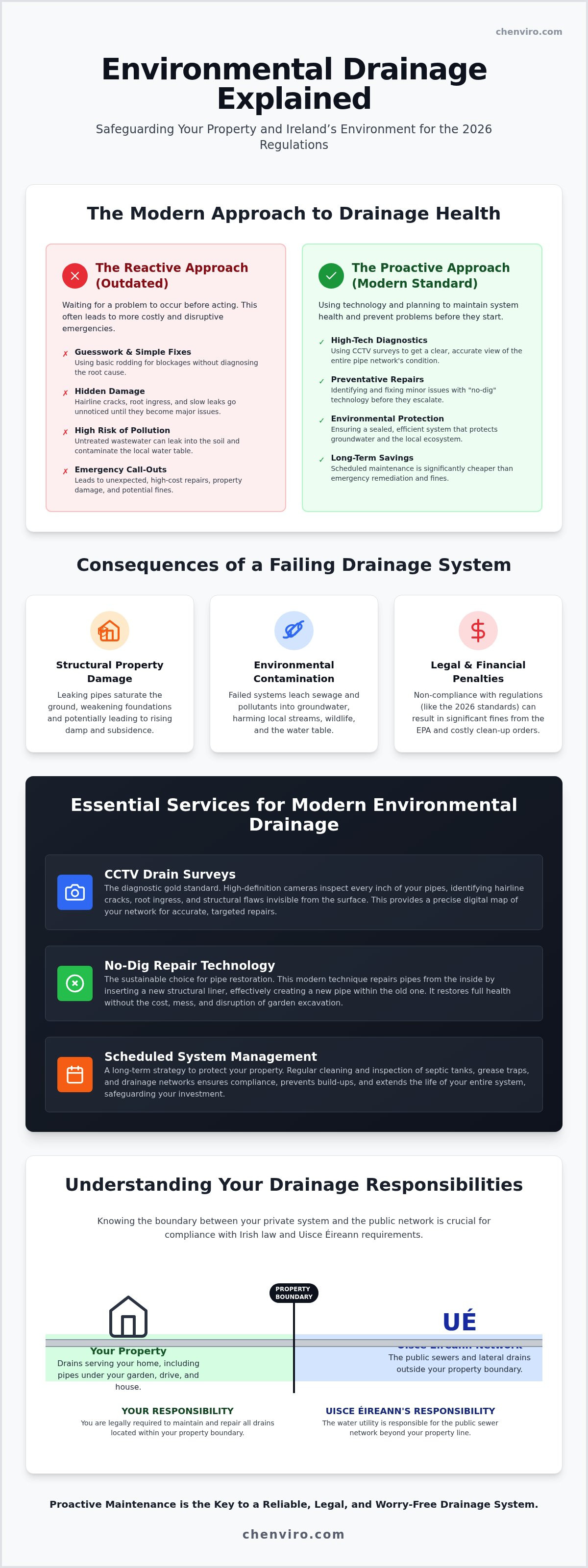
Understanding where your responsibility ends and Uisce Éireann's begins is often the most confusing part of property ownership. In Ireland, the general rule is simple: you are responsible for any pipework within your property boundary. Once the pipe crosses into public land and joins the main network, it becomes the concern of the national utility. However, environmental drainage laws are becoming increasingly precise. Under the European Union (Small Wastewater Discharge Register) Regulations 2026, a new register now exists for small wastewater discharges. This applies to any system serving fewer than 150 people, including private homes. Uisce Éireann is tasked with registering these systems with the EPA, making transparency a legal requirement rather than a choice.
Commercial property owners face even stricter oversight. In the hospitality sector, grease management is a primary focus for local authorities. Failure to maintain grease traps can lead to significant financial levies or immediate stop-work orders from the EPA. The goal of these regulations is to prevent untreated waste from entering the groundwater or causing blockages in the public network. Staying compliant isn't just about avoiding fines; it's about ensuring your business operations don't compromise the local ecosystem. Clear communication and regular maintenance are the only ways to stay ahead of these evolving legal standards.
Identifying Your Responsibility
Determining if a blockage is your problem or the council's depends on where the fault lies. If the issue is inside your garden or under your driveway, it's your responsibility. Shared drains in older Dublin housing estates often create complications. In these terraced settings, a single pipe might serve several houses before reaching the public sewer. If the blockage occurs in a shared section, the responsibility is often split between the affected neighbours. Before you spend time arguing over boundaries, it's best to call a drain unblocking service Dublin to locate the exact point of the failure. This prevents unnecessary delays and ensures the right party is notified.
Maintaining a Compliance Log
Keeping a detailed record of your system's maintenance is the best defence against legal issues. If an inspector from the local authority in Meath or Wicklow visits your property, they will ask for proof of regular cleaning. For rural homeowners, this means keeping receipts for septic tank emptying. For businesses, professional certification is a vital part of facility maintenance Dublin. A compliance log proves that you are managing your environmental drainage responsibly and helps you avoid the severe penalties associated with non-compliance. If you are unsure about your current legal obligations, speak to our team about your drainage compliance needs today.
Professional Environmental Drainage Solutions with CH Enviro
At CH Enviro, we take a straight-talking approach to property maintenance. We don't believe in temporary fixes or "fluff" marketing. Our team provides reliable environmental drainage solutions designed to protect your property and the local ecosystem over the long term. We have seen every possible scenario across the Greater Dublin Area and remain unfazed by even the most complex challenges. Our goal is simple: we solve your drainage problem completely, the first time we visit. This commitment to efficiency and honesty has made us a trusted partner for homeowners and businesses alike.
Choosing a local expert is essential for maintaining Irish infrastructure. The soil conditions in Meath or the coastal challenges in Wexford require specific knowledge that a general contractor might lack. We understand the local environment and the specific requirements set out by Uisce Éireann and the EPA. Our technicians are equipped with the latest technology, from high-pressure jetting units to advanced CCTV cameras, ensuring that every job is handled with professional precision. You get the benefit of modern, tech-savvy service combined with the personal touch of a community-focused business.
Service Coverage Across the Greater Dublin Area
Our team provides a rapid response across Dublin, Meath, Kildare, Louth, Wicklow, and Wexford. This broad coverage allows us to support a wide variety of clients across Leinster. We provide tailored solutions for urban apartments in the city centre where space is limited and access is difficult. Simultaneously, we manage large-scale systems for rural farmsteads and commercial facilities in the surrounding counties. No matter your location, we bring the same level of expertise and dedication to every site visit. We know the regional issues, from root ingress in older estates to septic tank compliance in rural areas.
Getting Started with a Drainage Health Check
Taking the first step toward a healthier system is straightforward. You can book a comprehensive environmental drainage survey or a routine maintenance visit by contacting our office directly. When our technicians arrive at your property, they perform a methodical assessment of your infrastructure. We don't just look for blockages; we look for structural integrity, potential leak points, and compliance risks. You will receive a clear, uncomplicated report on our findings and a direct recommendation for any necessary work. The peace of mind that comes with a fully functional, compliant drainage system is invaluable. It protects your property value and ensures you are never caught off guard by unexpected fines or emergency repairs. Contact CH Enviro today to secure your property's infrastructure.
Secure Your Property with Sustainable Drainage
Protecting your property requires a move away from reactive fixes toward a comprehensive strategy for environmental drainage. You now understand that modern maintenance is a balance of high-tech diagnostics, legal compliance, and non-invasive repair methods. By prioritising regular CCTV surveys and no-dig technology, you can prevent structural damage and avoid the severe penalties associated with EPA non-compliance. These proactive steps ensure your drainage system remains a silent, efficient part of your infrastructure rather than a source of stress or environmental harm.
If you're dealing with a recurring blockage or need to ensure your system meets the latest Irish regulations, we are here to help. As no-dig repair specialists, we provide everything from emergency drain unblocking to full septic and grease trap compliance. Our straight-talking approach ensures you get the right solution without unnecessary excavation or hidden costs. Contact CH Enviro for Professional Environmental Drainage Services and let our team restore your peace of mind. Your property's health is our priority, and we're ready to resolve your drainage issues for good.
Frequently Asked Questions
What is the difference between a drain and a sewer in Ireland?
A drain is a pipe that serves a single building, whereas a sewer serves two or more properties. Under current Uisce Éireann terminology, you are responsible for the maintenance of all private drains within your property boundary. Once a pipe becomes a shared line or crosses into public land, it is generally classified as a public sewer and falls under the remit of the national utility.
How do I know if my septic tank is failing environmental standards?
Signs of failure include slow-draining toilets, foul odours, or unusually lush, damp patches of grass near the percolation area. If you notice ponding water or gurgling sounds in your pipes, your system may be leaching untreated waste into the soil. Regular inspections are vital to ensure your system meets the European Union (Water Policy) (Small Wastewater Discharge Register) Regulations 2026.
Does environmental drainage maintenance include rodent control?
Yes, vermin control is a standard component of professional drainage maintenance because rats frequently use broken pipes to enter buildings. A collapsed or cracked pipe provides a direct subterranean path for rodents to move from the public sewer into your property. Repairing these structural defects is the most effective long-term solution for preventing recurring infestations.
Can I be fined for a leaking drain on my private property?
Yes, property owners can face significant financial levies and immediate stop-work orders from the EPA for environmental non-compliance. If a leak on your property leads to groundwater contamination or pollution of local water bodies, you are legally liable for the remediation costs. Maintaining a healthy environmental drainage system is the only way to avoid these penalties and protect the local water table.
Is no-dig pipe repair as strong as traditional pipe replacement?
No-dig repairs are often stronger and more durable than the original clay or concrete pipes they reinforce. The resin-impregnated liners used in trenchless technology create a seamless, jointless internal surface that is highly resistant to root ingress and chemical corrosion. This modern method provides a permanent structural fix with a lifespan that can exceed fifty years without the need for excavation.
What should I do if my grease trap overflows in a commercial kitchen?
Stop using all sinks and dishwashers immediately to prevent further waste from entering the system and call a professional cleaning service. An overflow usually indicates a significant blockage or a failure to follow a regular desludging schedule. You must clear the obstruction and thoroughly sanitise the area to remain compliant with Irish food hygiene and environmental health standards.
How often should a CCTV drain survey be performed on an older property?
A CCTV survey should be performed every three to five years on properties older than thirty years to identify gradual structural shifts. Older pipes are more susceptible to root intrusion and joint displacement, which can go unnoticed until a total collapse occurs. Routine surveys allow you to catch these minor issues early, enabling cost-effective patch repairs rather than full system replacements.
Does heavy rain in Dublin affect my environmental drainage system?
Heavy rain increases the hydraulic load on your pipes and can quickly overwhelm a system that has existing blockages or cracks. In urban areas like Dublin, managing surface water is a core part of environmental drainage to prevent localised flooding and sewer surcharging. Ensuring your gutters and gullies are clear of debris is a simple but essential task for protecting your property during the winter months.


Comments