
Grease Trap Compliance Ireland: The Complete Guide for Food Businesses
- chenviro2
- Jun 3
- 13 min read
Did you know that Uisce Éireann can inspect your kitchen up to four times a year without giving you a single minute of notice? It's a stressful reality for any food business, but achieving total grease trap compliance Ireland doesn't have to feel like a gamble. You probably already feel the pressure of keeping your drains clear while worrying about the heavy fines or business closures that follow a failed inspection. It's frustrating to deal with confusing licence types and the constant threat of foul smells or costly blockages disrupting your daily service.
We understand that you want a reliable, "set and forget" strategy that keeps your kitchen running smoothly. This guide provides a professional roadmap to master Irish FOG regulations and ensure you pass every inspection without the stress. You'll learn the exact requirements of the Local Government (Water Pollution) Act 1977, how to handle the €380 licence application, and which records you must have ready when an inspector walks through your door. We're moving beyond simple hardware to help you build a bulletproof documentation system that protects your business and your bottom line.
Key Takeaways
Understand your legal obligations under the Section 16 Trade Effluent Licence to protect your business from heavy fines and potential closure.
Ensure your equipment meets the IS EN 1825 technical standard to avoid common sizing errors that lead to automatic inspection failure.
Prepare for unannounced Uisce Éireann visits by maintaining a perfect paper trail of service records and licensed waste disposal logs.
Master grease trap compliance Ireland by establishing a professional cleaning frequency that prevents foul smells and emergency plumbing call-outs.
Discover how a structured maintenance plan turns complex FOG regulations into a simple, "set and forget" strategy for your kitchen operations.
Table of Contents
Understanding the FOG Licence and Irish Regulations
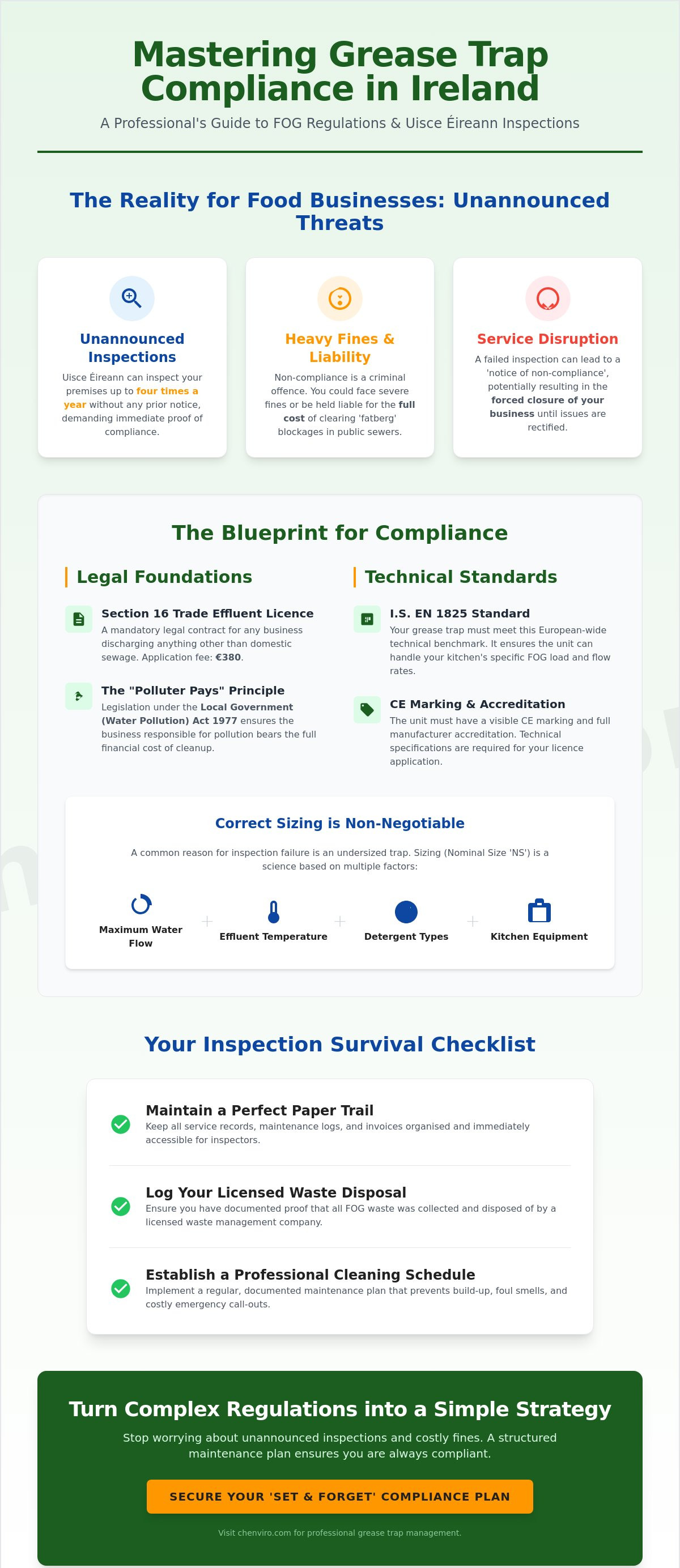
Fats, oils, and grease, commonly known as FOG, are more than just a kitchen nuisance. In the eyes of Irish law, they are regulated pollutants that cause massive damage to our national infrastructure. When hot grease is poured down a sink, it cools and solidifies in the sewer network. Over time, these deposits combine with other debris to form "fatbergs". These are massive, rock-hard blockages that can paralyse an entire town's drainage system. A Grease trap is the primary line of defence used to capture these substances before they reach the public pipes.
Achieving grease trap compliance Ireland begins with understanding the Section 16 Trade Effluent Licence. Under the Local Government (Water Pollution) Act 1977, any business discharging anything other than domestic sewage into a public sewer must hold this licence. It's a legal requirement for every restaurant, deli, hotel, and industrial kitchen in the country. Failing to comply isn't just a minor oversight; it's a criminal offence. You could face heavy fines or be held liable for the full cost of clearing downstream blockages and repairing damaged sewers.
The Role of Uisce Éireann and Local Authorities
Uisce Éireann now manages Ireland's water and wastewater infrastructure, taking over from the body formerly known as Irish Water. Whilst they oversee the network, your local council often acts as the enforcement arm on their behalf. If an inspector finds your business is discharging FOG without a licence or with a poorly maintained trap, they'll issue a "notice of non-compliance". This system is built on the "polluter pays" principle. It means the business responsible for the pollution bears the financial burden of the cleanup. This is a priority for regulators, especially since the EPA reported that 59% of treatment plants failed to meet standards in 2024.
Types of Trade Effluent Licences
Not every food business needs the same type of permit. Most small cafes and restaurants require a standard FOG Licence, which focuses specifically on grease management. However, larger food processors or industrial kitchens often need a more complex Trade Effluent Licence. These complex licences regulate other pollutants like chemicals, suspended solids, and organic loads. Understanding the nuances of grease trap compliance Ireland is essential for long-term operational success.
Applying for your licence involves a €380 application fee payable to Uisce Éireann. Once issued, this licence acts as a legal contract between your business and the utility provider. It specifies your exact discharge limits and how often you must service your equipment. It's a binding agreement, so you must ensure your maintenance logs are always up to date and your waste disposal records are accurate.
Technical Standards: Sizing and CE Certification
Installing any old tank under your sink won't satisfy a local authority inspector. To achieve grease trap compliance Ireland, your equipment must meet the I.S. EN 1825 standard. This European-wide benchmark ensures that the separator is actually capable of handling the flow rates and grease volumes produced by a commercial kitchen. If your unit lacks this certification, you're essentially throwing money away on a system that could be condemned during its first unannounced visit.
A major reason businesses fail inspections is the "one size fits all" mistake. A small deli and a 100-seat hotel have vastly different requirements. Every unit must carry a visible CE marking and have manufacturer accreditation. When you apply for your Uisce Éireann FOG Licence, you'll need to submit the technical specifications of your trap. If the hardware doesn't match the volume of waste you produce, the licence will be rejected.
Calculating the Correct Size for Your Kitchen
Getting the dimensions right is a precise science. The calculation takes into account several variables, including the maximum flow of water, the temperature of the effluent, and the type of detergents you use. It also considers your kitchen equipment, such as dishwashers, pot sinks, and floor drains. Nominal Size (NS) is the standard measurement for trap capacity, representing the litres per second the unit can process. We always recommend oversizing slightly. It provides a safety margin during peak periods or busy weekends, ensuring your system isn't overwhelmed when you're at your busiest.
Passive Traps vs. Automatic Grease Removal Units (GRUs)
Choosing between a passive gravity trap and an automatic GRU often depends on your physical premises. Passive traps are traditional, often underground units that rely on gravity to separate grease. They are robust but require regular, professional pumping. In contrast, automatic GRUs are often compact, stainless steel units that sit directly under the sink. They use motorised skimmers or heating elements to remove grease daily into a separate container.
Dublin city-centre basements and heritage buildings often present significant space constraints. In these tight spots, a compact GRU is often the only viable option. Many inspectors prefer these automatic units for high-volume kitchens because they remove grease continuously, reducing the risk of sudden overflows. If you aren't sure which system fits your layout, a professional grease trap maintenance assessment can clarify your options before you commit to an expensive installation.
What to Expect During an Uisce Éireann Inspection
An inspector from Uisce Éireann or your local authority can arrive at your door up to four times a year. These visits are almost always unannounced. This is by design. Regulators want to see how your kitchen operates on a standard Tuesday afternoon, not how it looks after a scheduled deep clean. When they arrive, the process moves quickly from the front door to the heart of your operation. Maintaining grease trap compliance Ireland depends entirely on your readiness for these moments.
The audit usually begins with a visual walkthrough of the kitchen. The inspector isn't just looking at the grease trap; they're looking at your "source control" habits. They will check for sink strainers in every wash station and ensure food waste is being scraped into bins rather than rinsed down the drain. After the walkthrough, they'll perform a physical check of the grease trap itself. They'll assess the depth of the grease layer and check for foul odours. If the grease occupies more than 25% of the trap's volume, you're likely to face a non-compliance report.
The most critical part of the visit is the review of your Compliance Manual. This is the make-or-break moment. If your paperwork is disorganized or missing, even a sparkling clean kitchen won't save you. Following the inspection, you'll receive a report. A minor issue might result in an "Improvement Notice," giving you a set timeframe to fix the problem. However, severe or repeat offences can lead to a "Closure Order" or a summons to the District Court.
The Inspector’s Essential Checklist
You should have a dedicated folder ready to hand over the moment an inspector asks for it. They'll specifically look for these five items:
Maintenance Logs: A chronological record of every time the trap was cleaned or inspected.
Waste Transfer Notes: Proof that a licensed contractor collected your grease. Receipts from a "man with a van" won't count.
Sizing Certs and Design Details: Documentation proving the unit meets I.S. EN 1825 standards for your specific kitchen volume.
FOG Licence Copy: A current copy of your Section 16 Trade Effluent Licence.
Staff Training Records: Evidence that your team knows how to manage FOG and use the equipment correctly.
Remember, a clean trap on the day of inspection is useless if you can't prove it's been maintained consistently over the previous six months.
Common Reasons for Inspection Failure in Ireland
The most common reason for failure is the "we clean it ourselves" approach. Whilst it's legal to perform daily skimming on some units, you cannot legally dispose of that grease in your standard refuse bin. Without official waste transfer notes from a licensed contractor, you have no proof of legal disposal. Another major red flag is the use of enzymes or chemicals. Many businesses try to use these to "dissolve" grease, but this is strictly prohibited under Irish regulations. These additives simply push the grease further down the pipe where it solidifies, causing blockages elsewhere. Finally, structural issues like unsealed lids that allow odours to escape or leaking pipes will result in an immediate fail. High-quality grease trap cleaning and maintenance ensures these mechanical failures are caught before the inspector finds them.
Maintenance Best Practices and Record Keeping
A grease trap is not a "fit and forget" piece of equipment. It is a hardworking filter that requires a disciplined service schedule to remain effective. Establishing a consistent cleaning frequency is the cornerstone of grease trap compliance Ireland. For a high-volume restaurant, this might mean a professional pump-out every month. For a smaller deli, a quarterly service may suffice. The goal is to ensure the grease layer never exceeds 25% of the unit's total capacity. This is the threshold where efficiency drops and the risk of discharge into the public sewer increases significantly.
Beyond professional pumping, daily kitchen habits dictate how long your system lasts between services. Use sink strainers in every wash station to catch solid food particles. Train your staff to scrape plates thoroughly into the bin before they ever touch the water. These simple preventative measures reduce the FOG load on your separator and prevent foul odours. Don't let your team pour boiling water or bleach down the drains to "clear" them. This only shifts the problem further down the line and can lead to a failed inspection when the inspector notices a blockage in the external manhole.
Legal Disposal of Grease Waste
Under the Waste Management Act, grease trap waste is a controlled substance. You cannot simply dump it in the general waste or pour it down an external drain. It must be collected, transported, and disposed of by an authorised carrier with a valid waste collection permit. Every time your trap is serviced, you must receive a Waste Transfer Note (WTN). This document is your legal shield. It must include the European Waste Catalogue (EWC) code for grease (19 08 09), the quantity of waste removed, and the permit number of the contractor. If you don't have these notes, you have no proof of legal disposal, which is an automatic fail during an audit.
Creating Your Compliance Manual
The best way to handle an unannounced visit is to have a physical Compliance Manual ready at all times. Don't keep this folder in a remote head office or locked in a manager's car. It should live in the kitchen or the main office where staff can access it immediately. A well-organised manual should include:
Your current Section 16 Trade Effluent Licence.
The original sizing calculations and CE accreditation for the unit.
A chronological log of every maintenance visit.
All Waste Transfer Notes filed by date.
Staff training records regarding FOG management.
Keeping these documents in one place shows the inspector that you take your environmental responsibilities seriously. It turns a potentially stressful audit into a straightforward verification of facts. If you need help setting up a schedule that keeps you on the right side of the law, we offer a comprehensive Grease Trap Cleaning & Maintenance service tailored to your specific kitchen volume.
Professional Grease Trap Management with CH Enviro
Managing a commercial kitchen is demanding enough without the added stress of complex sewer regulations. CH Enviro simplifies the entire process of grease trap compliance Ireland by acting as your dedicated environmental partner. We don't just pump out tanks; we provide a complete management system that ensures your business remains on the right side of Uisce Éireann inspectors. From the initial sizing and installation of I.S. EN 1825 certified units to the meticulous filing of waste transfer notes, we handle the technical details so you can focus on your customers. Our "straight-talking" approach means you get clear answers and practical solutions without the fluff.
Our comprehensive service covers every stage of the compliance lifecycle. If you're opening a new premises, we ensure your equipment is correctly specified from day one. For established businesses, we provide the regular, documented maintenance that regulators demand. We also offer emergency support, including our professional drain unblocking service, to resolve issues before they lead to an inspection failure. Having a seasoned professional on call means you're never left guessing when a drain backs up during a busy Friday night service. We've seen every possible scenario and remain unfazed by the challenges of high-volume kitchen waste.
Why Choose a Professional Maintenance Contract?
A professional maintenance contract is the ultimate "peace of mind" factor for any food business owner. We track your cleaning dates and service intervals, so you never have to worry about missing a deadline or letting your trap exceed the 25% grease limit. We operate extensively across the Greater Dublin Area, serving businesses throughout Meath, Louth, Kildare, and Wicklow. This local presence allows us to respond rapidly to your needs whilst maintaining a helpful, community-focused touch. Regular, professional cleaning doesn't just satisfy the law; it extends the lifespan of your entire drainage infrastructure. It prevents the corrosive buildup of fatty acids that can damage pipes and lead to expensive repairs in the future. We ensure your grease trap compliance Ireland strategy is robust and reliable.
Ready to Secure Your Compliance?
Don't wait for an inspector to find a problem with your FOG management. A proactive approach is always more cost-effective than paying emergency call-out fees or facing potential court fines. We recommend booking a comprehensive site survey to assess your current trap efficiency and the state of your compliance manual. We'll give you an honest, authoritative assessment of what's working and exactly what needs to change to meet current Irish standards. Our goal is to move you from a state of worry to a "set and forget" strategy that protects your bottom line. Contact CH Enviro today for a grease trap compliance audit and take the first step toward a worry-free kitchen operation.
Secure Your Kitchen's Future Today
Achieving long-term grease trap compliance Ireland is more than just a box-ticking exercise. It's a commitment to protecting the local environment and your business's reputation. By ensuring your equipment meets the I.S. EN 1825 standard and keeping a meticulous compliance manual, you remove the fear of unannounced inspections. Your Waste Transfer Notes remain your most vital legal defence. Without them, you simply have no proof of legal disposal when an inspector arrives.
Professional support makes this complex regulatory landscape manageable. We provide fully licensed waste carriers and deep expertise across Dublin, Meath, and Kildare. Our team ensures you have the comprehensive compliance documentation required to satisfy Uisce Éireann every time. You don't have to face these regulations alone or risk the disruption of costly emergency call-outs. We help you turn a complex legal requirement into a reliable, "set and forget" operational strategy.
Get a Professional Grease Trap Compliance Quote
Take control of your kitchen's drainage today. With the right maintenance partner, you can focus on serving your customers whilst we ensure your operations remain clean, compliant, and completely stress-free.
Frequently Asked Questions
Is a grease trap a legal requirement for restaurants in Ireland?
Yes, a grease trap is a legal requirement for any food business in Ireland that discharges trade effluent into the public sewer. Under the Local Government (Water Pollution) Act 1977, you must hold a Section 16 licence and have the appropriate equipment to prevent fats, oils, and grease from causing blockages. This applies to restaurants, cafes, hotels, and even small delis with minimal food prep.
How often should a commercial grease trap be cleaned?
You should have your grease trap professionally cleaned at least four times per year, though high-volume kitchens often require monthly servicing. The legal standard requires that grease is physically removed when the trap reaches 25% of its total capacity. Regular cleaning prevents foul odours and ensures your system continues to meet grease trap compliance Ireland standards during unannounced audits.
Can I clean my own grease trap to stay compliant?
Whilst you can perform daily skimming of automatic units, you cannot legally perform a full service yourself because you lack the means for legal disposal. To remain compliant, you must have Waste Transfer Notes from a licensed waste contractor. Disposing of grease in general waste or down external drains is a criminal offence under Irish waste management laws.
What is an Uisce Éireann FOG inspection?
An Uisce Éireann FOG inspection is an unannounced audit of your kitchen’s grease management practices. The inspector will check your sinks for strainers, physically measure the grease layer in your trap, and review your Compliance Manual. They specifically look for your Section 16 licence, maintenance logs, and waste disposal records from the past two years.
What happens if my business fails a grease trap inspection?
Failing an inspection usually results in an Improvement Notice, which outlines specific actions you must take within a set timeframe. Serious or repeated non-compliance can lead to a Closure Order, heavy fines, or your business being held liable for the full cost of clearing public sewer blockages. Maintaining grease trap compliance Ireland is the only way to avoid these legal and financial risks.
How much does a Trade Effluent Licence cost in Ireland?
The application fee for a Trade Effluent FOG Licence in Ireland is currently €380, payable to Uisce Éireann. This is a one-time application fee, though a new national tariff framework being implemented between 2025 and 2026 may introduce recurring annual compliance and licensing charges. You should also budget for the ongoing costs of professional maintenance and licensed waste disposal.
What is the difference between a grease trap and a grease interceptor?
The primary difference lies in the size and flow rate capacity of the unit. Grease traps are generally smaller units installed directly under kitchen sinks or inside the kitchen area for lower flow rates. Grease interceptors are larger, high-capacity units usually installed underground outside the building to handle the heavy wastewater volumes produced by large hotels or industrial food producers.
Are enzymes or biological treatments allowed for grease trap maintenance?
No, the use of enzymes, bacteria, or chemicals to "dissolve" grease is not an acceptable method of compliance in Ireland. These treatments do not meet the I.S. EN 1825 standard because they simply emulsify the grease so it can travel further into the sewer network before solidifying again. Regulations require that grease be physically trapped and removed from the waste stream by a licensed contractor.


Comments