
Grease Trap Maintenance Dublin: The 2026 Guide for Commercial Kitchens
- chenviro2
- Jul 2
- 11 min read
Updated: Jul 18
What if a single afternoon of kitchen downtime cost your business more in lost revenue and Dublin City Council fines than three years of scheduled servicing? It's a reality many local restaurateurs face when they treat drainage as an afterthought. Reliable grease trap maintenance Dublin is no longer just a best practice for your kitchen; it's a legal necessity that protects your bottom line. You already understand that foul odours and slow-moving sinks can ruin a dining experience in minutes. Managing these risks whilst staying on top of Uisce Éireann’s evolving regulations can feel like a full-time job.
We've designed this guide to help you master your maintenance requirements, ensuring you achieve full regulatory compliance and prevent costly emergency call-outs. You'll learn about the critical 1/4th rule for emptying cycles and the implications of the new trade effluent charges coming into effect on 1 October 2026. We will walk you through the essential steps to maintain a clean, odour-free environment whilst keeping your €380.00 FOG Licence in good standing. This guide provides a clear plan to turn a potential regulatory headache into a predictable, manageable part of your kitchen's routine.
Table of Contents
Understanding Grease Trap Maintenance and Dublin FOG Regulations
Grease trap maintenance is the routine, systematic removal of fats, oils, and grease (FOG) alongside food solids from your drainage system. Without this intervention, these substances solidify within your pipes, leading to catastrophic blockages and foul smells. If you are looking for a foundational definition of what is a grease trap?, it is essentially a plumbing device designed to intercept most greases and solids before they enter a wastewater disposal system. For food business operators, professional grease trap maintenance Dublin is a non-negotiable operational requirement.
Dublin City Council operates a rigorous FOG Programme to protect the city's ageing infrastructure. This initiative isn't just about bureaucracy; it's about safeguarding the Dublin Bay ecosystem. When FOG enters the public sewer, it forms "fatbergs" that cause overflows. These overflows eventually reach our coastline, damaging local marine life and water quality. Consequently, every food business in the capital is legally required to hold a valid Trade Effluent FOG Licence. Failure to comply leads to severe consequences. You could face heavy fines, environmental damage charges, or even closure orders that can end a business overnight.
The Science of FOG Separation
Effective grease management relies on two simple principles: gravity and time. As warm wastewater enters the trap, it slows down. This allows the water to cool, which causes fats and oils to separate and float to the surface. Heavier food particles sink to the bottom. If your kitchen uses excessive boiling water or harsh degreasers, you might think you're "cleaning" the pipes. In reality, you are emulsifying the grease. This allows it to bypass the trap and solidify further down the line. Chemical quick fixes often lead to bigger bills and system failures later.
Dublin City Council Compliance Standards
Dublin-based food businesses face specific local standards that differ from other regions. Inspectors from Uisce Éireann or the Council can arrive unannounced up to four times per year. During these visits, they will demand to see your "FOG Logbook". This document must contain your grease trap sizing calculations, service records, and waste disposal certificates from a licensed contractor. CH Enviro specialises in keeping these records airtight. We ensure your grease trap maintenance Dublin schedule meets the exact requirements of your licence, so you are always ready for an unannounced inspection.
The Practical Mechanics of Professional Grease Trap Cleaning
Professional grease trap maintenance Dublin involves more than just removing the top layer of oil. A thorough service ensures the entire system functions as designed, preventing the blockages mentioned in the previous section. The process begins with a full pump-out of the unit’s contents. We don't just skim the surface; we remove every litre of wastewater, grease, and settled food solids. This is essential because the bottom layer of sludge often causes the most significant drainage issues if left to rot.
Once empty, the technician must scrape the interior walls and floor of the trap. This manual scraping removes hardened grease that pumps cannot reach. During this stage, we also remove and clean the internal baffles and filters. These components are designed to slow down water flow and trap FOG, but they quickly become choked with debris. If these aren't cleaned separately, the trap's efficiency drops instantly. Finally, we verify the integrity of the rubber seals and gaskets. A perished seal is the primary cause of those "rotten egg" odours that can ruin a restaurant’s atmosphere. If you’re unsure about the current state of your system, our team provides comprehensive grease trap cleaning & maintenance to keep your kitchen running smoothly.
Manual vs. Automatic Grease Removal Units (GRUs)
Traditional manual traps are simple but require more frequent professional intervention. They rely entirely on the volume of the tank to separate FOG, often following The 1/4th Rule, which dictates a clean-out once the unit is 25% full. Modern automatic GRUs use motorised skimmers to remove oil daily. Whilst these reduce the frequency of full pump-outs, they require daily staff attention to empty oil containers and check for mechanical failures. If a GRU motor fails, the unit becomes an undersized manual trap that will overflow in hours.
Safe Waste Disposal and Documentation
What happens after the waste leaves your kitchen is just as important as the cleaning itself. All FOG waste must be transported by a permitted collector to an authorised Waste Transfer Station. In the Dublin region, traceability is paramount. You must receive a "Certificate of Disposal" for every service. This document is your primary evidence during a Dublin City Council audit. It proves that you have disposed of your waste responsibly and haven't contributed to the city's fatberg problem. Without this paperwork, even a clean trap won't save you from a non-compliance notification.
Calculating Maintenance Frequency: The 1/4th Rule and Capacity
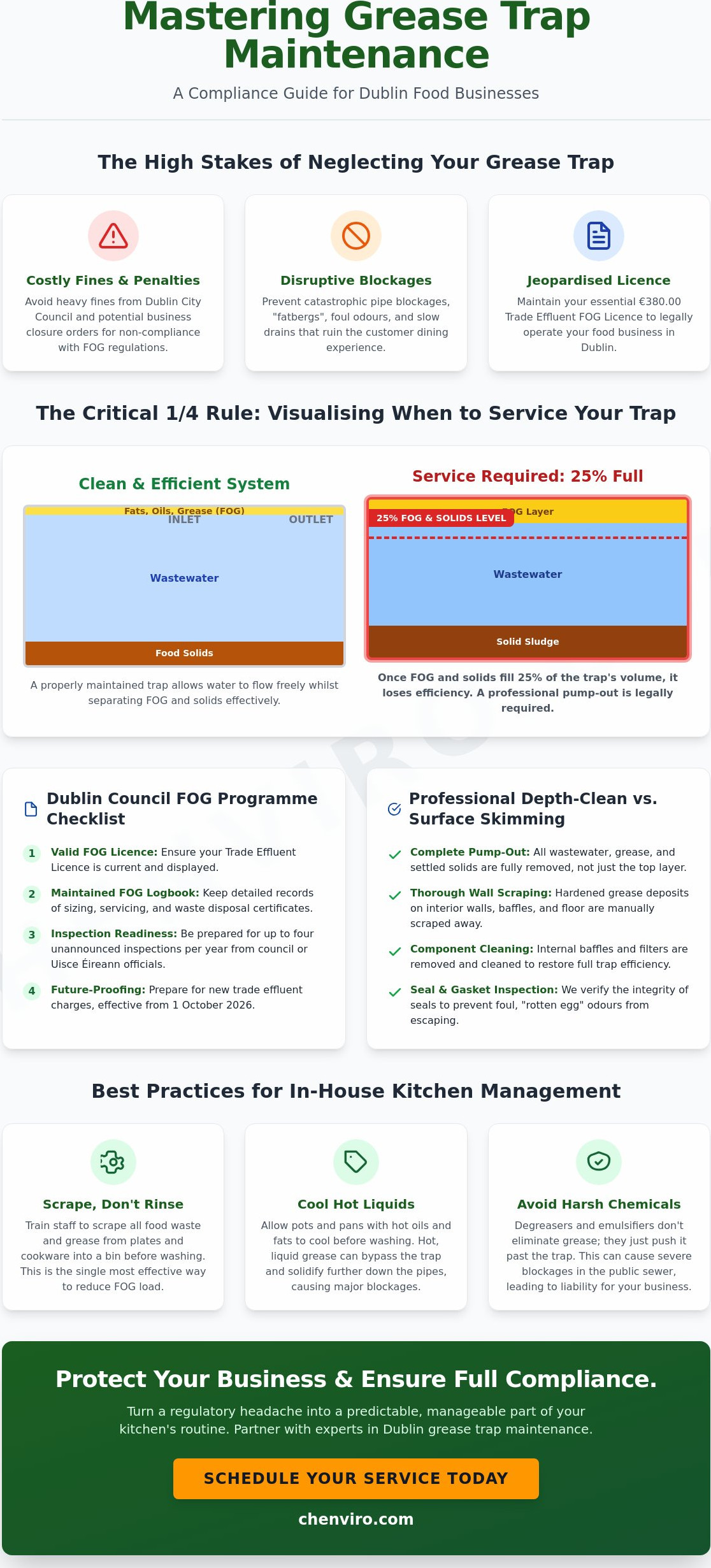
How often should you pump out your system? This is the most common question we hear regarding grease trap maintenance Dublin. The answer isn't based on a calendar date but on the physical volume of waste inside the unit. The industry standard is the 1/4th Rule. The 1/4th Rule for grease trap maintenance states that a unit must be professionally emptied once 25% of its total capacity is occupied by fats, oils, grease, and food solids.
Waiting until the trap is 100% full is a recipe for disaster. Once you pass that 25% threshold, the unit's ability to slow down water and separate FOG diminishes rapidly. This leads to grease bypassing the system and entering the public sewer, which violates the Official FOG Regulations for Irish Businesses. Your specific frequency depends on several variables. A high-volume steakhouse in Dublin city centre will require more frequent visits than a small café serving mostly pre-packaged goods. You must account for your daily covers, the oil-heavy nature of your menu, and the physical capacity of the trap installed.
Warning Signs of Grease Trap Failure
Don't wait for a flood to take action. Your drainage system usually provides early warnings before a total blockage occurs. Listen for gurgling sounds coming from your sinks or floor drains. This indicates air-flow restrictions caused by grease build-up. You might also notice visible grease bypass in downstream manholes or secondary outlets. Persistent foul smells are another red flag; they often signal a broken seal or the anaerobic decomposition of old food waste that hasn't been cleared.
The Cost of Neglect vs. Scheduled Maintenance
A "set it and forget it" approach is expensive. Emergency call-out fees for a Saturday night blockage far exceed the cost of a structured maintenance contract. Beyond the immediate bill, grease trap maintenance Dublin protects your long-term plumbing infrastructure. Acidic food waste sitting in a trap for too long can corrode internal components and pipes. The biggest hidden cost is downtime. Closing your kitchen during peak hours results in lost revenue and reputational damage that a simple, scheduled service could have prevented. It's far better to manage a predictable cost than to react to a crisis. For business owners seeking to improve their financial oversight, you can learn more about the accounting services offered by Fair View Accounting Services.
Best Practices for In-House Kitchen Management
Professional grease trap maintenance Dublin keeps you compliant, but your staff’s daily habits determine how hard that system has to work. The most effective strategy is a strict "Scrape, Don’t Rinse" policy. Every plate, tray, and pot should be scraped thoroughly into a bin before it ever hits the sink. This simple step prevents bulk solids from entering the trap and filling that 25% capacity too quickly. Many chefs believe boiling water or heavy detergents can "melt" grease away. They don't. These methods only emulsify the fat, allowing it to escape the trap and solidify in your main sewer line. This leads to the very blockages and fatbergs that Dublin City Council is working to eliminate.
Organising your kitchen layout can also make a significant difference. Place bins and food waste containers in the direct path between the prep station and the wash-up area. This makes compliance the path of least resistance for your team. Training is the final piece of the puzzle. When staff understand that a failed grease trap leads to a closed kitchen and lost shifts, they are far more likely to follow these procedures. A well-trained team is your first line of defence against drainage crises, and if you need to bolster your kitchen brigade with skilled professionals, you can explore Temporary Chef Hire to ensure these standards are always upheld.
The Daily Kitchen Checklist
Consistency is vital for effective grease management. Assigning specific tasks to your closing or opening shifts ensures nothing is missed. This proactive approach keeps your kitchen odour-free and your records ready for an unannounced inspection. Every food business should follow these daily steps:
Clear sink strainers and floor drain baskets before and after every shift.
Check the external appearance of the trap for new leaks or damp patches.
Monitor for unusual odours that might suggest a broken seal or a full unit.
Ensure the FOG logbook is updated with any in-house checks or professional visits.
What NOT to Pour Down the Drain
Heavy oils, butter, and animal fats are the primary enemies of your drainage system. Even products marketed as "biodegradable" grease cleaners can be deceptive. These often break grease into smaller particles that simply reform into fatbergs further downstream. For a deeper look at protecting your infrastructure, read our Restaurant Drain Cleaning in Ireland: The Ultimate Maintenance Guide. Training your team to respect the drainage system ensures business continuity. If your staff report persistent issues despite these habits, it is time to book a professional grease trap service to clear the build-up.
Expert Grease Trap Maintenance Dublin: Why CH Enviro is the Right Choice
Choosing a partner for grease trap maintenance Dublin is about more than just finding a contractor with a pump. It is about securing the continuity of your business. We provide a straight-talking, no-nonsense service that removes the guesswork from drainage management. Our team understands that when a kitchen manager calls us, they need reliability and transparency, not marketing fluff. We operate across Dublin and the surrounding counties, including Meath, Louth, Kildare, Wicklow, and Wexford. This regional presence allows us to respond quickly to the needs of busy commercial hubs and local eateries alike.
We don't just stop at cleaning tanks. CH Enviro offers comprehensive facility solutions to keep your kitchen running without interruption. This includes professional vermin control and specialist pump station repairs. By managing multiple aspects of your wastewater and hygiene infrastructure, we reduce the number of contractors you need to coordinate. After every visit, we provide full compliance documentation. These records are vital for your peace of mind and are designed to satisfy the strictest inspectors from Uisce Éireann or local councils.
Bespoke Maintenance Contracts
Every kitchen has a different rhythm. A one-size-fits-all schedule rarely works; it either leads to over-servicing or, more dangerously, an unexpected overflow. We tailor our service intervals to fit your specific kitchen volume and menu type. This bespoke approach ensures your grease trap maintenance Dublin remains cost-effective and efficient. We favour a fixed-price model with no hidden fees, allowing you to plan your operational budget with total confidence. For a more detailed look at how these schedules work, see our Commercial Grease Trap Service: The Essential Guide for Irish Food Businesses.
The CH Enviro Advantage in Dublin
Our local expertise is our greatest asset. We have spent years working within the specific framework of the Dublin City Council FOG Programme. We know exactly what inspectors look for and how to ensure your system meets their standards. This deep understanding of local requirements is paired with 24/7 emergency support. Problems don't always happen during office hours, so we remain available to resolve crises whenever they arise. You can find more information on staying within the law in our guide to Grease Trap Compliance Ireland: The Complete Guide for Food Businesses. We are here to act as your authoritative guide, ensuring your kitchen stays clean, compliant, and open for business.
Future-Proof Your Commercial Kitchen
Managing a busy commercial kitchen in Dublin requires balancing high-speed service with strict environmental standards. By implementing the 1/4th rule and the "Scrape, Don’t Rinse" policy, you remove the primary causes of drainage failure and foul odours. Professional grease trap maintenance Dublin ensures your business stays on the right side of the local FOG programme whilst protecting your infrastructure from fatbergs. Staying ahead of these requirements isn't just about avoiding fines; it's about building a sustainable, efficient operation that your customers can trust.
CH Enviro has been serving the hospitality sector across Dublin, Kildare, and Meath since 2026. As fully insured and permitted waste collectors, we provide the comprehensive FOG compliance documentation you need to pass any unannounced audit with total confidence. We take the stress out of wastewater management so you can focus on your menu. Don't let a preventable drainage issue interrupt your peak service hours or damage your reputation.
Book your expert grease trap maintenance in Dublin today and secure your kitchen’s operational health. A proactive approach today prevents a costly emergency tomorrow.
Frequently Asked Questions
How often should a commercial grease trap be cleaned in Dublin?
Commercial grease traps should be cleaned at least four times per year or whenever they reach 25% capacity. This is known as the 1/4th rule. High-volume restaurants in the city centre often require monthly servicing, whilst smaller cafes might only need a visit every 90 days depending on their specific menu and trap size.
Can I clean my own commercial grease trap to save money?
You can physically clean a small under-sink unit yourself, but it is rarely practical or legally sufficient for a business. Professional grease trap maintenance Dublin includes the legal disposal of waste at a licensed facility. Without a Waste Transfer Note from a permitted collector, you cannot prove compliance during an unannounced Dublin City Council inspection.
What happens if my business fails a Dublin City Council FOG inspection?
Failing an inspection usually results in a formal notification of non-compliance and a strict deadline for remedial action. Continued failure can lead to heavy fines, being billed for the cost of clearing public sewer blockages, or even a closure order. Inspectors expect to see a valid FOG licence and a complete maintenance logbook on demand.
How much does professional grease trap maintenance cost in Dublin?
The cost of professional servicing in Dublin varies based on the size of your trap and the volume of waste removed. Small units under 200 litres generally cost less to maintain than large external interceptors. You should request a fixed-price quote from your provider to avoid emergency call-out fees or hidden disposal charges during your scheduled visits.
What is the difference between a grease trap and a grease interceptor?
The main difference lies in the size and flow rate of the unit. Grease traps are typically smaller devices installed under sinks or inside the kitchen area. Grease interceptors are much larger units, often located outside or underground, designed to handle high volumes of wastewater from multiple kitchen fixtures simultaneously.
Why does my grease trap smell even though it was recently cleaned?
Odours often persist if the rubber seals on the unit’s lid are perished or if the internal baffles weren't thoroughly cleaned during the last service. It can also indicate a venting issue that allows sewer gases to bypass the trap. A professional depth-clean resolves these smells by removing all anaerobic bacteria and decaying food solids from the unit.
Do I need a grease trap if I only serve coffee and light snacks?
Yes, any establishment that discharges catering wastewater into the public sewer requires a grease trap and a FOG licence. Fats and oils from milk, butter, and pastries can still cause significant blockages in the city's pipework. Dublin City Council regulations apply to all food service establishments regardless of how simple the menu might be.
What documentation do I need to keep for my grease trap compliance?
You must maintain an up-to-date FOG logbook containing your grease trap sizing calculations and a record of all maintenance visits. Crucially, you need to keep every Waste Transfer Note and Certificate of Disposal provided by your service contractor. These documents prove that the waste was handled by a permitted collector and disposed of at an authorised facility.


Comments