
Tree Roots in Drains Symptoms: Identifying Root Intrusion in Irish Properties
- chenviro2
- Jul 15
- 13 min read
Updated: Jul 16
Did you know that the trees in your garden aren't just growing towards the sun; they are actively "hunting" the moisture inside your pipes? In Ireland's damp climate, root systems use a process called hydrotropism to track down even the tiniest hairline cracks in your drainage system. It's incredibly frustrating to pay for a temporary unblocking service only for the same slow gurgles and foul sewage smells to return a few weeks later. You likely worry that the only permanent fix involves a digger tearing up your pristine lawn or driveway. This guide will show you how to identify the subtle warning signs of root intrusion and explain how to remove tree roots from drains Ireland using modern, no-dig methods.
We understand that you want a long-term solution that doesn't involve the chaos of a construction site in your garden. By the end of this article, you will know how to confirm if roots are your specific problem and how specialised CCTV technology can save you thousands in structural repairs. We will also preview the trenchless repair options that provide a permanent, garden-friendly fix for Irish homeowners. You can protect your property and your budget without the fear of unnecessary excavation.
Table of Contents
Understanding Tree Root Intrusion in Irish Drainage Systems
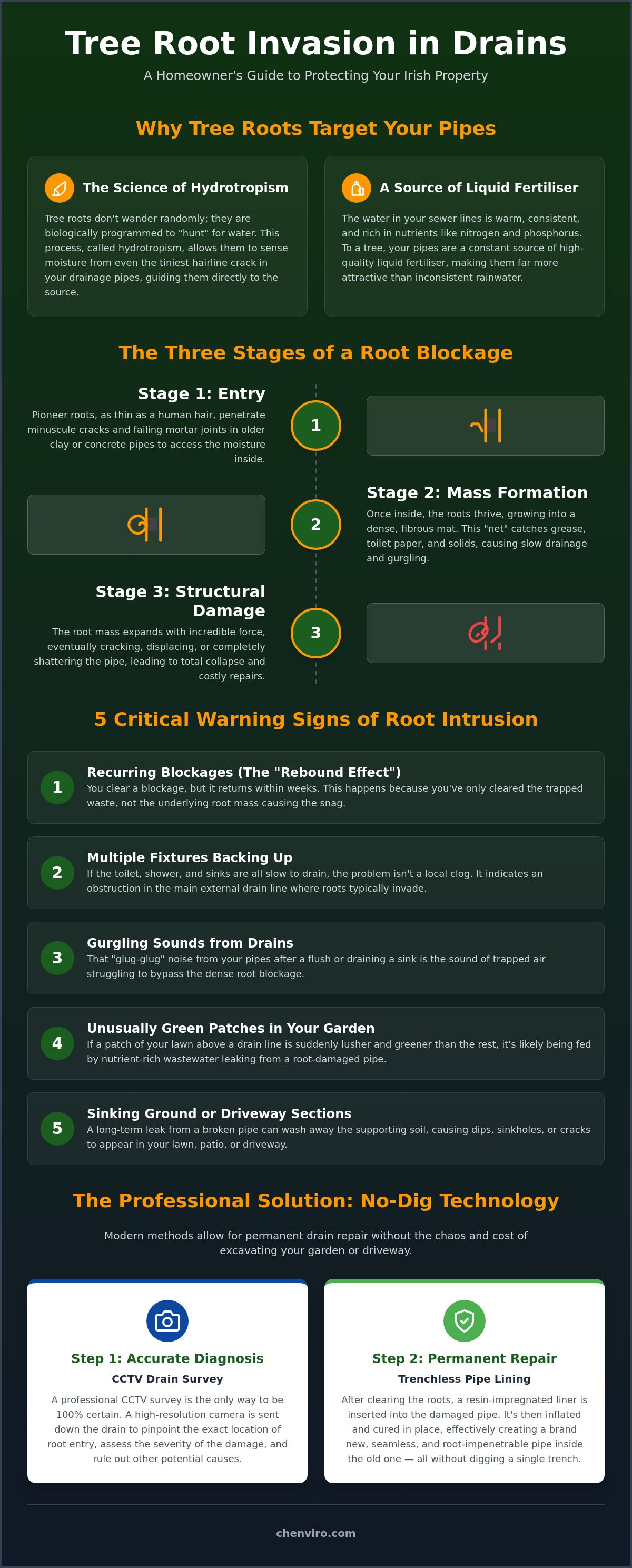
Tree roots don't wander into your pipes by accident. They are guided by a biological process called hydrotropism, which allows the root tips to sense moisture gradients in the surrounding soil. Even though Ireland is known for its high rainfall and damp ground, the water inside your drainage system is far more attractive to a tree than rainwater. It's warm, consistent, and packed with nitrogen and phosphorus. To a tree, your sewer line looks like a source of liquid fertiliser. Once a tree identifies this source, it will relentlessly push towards it, making it essential to understand how to remove tree roots from drains Ireland before the damage becomes irreversible.
In counties like Dublin and Meath, many older properties still rely on traditional clay or concrete piping. These systems were often installed with sand and cement mortar joints which, over several decades, naturally degrade and crack. These tiny fissures allow moisture to weep into the soil, creating a scent trail for thirsty roots. Regular sewer system maintenance is often overlooked until a total blockage occurs, but the problem starts much earlier. A root as thin as a human hair can enter a joint and, once it finds the nutrient-rich environment inside, it will expand rapidly. This expansion exerts incredible pressure, eventually shattering the structural pipe from the inside out.
Why Irish Gardens and Mature Trees are a Risky Mix
Certain species common in Irish landscapes are particularly aggressive when it comes to seeking water. Willow, Poplar, and Ash trees possess expansive root systems that can travel great distances. When selecting trees for your garden, consulting a specialist such as Buds Nursery Cavan can help you choose species with less invasive root systems to protect your infrastructure. In suburban Dublin estates, mature trees are often positioned close to property boundaries, exactly where main drainage lines run. Through capillary action, roots can detect even the microscopic beads of condensation on the outside of a pipe. This leads them directly to the weakest point in your network, regardless of how much it rains at the surface.
The Lifecycle of a Root Blockage
A root blockage typically develops in three distinct phases:
Stage 1: Entry. Pioneer roots enter through perished joints or hairline cracks in search of moisture.
Stage 2: Mass Formation. Once inside, the roots grow into a dense, fibrous "mat" that acts as a net, snagging grease, hair, and debris. This is when you'll notice slow drainage and gurgling sounds.
Stage 3: Structural Displacement. The root mass grows so large it begins to lift or crack the pipe. This causes the pipe to lose its gradient or collapse entirely, leading to costly structural damage.
Recognising these stages early is the best way to protect your property. If you suspect roots have already breached your system, knowing how to remove tree roots from drains Ireland using modern technology is the only way to ensure a permanent fix without destroying your garden.
5 Critical Tree Roots in Drains Symptoms Ireland Homeowners Should Note
Identifying a root problem isn't always straightforward. A standard grease clog is usually a one-off event caused by what you've put down the sink, but root intrusion is a structural invasion that requires a different approach. You might notice that your drains behave differently during dry spells. When the soil dries out, roots become far more aggressive in their search for the moisture inside your pipes. One of the most telling signs is the "rebound effect." You might use a plunger or a retail drain snake and find the water flows again, only for the blockage to return a week later. This happens because you've cleared the toilet paper or grease caught in the root mass, but the wooden "web" remains firmly in place.
It's also vital to distinguish between internal plumbing issues and external main line intrusion. If only your kitchen sink is slow, the problem is likely a local fat clog. However, if multiple fixtures across the house are backing up or gurgling, the obstruction is almost certainly in the main external line where tree roots are most common. Understanding these symptoms is the first step in learning how to remove tree roots from drains Ireland effectively without wasting money on temporary fixes. If you're tired of recurring issues, a professional drain unblocking service can provide the clarity you need to stop the cycle.
Persistent Gurgling and Slow Drainage
Sinks and toilets shouldn't "talk back" to you. That distinct "glug-glug" sound after a flush is air struggling to bypass a dense root mass. As the roots grow, the available space for water decreases, leading to a gradual slowdown that affects the entire property simultaneously. Many homeowners reach for caustic "unblocker" chemicals at this stage. These products are designed to dissolve hair or fat; they are completely ineffective against woody root structures and may even damage older clay pipes further.
Recurring Blockages and Foul Odours
If you notice the smell of stagnant water or sewage amongst your garden beds or near external gully traps, take it seriously. Roots create a sieve-like effect inside the pipe, catching wet wipes, grease, and other debris that would normally flow through. This trapped organic matter rots over time, creating foul odours that may fluctuate depending on your daily water usage. Because roots are living organisms, they will continue to grow and "re-block" the pipe regardless of how many times you attempt to rod the drain manually. Learning how to remove tree roots from drains Ireland requires moving beyond these manual methods to more advanced, permanent solutions.
External Property Damage: Signs the Problem is Underground
Sometimes the first sign of a major drainage crisis isn't found inside the home, but on the lawn. If you notice a specific line of grass that is significantly greener or taller than the rest of your garden, it's a major red flag. This happens because a root-damaged pipe is leaking nutrient-rich wastewater into the soil. It acts as a concentrated fertiliser. Whilst it might look healthy initially, it confirms that the structural integrity of your pipe is compromised. This is a critical stage where you need to investigate how to remove tree roots from drains Ireland before the leak causes the ground to shift or the pipe to collapse entirely.
Leaking sewage does more than feed the grass; it actively destabilises the local soil. As water escapes through root-punctured holes, it washes away the fine sediment that supports your garden or driveway. This process is often mistaken for natural ground subsidence, but it's actually a drainage-related collapse. Over time, this creates an underground void. If left unaddressed, the surface will eventually give way, leading to visible depressions that pose a safety risk. Distinguishing between natural settling and a drainage void is essential for any property owner in Dublin or Meath who wants to avoid a full-scale garden excavation.
Sinkholes and Wet Patches in the Garden
Small depressions or "soft spots" appearing near mature trees are rarely random. These indicators suggest that soil is being sucked into the pipe through root-damaged joints. You might also notice persistent puddles that refuse to drain even during dry spells in Dublin or Wicklow. This is water that has nowhere to go because the root mass has blocked the pipe's flow, forcing it out into the surrounding earth. If you step on a patch of grass and it feels spongy or gives way, the soil underneath has likely been displaced by a leaking pipe.
Structural Cracks and Boundary Wall Displacement
Roots are incredibly powerful. As they grow inside and around a pipe, they can exert several tonnes of pressure against concrete structures. This often results in cracks in garden walls or driveways that align perfectly with the drainage run. You should also check your manhole covers; if you see roots peeking through the edges of the lid, the intrusion is already advanced. At this point, finding a permanent solution for how to remove tree roots from drains Ireland is no longer optional. It's a necessity to prevent your boundary walls from shifting or collapsing under the weight of an expanding root system.
Professional Diagnosis: Moving from Symptoms to Solutions
Guessing the cause of a blockage is a fast way to waste money. Many homeowners in Dublin and Meath fall into a cycle of paying for "rod and jet" services that only provide temporary relief. While high-pressure jetting can clear debris, it won't stop a living root system from growing back. To understand how to remove tree roots from drains Ireland permanently, you need a professional drainage engineer to identify the exact entry point and the extent of the structural damage. This transition from treating symptoms to finding a permanent solution starts with a technical assessment that takes the guesswork out of the process.
A professional diagnostic report is also a vital tool for insurance claims in Ireland. Many Irish home insurance policies include "accidental damage" cover for underground services. However, insurers won't pay out based on a hunch. They require high-definition video evidence and a typed report from a qualified engineer. Before your surveyor arrives, ensure all manhole covers on your property are accessible. If they're buried under decorative gravel, decking, or garden sheds, the engineer won't be able to launch the camera, which could lead to additional call-out fees. If you're ready to stop the recurring blockages, booking a CCTV drain survey is the most cost-effective first step.
Why CCTV Drain Surveys are Non-Negotiable
Modern high-definition cameras allow us to see the "root curtain" inside the pipe. This is a dense wall of fine fibres that hangs from the top of the pipe, catching everything that passes through. A CCTV drain survey Dublin provides a precise map of the intrusion's location and depth. We don't just see the roots; we see the cracks they've caused. This data is essential for planning a "No-Dig" repair, as it tells us exactly where the structural lining needs to be placed to seal the pipe and prevent future entry.
Drain Surveys Before Buying a House
Standard property surveys in Ireland are often limited to what the surveyor can see at surface level. They rarely include a detailed look at the drainage network. Irish mortgage lenders and surveyors frequently miss hidden root damage that could cost thousands of Euro to repair post-sale. Identifying these issues before you close a sale gives you the leverage to negotiate the price or insist the seller resolves the problem. A pre-purchase survey also confirms if the pipes are suitable for modern trenchless technology, ensuring you won't have to dig up your new garden the week you move in. Learning how to remove tree roots from drains Ireland before signing a contract is one of the smartest moves a buyer can make.
Effective Treatment: Resolving Root Damage Without Excavation
The "No-Dig" revolution has fundamentally changed how we handle root intrusion in Irish properties. You no longer have to face the stress of a digger tearing up your driveway or prize-winning garden beds. Modern trenchless technology allows us to access and repair your drainage network through existing manholes. The process begins with robotic root cutters. These precision-engineered tools rotate at high speeds to grind away woody root structures without harming the host pipe. Once the cutters have cleared the path, we use high-pressure water jetting to flush the remaining debris out of the system. This leaves the pipe clean, smooth, and ready for a permanent structural repair.
If the damage is limited to a single joint or a small area, a patch repair is often the most efficient choice. This involves placing a resin-impregnated sleeve over the specific point of entry. It's a targeted solution that seals the crack and stops the scent of moisture from escaping into the soil. For homeowners wondering how to remove tree roots from drains Ireland without the high cost and mess of traditional excavation, these methods offer a faster, cleaner, and more affordable alternative. It's about working smarter, not deeper.
Pipe Relining: A Permanent Barrier
When root intrusion is widespread across multiple sections of a pipe, full relining is the gold standard. We create a "pipe within a pipe" using a durable epoxy resin liner that is pulled through the original line. Unlike old clay pipes with porous mortar joints, this new liner is a seamless, single unit. Because there are no joints, there are no entry points for roots to exploit. Choosing no dig drain repair Dublin ensures your drainage system has a 50-year life expectancy. This technology provides a permanent barrier that traditional materials simply cannot match.
Proactive Maintenance and Prevention
Resolution is only half the battle; prevention ensures you don't face the same crisis in a few years. If you have large, mature trees near your boundary lines, consider installing physical root barriers. These are deep, vertical shields buried in the soil to divert root growth away from your drainage run. Additionally, scheduling a regular drain unblocking service Dublin allows for periodic inspections. Catching a stray root before it matures into a dense, structural mass saves you from emergency call-out fees. For properties with protected trees, an annual CCTV check is a small investment that prevents massive structural bills later. Knowing how to remove tree roots from drains Ireland is essential, but stopping them from entering in the first place is the ultimate goal.
Secure Your Property Against Root Damage
Ignoring the signs of root intrusion won't make the problem go away; it only gives the roots more time to shatter your pipes. You've learned that recurring blockages and foul smells are often the result of an active biological invasion that targets the weakest joints in your system. The good news is that modern technology has made traditional garden excavation a thing of the past. By choosing a professional diagnosis, you can pinpoint the exact entry points and stop the cycle of expensive, temporary unblocking services.
We've explained how to remove tree roots from drains Ireland using robotic cutters and structural relining to create a permanent, root-proof barrier. Our team provides expert CCTV diagnostics and no-dig trenchless technology across Dublin, Meath, and Kildare to ensure your home remains safe and functional. Don't wait for a total pipe collapse to take action. Contact CH Enviro today for a professional CCTV Drain Survey and No-Dig Repair. We're here to help you restore your drainage system with minimal disruption and maximum reliability. Your property is in safe hands.
Frequently Asked Questions
How do I know if tree roots are in my drain or if it is just a normal blockage?
The most telling sign is a recurring blockage that returns shortly after being cleared. A standard grease or hair clog usually stays clear once removed, but roots are living structures that continue to grow. If your drains work perfectly for a week after plunging and then suddenly slow down again, roots are the likely culprit. You may also notice multiple fixtures gurgling simultaneously, which suggests the problem is in the main external line rather than a single internal pipe.
Will my home insurance cover the cost of removing tree roots from my drains in Ireland?
Many Irish home insurance policies include "accidental damage" cover for underground service pipes. This often includes damage caused by root intrusion, provided the pipes haven't simply perished due to old age. To make a successful claim, you'll almost certainly need a professional CCTV survey report that clearly shows the root entry point. You should check your specific policy wording or speak with your broker to confirm your level of cover before proceeding with repairs.
Can I use copper sulphate or chemicals to kill tree roots in my pipes?
We strongly advise against using harsh chemicals or copper sulphate in your drainage system. These substances are toxic to the environment and can kill the entire tree rather than just the invading roots. More importantly, chemicals don't fix the hole in the pipe, meaning new roots will simply return a few months later. Professional mechanical removal is the only reliable method for how to remove tree roots from drains Ireland without risking local groundwater contamination.
Do I have to cut down the tree to stop the roots from blocking my drains?
You don't usually need to remove the tree to solve a drainage problem. Modern trenchless technology allows us to seal the pipe from the inside, creating a barrier that roots cannot penetrate. Once the pipe is relined, the tree can continue to grow safely without sensing the moisture inside the drain. This preserves your garden's maturity and local biodiversity whilst ensuring your pipes remain clear and functional for decades.
How much does a CCTV drain survey cost in Dublin to check for roots?
The cost of a CCTV survey in Dublin depends on the size of your property and the total length of the drainage lines that need to be inspected. Most reputable providers offer a transparent service based on the complexity of the layout. It's best to request a specific quote for your property to ensure the survey covers all potential entry points and provides the high-definition footage required for insurance or repair planning.
What is no-dig drain repair and does it work for root damage?
No-dig repair, also known as relining, involves inserting a resin-impregnated sleeve into the damaged pipe and inflating it to create a new, seamless inner wall. It's an excellent solution for root damage because it eliminates the joints where roots typically enter. This "pipe within a pipe" is structurally independent and incredibly durable. It effectively "root-proofs" your drainage system without the need to excavate your lawn or driveway.
Whose responsibility is it if tree roots from a neighbour’s garden block my drain?
Homeowners are generally responsible for the maintenance of all drainage pipes within their property boundary. If a neighbour's tree is causing damage, it's typically considered a civil matter between the two parties. However, if the blockage occurs in a public sewer outside your boundary, Uisce Éireann is responsible for the repairs. Identifying exactly where the damage is located via a survey is the first step in determining who should pay for the fix.
Can tree roots grow through plastic (PVC) drainage pipes?
Roots can still enter PVC pipes, although it's less common than with older clay systems. While roots can't easily punch through the plastic itself, they are experts at finding gaps in the rubber seals at the pipe joints. If a PVC pipe has been slightly displaced by ground movement or was poorly installed, roots will exploit that tiny opening. Once inside, they will expand and can eventually crack the plastic through sheer pressure.


Comments