
What Causes Drains to Keep Blocking? Solving Recurring Drainage Issues in 2026
If you have poured your third bottle of chemical unblocker down the sink this month, you aren't just fighting a clog; you're fighting a losing battle against a symptom. It is a common frustration for homeowners across Dublin and the surrounding counties. You clear the pipe, only for the water to start backing up again a fortnight later. Understanding exactly what causes drains to keep blocking is the only way to stop this cycle of temporary fixes and wasted money.
We know how stressful it is to deal with the constant threat of a sewage backup or that lingering smell in the kitchen. You shouldn't have to live with the fear of a collapsed pipe or an expensive, messy excavation. This article identifies the hidden structural and behavioural reasons why your drainage fails repeatedly. We will explain how professional diagnostics, such as CCTV surveys, pinpoint the real issue. You will discover how modern, no-dig solutions provide a permanent fix without the need to dig up your garden or driveway. It's time to move past the guesswork and finally secure a reliable, long-term resolution for your home.
Table of Contents
The Cycle of Recurring Blockages: Why Your Drain Keeps Backing Up
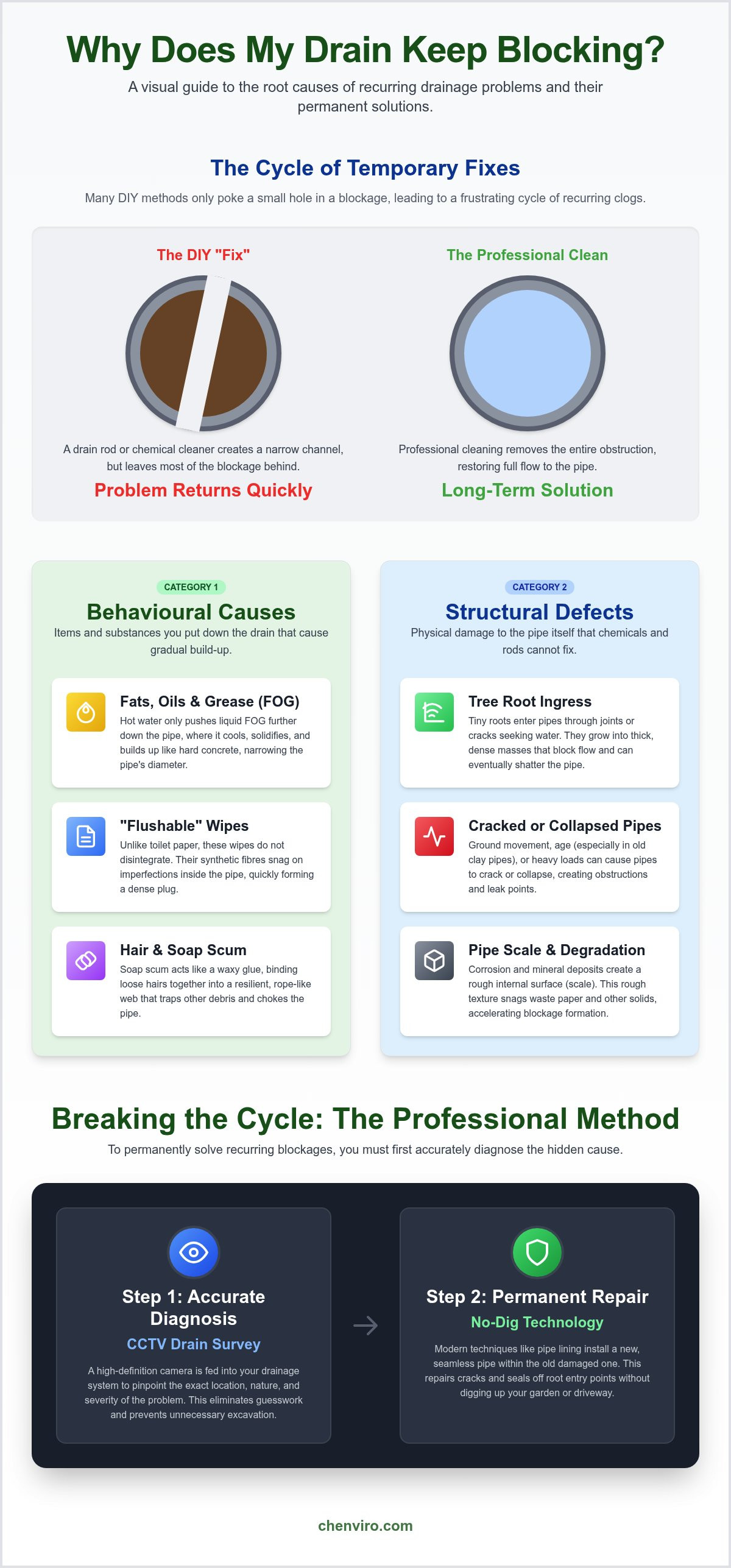
A single blocked sink is an inconvenience. However, if you find yourself reaching for the plunger or calling for help more than twice in a single year, you aren't dealing with a simple clog. You are trapped in a cycle of recurring blockages. Understanding what causes drains to keep blocking starts with recognising that a "cleared" drain isn't always a "clean" drain. Often, a standard rod only pokes a small hole through a larger mass, allowing water to flow temporarily whilst leaving the bulk of the obstruction behind.
There is a fundamental difference between a simple clog and a systemic drainage failure. A simple clog is usually a localised object, like a trapped bottle cap or a clump of hair, that is easily removed. A systemic failure suggests an underlying issue with the pipe's condition or its capacity to handle waste. Ignoring the early warning signs, such as slow drainage or gurgling sounds, is a mistake. These symptoms are your system's way of telling you that a total backup is imminent. Waiting until sewage appears in your garden or kitchen usually results in a much more expensive emergency call-out.
Understanding the basic design of plumbing drains helps clarify why these systems fail. When a drain is working correctly, gravity and smooth internal surfaces move waste away efficiently. When that internal environment is compromised, even small amounts of debris begin to snag and accumulate.
Behavioural vs Structural: Identifying the Category
Most drainage issues fall into two categories: behavioural or structural. Behavioural issues are down to what goes into the pipe. This includes the build-up of fats, oils, and grease (FOG) or the accumulation of "flushable" wipes that don't actually break down. Structural issues are physical defects. These include cracks, collapsed sections, or tree root ingress. If you've changed your habits but the clogs persist, the problem is almost certainly structural. You cannot fix a cracked pipe with better kitchen habits.
The Impact of Local Infrastructure in Dublin and Kildare
The age and location of your property play a massive role in drainage health. In Dublin city centre, many homes still rely on original Victorian clay pipes. These are prone to shifting and cracking over time. In regions like Meath and Wicklow, natural soil shifts can cause pipes to lose their "fall," meaning they no longer have the correct slope to move waste via gravity. Even in modern housing estates across Kildare, we often see issues caused by poor initial installation or heavy construction traffic that has compressed and deformed plastic piping underground.
While structural damage is a major factor, your daily habits often dictate what causes drains to keep blocking on a week-to-week basis. Most homeowners assume that if waste disappears down the plughole, it's gone for good. In reality, many substances linger, creating an "invisible" build-up that narrows the pipe's diameter over time. This process is cumulative. A small amount of grease today provides a sticky surface for hair or food particles tomorrow, eventually leading to a total obstruction that no domestic chemical can reach.
In the bathroom, hair and soap scum are the primary offenders. Soap scum isn't just a surface stain; it's a waxy substance that binds hair together into a resilient, rope-like web. This web acts as a filter, catching everything from skin cells to toilet paper. Once this matrix is established, even the most powerful domestic plungers struggle to shift it because the blockage is often located several metres deep into the system.
The Kitchen FOG Trap
Many people believe that flushing fats, oils, and grease (FOG) with plenty of hot water and washing-up liquid prevents clogs. This is a myth. Hot water simply carries the liquid fat further into your external drainage system. Once the water cools, the fat solidifies against the pipe walls. Over months, this creates a "fatberg" that is as hard as concrete. To avoid this, always scrape plates into the organic waste bin and use a sink strainer to catch food debris. If your kitchen sink is already sluggish, a professional Grease Trap Cleaning & Maintenance service can clear the line before it backs up into your home.
The "Flushable" Myth and Bathroom Blockages
The rise of "flushable" wipes has caused a significant increase in recurring blockages. Unlike toilet paper, which is designed to disintegrate in seconds, these wipes are made of sturdy synthetic fibres. They don't break down. Instead, they snag on the slightest imperfection in the pipe, such as a joint or a small bit of scale. Once one wipe snags, it catches the next, quickly forming a massive plug. Other common culprits include dental floss and sanitary products, which are essentially indestructible in a sewer environment. Educating everyone in the household to "think before they flush" is the best way to protect your drainage services Dublin and keep your system running smoothly. If habits haven't changed but the clogs persist, the issue is likely structural, as we will explore in the next section.
Structural Defects: The Problems You Cannot See Without a Camera
If you have changed your household habits and the water still refuses to flow, the issue is almost certainly structural. This is the most common answer to what causes drains to keep blocking when simple rodding fails. Unlike a surface clog, a structural defect is a physical failure of the pipe itself. These problems are invisible from the surface, often occurring metres underground where no amount of domestic chemical cleaner can reach them.
Structural issues often begin as minor hairline fractures. Over time, these develop into major obstructions or complete collapses. In many Irish regions, particularly those with hard water, pipe scale and calcification also play a role. This mineral build-up creates a rough, sandpaper-like surface inside the pipe, which catches hair and grease far more easily than a smooth, clean surface would. When the structure of the pipe is compromised, even a "perfect" flush can result in a backup.
Tree Root Intrusion: A Silent Threat
Roots are naturally drawn to the warmth, moisture, and nutrients found inside your drainage system. A tiny root hair can enter through a microscopic crack or a loose joint. Once inside, it thrives, growing into a thick, fibrous mass that completely chokes the pipe. In Ireland, trees like Willows, Poplars, and Sycamores are notorious for this. Simply cutting the roots back with a mechanical tool is a temporary fix. Unless you seal the entry point, the roots will return, often thicker and faster than before, because they have found a reliable water source.
Misaligned Joints and Pipe Subsidence
Our local landscape is constantly shifting. Whether it is the heavy clay soil in Dublin or the soft ground in parts of Meath and Wicklow, movement is inevitable. When the ground shifts, pipe joints can "step" or misalign. This creates a lip that catches solid waste and toilet paper. Similarly, subsidence can cause a section of the pipe to sag, creating what we call a "belly." In these sagging sections, water pools and silt settles, eventually leading to a hard blockage. A professional CCTV drain survey Dublin is the only reliable way to spot these defects. It replaces guesswork with visual proof, allowing for a targeted repair rather than a complete, unnecessary excavation of your garden.
Why DIY Fixes and Chemicals Often Make the Problem Worse
The temptation to reach for a bottle of supermarket unblocker is understandable when you're faced with a slow-moving sink. However, relying on these quick fixes is often a false economy. These products are designed for minor, soft clogs in the U-bend, not the deep-seated structural issues that represent what causes drains to keep blocking. By repeatedly using these solutions, you are likely masking a more serious problem, such as a fracture or a slow collapse. This delay only allows the underlying damage to worsen, eventually leading to a much more expensive emergency.
Statistics show that while roughly 70% of standard blockages are resolved quickly by professionals, the remaining 30% involve complex structural failures. DIY methods almost never solve this latter category. Instead of fixing the issue, persistent DIY attempts can lead to "blockage fatigue," where the homeowner ignores the warning signs until sewage actively enters the property.
The Caustic Chemical Trap
Let's be direct: caustic soda and heavy chemical cleaners can be incredibly destructive. When you pour these liquids down a drain, they generate intense heat through an exothermic reaction. In modern plastic pipes, this heat can actually soften or melt the pipe walls, leading to leaks. In older properties with clay or pitch fibre pipes, the chemicals can accelerate the decay of the pipe's structural integrity. Furthermore, if the chemical fails to clear the blockage, it sits in the pipe as a "caustic pocket." This creates a significant safety risk for any plumber who later has to dismantle the pipework, as they risk chemical burns from the trapped liquid.
The Limitations of Manual Rodding
A set of drainage rods from a local hardware store is a blunt instrument. Whilst rodding can sometimes push a blockage further down the line, it rarely clears the pipe completely. Often, the rod simply "pokes a hole" through the soft debris, allowing water to flow for a few days before the hole closes up again. Rods are also incapable of removing hard scale, calcification, or grease build-up. There is also a genuine risk of getting the rods stuck or breaking them inside a damaged pipe, which turns a simple unblocking job into a complex retrieval operation. If your rods meet significant resistance, it is time to stop and call for a professional drain unblocking service Dublin.
Stop wasting money on temporary fixes that could be damaging your home's infrastructure. If you are dealing with a recurring issue, you need a permanent solution rather than a chemical patch. Contact us today for a professional drain unblocking service that identifies the root cause and clears your pipes for good.
Breaking the Cycle: Diagnostic Surveys and Permanent Fixes
Breaking the cycle of recurring blockages requires a shift from reactive clearing to proactive diagnostics. If you have already cleared a pipe multiple times, you are no longer dealing with a simple obstruction. You are dealing with a defect. To truly understand what causes drains to keep blocking, you need to see the internal condition of the pipework. Guesswork is expensive and often leads to the same problem returning within weeks. Visual certainty allows for a permanent fix that addresses the root cause rather than just the symptoms.
Modern drainage technology has moved past the era of digging up entire gardens to find a single leak. Today, we use precision tools to map the health of your system from the inside. This approach saves time, reduces stress, and ensures that the money you spend on repairs actually solves the problem for the long term. Whether you are a homeowner or a facility manager, the goal is the same: moving from a state of emergency to a state of maintenance.
The Power of a Professional CCTV Drain Survey
A professional CCTV survey is the only way to achieve total clarity. Our high-definition cameras travel deep into the system to reveal issues that a rod simply cannot detect. This might include misaligned joints, the early stages of a collapse, or a hidden root mass. This footage provides the objective evidence needed for insurance claims or to negotiate repairs during a property purchase. Most importantly, it allows us to plan a no dig drain repair Dublin, ensuring the fix is targeted and efficient.
No-Dig Technology: The Permanent Solution
Trenchless technology, or pipe relining, has revolutionised how we handle structural failures. We insert a specialised resin liner into the damaged pipe and inflate it. Once it hardens, it creates a seamless, incredibly durable "pipe within a pipe." This new surface is smoother than the original, which improves flow and prevents debris from snagging. Because it is a single, continuous piece, there are no joints for roots to penetrate. The entire process is fast, clean, and avoids the significant cost and disruption of excavating your garden or driveway. It's the most cost-effective way to stop blockages forever.
For commercial facility managers, the stakes are even higher. A blocked drain can lead to health and safety risks or forced closures. Moving to a planned maintenance schedule is the only way to manage these risks effectively. By combining regular grease trap maintenance with periodic surveys, you can identify wear and tear before it leads to a crisis. This professional, tech-led approach ensures your facility remains operational and your drainage infrastructure stays in peak condition for years to come.
Secure a Permanent Fix for Your Drainage System
A recurring blockage is more than a nuisance; it's a sign that your property's infrastructure is under threat. Whether the issue stems from a hidden fatberg, invasive tree roots, or a structural collapse, understanding what causes drains to keep blocking is the only way to break the cycle of temporary repairs. Relying on caustic chemicals or manual rodding often masks deeper defects that will eventually lead to an expensive emergency.
By choosing a diagnostic approach, you move from guesswork to certainty. Our team provides expert drainage solutions across Dublin, Meath, and Kildare, using high-definition CCTV technology to pinpoint failures with precision. We specialise in advanced no-dig repair technology, allowing us to seal cracks and restore flow without the need for messy excavation. We're also fully equipped for emergency unblocking when a total backup occurs.
Don't let drainage problems disrupt your home or business any longer. Contact CH Enviro for a professional CCTV drain survey and permanent fix today. We're here to provide the straight-talking advice and reliable results you need to keep your pipes clear for good.
Frequently Asked Questions
Why does my kitchen sink block every few months?
Kitchen sinks usually block due to the accumulation of fats, oils, and grease, often called FOG. Even if you use hot water, these substances eventually cool and solidify on the pipe walls. Over several months, this build-up narrows the passage until food particles and soap scum create a total obstruction. In busy households across Kildare and Meath, we recommend using sink strainers and avoiding pouring any oil down the plughole to prevent these frequent issues.
Can tree roots really grow inside a sealed pipe?
Tree roots are persistent and can enter even the smallest pipe imperfections. They are attracted to the moisture and nutrients inside your drainage system. A tiny hairline crack or a loose joint is enough for a root hair to penetrate. Once inside, the root thrives and expands into a thick mass that catches waste. This is a major factor in what causes drains to keep blocking, especially in properties with mature gardens.
Is it safe to use caustic soda on a recurring blockage?
Caustic soda is generally not safe for recurring blockages and can cause significant damage. The chemical reaction generates intense heat that can warp or melt modern plastic pipes. In older clay pipes, it can accelerate structural decay. If the chemical doesn't clear the clog, it remains in the pipe as a "caustic pocket," creating a severe burn risk for any professional plumber who later has to work on the system.
How does a CCTV drain survey help with recurring issues?
A CCTV drain survey removes the guesswork by providing high-definition visual proof of the pipe's internal condition. Instead of just poking a hole through a blockage with a rod, we can see if the issue is a structural crack, a collapsed section, or a root infestation. This technology allows us to identify the exact metre-point of the defect, ensuring that any subsequent no-dig repair is targeted, efficient, and permanent.
What is the most common cause of blocked drains in Dublin?
In Dublin, the most common cause is a combination of ageing infrastructure and modern waste. Many city centre properties still rely on Victorian-era clay pipes that are prone to cracking and shifting. When you add the build-up of non-biodegradable "flushable" wipes and kitchen grease to these fragile systems, blockages become inevitable. Our local expertise across Dublin and Louth shows that structural wear is often the silent partner to behavioural clogs.
Can a collapsed pipe be fixed without digging up my garden?
Most fractured or partially collapsed pipes can be fixed using no-dig repair techniques. This trenchless technology involves inserting a resin-saturated liner into the damaged pipe, which then hardens to create a durable new surface. It effectively seals cracks and prevents root ingress without the need to excavate your garden or driveway. However, if the pipe has completely pancaked, a traditional excavation may still be required to restore the flow.
Why does my drain smell even after I have unblocked it?
Lingering smells are often caused by residual organic matter or bacteria that wasn't fully removed during the unblocking process. If a grease layer remains on the pipe walls, it will continue to decay and produce foul gases. Alternatively, the smell could indicate a venting problem or a "dry trap" where the water seal has evaporated, allowing sewer gases to enter your home. A professional survey can identify these hidden sources of odour.
How often should I have my drains professionally cleaned?
For most domestic properties in Wicklow and Wexford, a professional inspection and cleaning every 12 to 24 months is sufficient. However, if your home has older pipes or significant tree cover, annual maintenance is a safer bet. Commercial properties, particularly those with kitchens, require more frequent attention. Regular grease trap cleaning and maintenance are essential for businesses to stay compliant with local regulations and avoid the disruption of a sudden sewage backup.


Comments