
What to Expect from a Professional Drain Inspection in Dublin: A 2026 Guide
- chenviro2
- 23 hours ago
- 13 min read
Is that recurring blockage a simple clog, or is it a warning sign of a collapsing pipe beneath your foundations? Most Dublin homeowners live with the frustration of slow drains, often relying on temporary DIY fixes that fail to address the root cause. If you're managing a complex system and need advice on pump station repair Dublin, you already know that guesswork is expensive. It's natural to worry about the structural integrity of an older property or the high cost of digging up a driveway just to find a single leak.
Discover how modern diagnostic technology identifies hidden pipe issues and saves Dublin homeowners thousands in unnecessary repairs. This guide walks you through the professional inspection process as it stands in 2026. You'll learn what happens during a CCTV survey, how to interpret a professional report for your insurer, and why a data-driven diagnosis is the only way to get lasting peace of mind before committing to a house purchase.
Key Takeaways
Learn the difference between reactive unblocking and proactive diagnostic inspections to prevent sudden, costly pipe failures.
Understand how high-definition CCTV technology provides a clear view of your property’s underground infrastructure without the need for invasive digging.
Identify the warning signs of failing systems that require expert intervention, including complex issues like pump station repair Dublin.
Discover why a professional drainage report is essential for securing mortgages or insurance coverage on older Dublin properties.
Gain clarity on the industry-standard grading system used to assess pipe health and prioritise necessary maintenance.
Table of Contents
Understanding Drain Inspections: More Than Just a Camera in a Pipe
A professional drain inspection is a non-invasive diagnostic procedure. It's essentially a forensic health check for your property's underground infrastructure. Unlike a standard unblocking service, which only clears an immediate obstruction, an inspection identifies the structural reason why that blockage occurred in the first place. For properties with complex setups, such as those requiring pump station repair Dublin, a surface-level look is never enough. You need to see the invisible to avoid the revolving door of recurring call-out charges. This proactive approach turns a hidden liability into a manageable asset.
A full system health check is designed for both domestic and commercial properties. It moves beyond the "fix it when it breaks" mentality. Instead, it provides a comprehensive map of your drainage network, identifying potential weak points before they become catastrophic failures. By choosing a diagnostic survey, you are investing in data. This data allows you to make informed decisions about repairs, ensuring that every Euro spent is targeted at a verified problem rather than a guess.
The Difference Between a CCTV Survey and General Inspection
Whilst most people use the terms interchangeably, they aren't the same. All CCTV surveys are inspections, but a comprehensive diagnostic session often involves more than just digital footage. A general inspection might include manual manhole checks to assess flow levels or dye testing to trace specific leaks. However, high-specification drain camera equipment remains the gold standard for accuracy. Using CCTV drain cameras allows engineers to pinpoint cracks, root intrusions, or displaced joints with millimetre precision. This broader diagnostic approach also captures issues that cameras alone might miss, such as the source of foul odours or subtle evidence of vermin activity within the pipework.
Why Dublin Homeowners Prioritise Diagnostic Drainage
Dublin presents unique challenges for drainage. Our city combines Victorian-era clay pipes in the centre with modern PVC systems in the suburbs. Heavy rainfall often puts these ageing networks under immense pressure. By opting for a full system health check, you get a fixed-cost roadmap for any necessary work. It's a proactive strategy that moves you away from emergency crises and towards planned maintenance. This is particularly vital for landlords and facility managers who need to ensure their buildings remain compliant and operational. Whether you are dealing with a standard terrace house or need specialist pump station repair Dublin for a basement apartment, knowing the exact condition of your pipes is the only way to protect your investment. It provides the reassurance needed to manage an older Dublin property without the fear of hidden structural damage.
The Technology Behind Modern CCTV Drain Surveys
Professional drainage diagnostics in 2026 rely on military-grade optics. High-definition lenses are now the industry standard; they allow engineers to identify hairline fractures that older analogue systems would simply miss. These lenses are often protected by sapphire glass to prevent scratching in abrasive environments. To ensure the footage is usable, high-intensity LED arrays illuminate the pipe interior. This lighting is essential for seeing through the damp, murky conditions typical of Dublin's Victorian sewer lines. Clear visuals are especially critical when diagnosing issues that might require pump station repair Dublin, as the health of the incoming lines directly impacts the performance of the station's submersible pumps.
Data accuracy is further guaranteed by WRC (Water Research Council) coded reporting. Every defect found is assigned a specific code based on its severity and type. This universal language ensures your report is recognised by insurance companies, mortgage providers, and local authorities. It provides a transparent, unbiased record of the pipework's condition at a specific point in time. It's a professional standard that moves the industry away from vague descriptions and towards forensic data.
Push-Rod Cameras vs. Robotic Crawlers
The choice of equipment depends entirely on the scale of the pipework. For standard residential 100mm to 150mm pipes, we use flexible push-rod systems. These are designed to navigate tight bends and junctions common in domestic gardens. For larger industrial diameters or main sewers reaching up to 1200mm, robotic crawlers are deployed. These remote-controlled units can travel hundreds of metres from a single access point. These cameras utilise self-levelling heads to maintain a constant upright orientation whilst navigating through debris and bends. If you are concerned about persistent blockages in a large commercial facility, booking a CCTV drain survey is the most efficient way to see exactly what is happening underground.
Digital Mapping and Sonar Tracing
Identifying a fault is only half the battle. You also need to know exactly where it is located on the surface. Sonar tracing involves sending a transmitter through the pipe while an engineer uses a receiver above ground. This allows us to map the exact path and depth of the drainage network under your driveway or lawn. Digital mapping eliminates the need for speculative digging. It provides a precise location for any necessary repairs. This precision is particularly helpful when planning a pump station repair Dublin, as it allows for exact site preparation before any ground is broken. All digital footage and maps are archived securely. This provides a permanent record that can be used for future structural surveys or insurance claims if the property's condition changes.
When is a Professional Inspection Essential in Dublin?
Professional inspections are often triggered by a crisis, but timing is everything when protecting a property. If you are managing a commercial site or a large residential complex, a delay in identifying a fault could lead to an urgent need for pump station repair Dublin. Beyond emergency responses, inspections serve as forensic tools for property transactions, health checks, and insurance claims. They are essential whenever a problem persists despite standard maintenance. If you've had your drains jetted twice in six months and the water is still slow to move, you aren't dealing with a simple clog; you're likely dealing with a structural defect.
We also use inspections to address issues that aren't immediately visible at the plughole. This includes tracing the source of foul smells that permeate a building or investigating damp patches appearing in a foundation. In Dublin's densely populated city centre, vermin infiltration is a common concern. Rats often use small fractures in older pipework as entry points into a property. A comprehensive inspection identifies these breaches, allowing for targeted repairs that physically block pests from entering. Finally, an inspection is vital for post-repair validation. Once a no dig drain repair Dublin is complete, a final camera pass ensures the liner is perfectly seated and the flow is fully restored.
Pre-Purchase Surveys: A Critical Step for Dublin Buyers
In 2026, a drain survey before buying house Ireland has become a non-negotiable part of the conveyancing process. Dublin’s older suburbs, such as Rathmines, Phibsborough, and Stoneybatter, are famous for their Victorian charm, but they are also home to ageing clay pipes. These pipes are prone to longitudinal fractures and root ingress. A survey report provides a transparent view of what lies beneath the garden. If significant damage is found, the report serves as a powerful negotiation tool. It allows you to request a price reduction or ask the seller to complete repairs before the sale closes, preventing you from inheriting a €5,000 bill on move-in day.
Identifying Structural Failure vs. Simple Blockages
It is difficult for a layperson to tell the difference between a blocked drain or collapsed pipe without professional eyes. In leafier Dublin neighbourhoods like Foxrock or Clontarf, tree root infiltration is the primary cause of structural failure. Roots find their way into tiny joint gaps in search of water, eventually expanding and cracking the pipe. Inspections catch these "displaced joints" in their early stages. By identifying these issues before a full collapse occurs, we can often avoid the need for pump station repair Dublin or extensive excavation, saving you both time and significant expense.
The Step-by-Step Process of a Diagnostic Survey
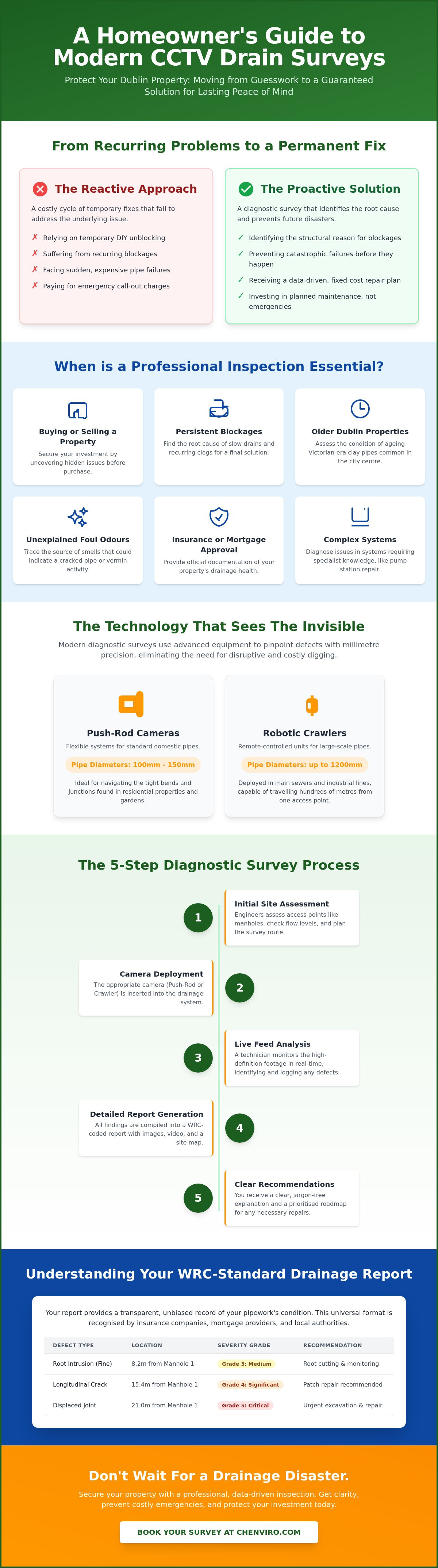
A professional diagnostic survey begins with a methodical site assessment. When the specialist arrives, they don't simply insert a camera into the nearest drain. They first map the visible layout of the property's drainage network to identify the most efficient access points. This preparation ensures that the inspection is comprehensive and covers every branch of the system. For commercial clients or managed residential blocks, this initial check often includes an evaluation of the machinery involved, ensuring that debris isn't building up in a way that would necessitate an urgent pump station repair Dublin. Once the layout is understood, the engineer identifies the manholes or inspection chambers required for entry.
The "clean-first" rule is the most critical part of the process. A camera cannot see through standing water or layers of thick sludge. To ensure high-visibility footage, we often perform high-pressure water jetting before the survey begins. This clears away loose debris and silt, exposing the actual pipe wall for inspection. Without this step, a survey is merely a guess. By cleaning the lines first, we ensure that hairline cracks and displaced joints are clearly visible on the monitor. This thoroughness is what prevents small issues from escalating into major structural failures.
During the survey, the engineer operates from a mobile workstation. As the camera travels through the pipe, the footage is broadcast in real-time to a high-definition monitor. This allows for immediate fault logging. If a specific issue is spotted, the engineer can pause, rotate the camera head, and capture detailed images from multiple angles. If you suspect your system is failing, you can book a professional drain unblocking or inspection to get a definitive answer immediately.
Site Preparation and Access
Engineers are experts at locating hidden access points. In many Dublin properties, manhole covers have been buried under layers of tarmac, paving, or decorative lawns over the decades. We use electronic sondes to locate these chambers without disturbing your landscaping. Once accessed, any standing water is cleared to provide a dry environment for the optics. This entire process is non-invasive; no excavation is required for the inspection itself, which keeps your property tidy and your costs controlled.
Data Capture and Fault Logging
Every metre of the pipe is logged with precision. The engineer looks for "fatbergs," hardened grease build-up, and foreign objects like wet wipes that have snagged on rough joints. They also monitor the pipe's levels to identify "ponding," a condition where water sits in a sagged section of the pipe because the ground beneath has shifted. This data is vital for preventing long-term damage. Catching these sags early can prevent the build-up of solids that eventually leads to a complete system blockage or a requirement for pump station repair Dublin. Each defect is recorded with a timestamp and a distance measurement from the access point, providing a precise map for any future repairs.
Navigating the Findings: Understanding Your Drainage Report
Receiving your drainage report is the moment of clarity in the diagnostic process. It transforms hours of high-definition footage into a structured, actionable document. A professional report should be comprehensive; it must include the raw digital footage, a detailed site map of your pipework, and a log of every fault found. At CH Enviro, we prioritise a straight-talking approach. We don't hide behind confusing jargon. Instead, we provide a transparent overview that tells you exactly what is happening beneath your property. This clarity is especially critical if the findings suggest that a failing line is putting pressure on your infrastructure, requiring urgent pump station repair Dublin to restore full functionality.
The core of the report is the industry-standard grading system, which ranks pipe conditions from Grade 1 to Grade 5. Understanding these grades helps you prioritise your budget:
Grade 1: The pipe is in excellent structural condition with no detectable defects.
Grade 2: Minor defects are present, such as surface wear, but no immediate action is required.
Grade 3: Significant defects found that may require repair in the medium term to prevent deterioration.
Grade 4: Serious structural damage is present; the pipe is at high risk of collapse and needs urgent attention.
Grade 5: The pipe has already collapsed or is completely blocked, requiring immediate intervention.
Interpreting Faults and Recommendations
Your report will highlight specific issues using technical but accessible terms. "Root ingress" refers to tree roots penetrating pipe joints, whilst a "fractured collar" indicates a crack at the point where two pipe sections meet. You might also see "encrustation," which is a build-up of mineral deposits that narrows the pipe diameter. Not every fault requires a dig. A minor Grade 2 crack might only need periodic monitoring. However, a Grade 4 fracture usually necessitates a structural liner to prevent a total cave-in. For buyers, this report serves as essential proof of condition for mortgage lenders, ensuring that the property's value isn't undermined by hidden liabilities.
Next Steps: From Diagnosis to Resolution
Once you have the report, you can use the data to secure an accurate, fixed-price quote for drainage services Dublin. There is no more guessing. If the survey identifies structural damage, we often transition to trenchless repair solutions, such as no-dig lining, which fixes the pipe from the inside. This saves you the cost and disruption of excavating your driveway or garden. Whether you need a simple patch repair or a complex pump station repair Dublin, the report is your roadmap to a permanent resolution. Don't leave your property's health to chance. Contact CH Enviro today for a professional drain inspection in Dublin and get the facts you need to protect your home.
Take Control of Your Drainage Health Today
A professional drain inspection is the only way to eliminate the uncertainty of underground pipe damage. By utilising Full HD CCTV technology and adhering to WRC Coded Reporting Standards, you receive a forensic map of your system's health. This data is vital for securing insurance claims, finalising property purchases, or identifying the need for pump station repair Dublin. Instead of waiting for a catastrophic failure, proactive diagnostics allow you to manage repairs on your own terms and avoid the revolving door of recurring call-out fees.
Our team brings expert local knowledge to every site across Dublin, Meath, and Kildare, ensuring that your drainage issues are resolved with transparency and precision. Don't let a small fracture turn into an expensive excavation project. Take the first step toward long-term peace of mind by choosing a service that values accuracy over guesswork. We provide the fixed-cost roadmap you need to maintain a safe and functional property without the stress of hidden structural defects.
Book Your Professional Drain Inspection with CH Enviro and get a clear, straight-talking report on your property’s infrastructure. We are here to help you protect your home or business with reliable, tech-led solutions.
Frequently Asked Questions
Is a drain inspection worth the cost for a residential property?
Yes, a drain inspection is a vital investment that prevents the high costs associated with emergency excavations and structural repairs. By identifying hairline cracks or displaced joints early, you can address minor issues before they lead to a total system failure. It also provides the necessary documentation for insurance claims or property sales, ensuring you don't inherit a hidden liability that could cost thousands of Euros to rectify later.
How long does a typical CCTV drain survey take to complete?
A standard residential CCTV drain survey typically takes between one and two hours to complete. This timeframe depends on the accessibility of the manholes and the total length of the pipework being inspected. If the system requires high-pressure water jetting to clear debris before the camera can enter, the process may take slightly longer. The engineer will provide a real-time assessment of the system's condition during the visit.
Will my insurance company cover the cost of a drain inspection?
Insurance coverage for a drain inspection depends on your specific policy and whether the damage was caused by an "insured peril" like a sudden pipe collapse. Most insurers will cover the cost of a diagnostic survey if it is required to identify a valid claim. However, standard maintenance or pre-purchase surveys are generally not covered. Always check your policy details with your provider before booking a diagnostic service.
Do I need to be at home whilst the drain inspection is being carried out?
You do not necessarily need to be present during the inspection if the engineer has clear access to the external manholes and chambers. However, many homeowners prefer to be on-site to view the live footage on the mobile workstation. If the inspection reveals complex issues like the need for pump station repair Dublin, being present allows the engineer to explain the technical findings and the immediate next steps in person.
What happens if the camera gets stuck in the pipe?
If a camera becomes snagged on a displaced joint or heavy root mass, engineers use specialised retrieval equipment to free it safely. Because the camera is equipped with a transmitter, its exact location and depth can be pinpointed from the surface using sonar tracing. This ensures that even in the rare event of a camera getting stuck, we know exactly where it is, avoiding any unnecessary guesswork or disruptive digging.
Can a drain inspection detect rats or other vermin in the system?
Yes, a CCTV inspection is the most effective way to identify vermin infiltration within your drainage network. The camera can spot chewed pipe bungs, nesting material, or the specific fractures rats use to enter a property from the main sewer. Identifying these breaches allows for the installation of rat-blocking valves or structural liners, providing a permanent physical barrier against pests without the need for harmful chemicals or baiting.
Is a drain survey a standard requirement for Irish mortgages in 2026?
Whilst not a universal legal requirement, many Irish mortgage lenders and surveyors now insist on a CCTV drain survey for properties over 30 years old. In 2026, this has become standard practice to protect the lender's investment from hidden structural defects. A professional report ensures there are no collapsed pipes or significant root ingress that could affect the property's value or the long-term integrity of the building's foundations.
What is the difference between a drain survey and a drain test?
A drain survey is a visual inspection using high-definition cameras to identify structural defects, whilst a drain test checks for leaks using air or water pressure. A test confirms if a pipe is watertight, but it cannot show you the cause of a leak. Only a survey can show you exactly why a system is failing or if you require a specialist pump station repair Dublin to restore your wastewater management.


Comments