
Why Your Drain Keeps Blocking in Dublin: 5 Common Myths Debunked
- chenviro2
- Jun 23
- 12 min read
What if the reason your drain keeps blocking in Dublin isn't just bad luck, but a structural failure that a standard drain rod is physically incapable of fixing? It is exhausting to deal with the same rising water and persistent bad smells every few months. You have likely spent a significant amount on repeat call-outs, only to find the problem returns the moment you think it's settled. It is a common frustration for many homeowners, especially when you consider that Uisce Éireann responds to approximately 10,000 notified blockages in the wastewater network every single year.
We know you want a solution that actually lasts, rather than another temporary patch that leaves you fearing a major sewage backup. You deserve to understand exactly what is happening beneath your property so you can break the cycle of recurring issues for good. This article explores the real structural and behavioural reasons your pipes are failing and debunks five common myths that keep people stuck in a loop of expensive repairs. You will learn how to find a permanent fix that doesn't involve massive excavation or high long-term maintenance costs.
Table of Contents
Why Your Drain Keeps Blocking in Dublin: The "Clearance Cycle" Explained
Debunking Common Drainage Myths: Why Rodding Isn’t a Permanent Fix
Structural Realities: What Recurring Blocks Reveal About Your Dublin Property
Breaking the Cycle: How to Diagnose and Fix Recurring Drainage Issues
Professional Drainage Solutions: How CH Enviro Ends Recurring Blockages
Why Your Drain Keeps Blocking in Dublin: The "Clearance Cycle" Explained
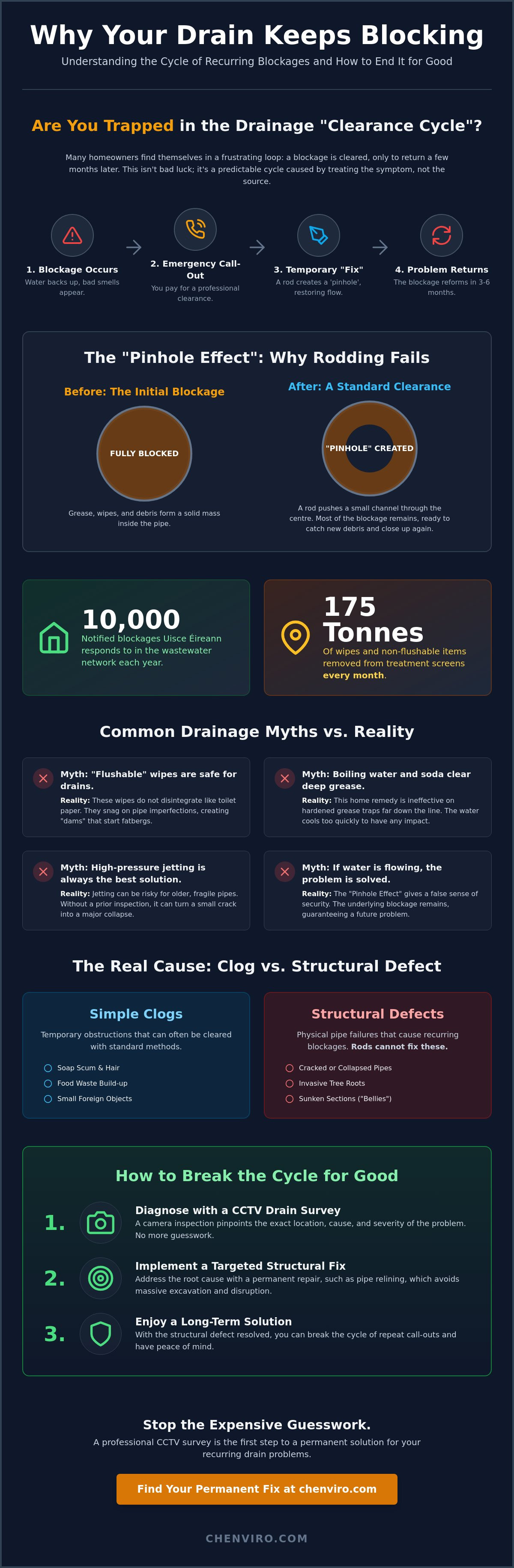
If your drain keeps blocking Dublin, you are likely stuck in what we call the "clearance cycle". This is a frustrating loop where you pay for a professional to clear a blockage, only for the same issue to return three to six months later. It feels like bad luck, but it's actually a predictable result of how many standard clearances are performed. You aren't just paying for a service; you are paying for a temporary reprieve. This cycle takes a heavy emotional toll on homeowners who live in constant fear of the next backup and the inevitable financial cost of another call-out.
The primary reason for this recurrence is the "Pinhole Effect". When a technician uses a standard drain rod or a basic spring to clear a mass of grease or tree roots, they often only create a narrow tunnel through the centre of the obstruction. Water starts to flow again, which gives the illusion that the problem is solved. In reality, the majority of the blockage is still there, clinging to the pipe walls. This isn't a clean pipe; it's a pipe with a small hole poked through a larger mess.
This remaining residue acts as a physical magnet for everything you send down the sink. New grease, hair, and tissue catch on the jagged edges of the old blockage almost immediately. Understanding what a fatberg is reveals why these hardened masses of oil and non-flushables are so difficult to remove completely with manual tools alone. Without a thorough cleaning or a structural fix, the "pinhole" closes up quickly, and you are back to square one.
The Difference Between a Clog and a Structural Defect
It's vital to distinguish between a simple clog and a structural defect. A clog is a temporary obstruction, like a build-up of soap scum or a foreign object. A structural defect is a physical failure of the pipe itself. This includes cracked clay pipes, sunken sections known as bellies, or invasive tree roots. You can unblock a clog, but you cannot "unblock" a collapsed pipe or a displaced joint with a rod. These issues require a permanent repair to stop the cycle of sewage backing up into your home.
Signs You Are Trapped in a Recurring Blockage Cycle
If your drain keeps blocking Dublin, you can usually tell by watching how your fixtures behave. If the drain clears for a week but then begins to slow down again, the blockage was never fully removed. You might notice multiple fixtures, like your toilet and kitchen sink, gurgling at the same time. This indicates a deeper issue in the main line rather than a simple sink clog. Persistent foul odours that return shortly after you've used chemical cleaners are another clear sign that waste is trapped somewhere in the system.
Debunking Common Drainage Myths: Why Rodding Isn’t a Permanent Fix
If your drain keeps blocking Dublin, you've probably tried every trick in the book to keep the water flowing. Many homeowners rely on traditional advice that sounds logical but actually makes the problem worse over time. These myths lead to wasted money on repeat call-outs and avoidable stress. We see these misconceptions daily. Understanding the reality of your drainage system is the first step toward a permanent fix.
The Danger of the "Flushable" Label
Wipes are a major culprit in recurring blockages. Despite what the packaging says, wipes don't disintegrate whilst travelling through the Dublin sewer network. In fact, Uisce Éireann removes about 175 tonnes of wipes and other non-flushable items from treatment screens every month. These wipes snag on minor pipe imperfections or displaced joints, creating a "dam" effect that catches grease and hair. This is how domestic fatbergs begin. If your pipes are older clay models, these wipes are particularly dangerous as they provide a perfect anchor for debris.
Another common myth is that boiling water and soda will dissolve a deep structural grease trap. Whilst this might help a minor kitchen sink clog near the surface, it won't reach a hardened mass ten metres down the line. The water cools too quickly to have any effect on deep-seated fat. Similarly, people assume high-pressure jetting is always the best first step. It is powerful, but it can be risky for fragile, older pipes. Without knowing the pipe's condition, high pressure can turn a small crack into a total collapse. It's often better to start with a professional CCTV Drain Survey to see what you're dealing with before applying force.
The most dangerous myth is believing that if the water is flowing, the problem is completely gone. Flowing water only means there is a path. It doesn't mean the pipe is clear or structurally sound. A pipe could be 90% restricted and still allow a basin to drain, leaving you unprepared for the next major backup.
Why Rodding Often Fails Recurring Issues
Rodding is the standard go-to for emergency clearances, but it has massive limitations for long-term maintenance. Rods lack the visibility to see if the obstruction was 10% or 100% removed. You are essentially working in the dark. Often, rods just push the blockage further down the line into a shared Dublin City sewer. This solves your immediate problem but often leads to a more complex backup later. Rods also cannot fix a "belly". This is a dip in the pipe where standing water collects and debris settles. No amount of rodding will level out a sunken pipe; it only clears the latest symptom of a physical defect.
Structural Realities: What Recurring Blocks Reveal About Your Dublin Property
If your drain keeps blocking Dublin, the issue might be buried deeper than a simple clog. Many Dublin properties, particularly those built before the 1970s, rely on aging infrastructure that was never designed for modern usage levels. These structural failures aren't your fault, but they are your responsibility to identify. When a drain fails every few months in the same spot, it is almost always a sign that the pipe itself has changed shape or integrity.
Victorian clay pipes were the standard for decades. Whilst durable, they are brittle. As the ground shifts, these pipes crack or the mortar in the joints washes away over time. This leads to "offset joints", where one pipe section drops slightly lower than the next. This creates a physical ledge inside the line. Toilet paper and solid waste catch on this ledge, building up until the flow stops. Clay pipes across much of Dublin City are now rapidly approaching the end of their natural functional lifespan.
Victorian Clay Pipes vs. Modern PVC
Modern PVC is flexible and features watertight rubber seals. In contrast, older clay pipes are rigid and susceptible to cracking as the ground settles over decades. Once a crack appears, it acts as a beacon for tree roots. In leafy suburbs across Dublin, Wicklow, and Kildare, tree root ingress is a leading cause of recurring blocks. Roots seek out the moisture inside your pipes. They enter through microscopic cracks and grow into thick, woody masses that act as a filter, catching every bit of debris.
The soil in the East of Ireland can also be prone to shifting, which causes "bellies" or dips in the drainage line. Because drains rely on gravity, any dip creates a pool of standing water. Debris settles in this pool instead of being washed away, eventually causing a blockage that rods can only clear temporarily. In Dublin’s many terraced streets, you may also be dealing with shared drainage. If a neighbour further down the line has a structural issue, it can cause a backup in your property regardless of your own habits.
The Impact of Heavy Rain in Dublin and Wicklow
Heavy rainfall puts immense hydraulic pressure on already compromised drainage systems. If your pipes have cracks or displaced joints, the surrounding groundwater can seep in, overwhelming the system. This is why many homeowners report that their drain smells after rain. It is a major red flag that your system is no longer watertight and likely has a structural defect allowing sewer gases to escape. Identifying these defects early prevents the total collapse of the line.
Breaking the Cycle: How to Diagnose and Fix Recurring Drainage Issues
If your drain keeps blocking Dublin, stop paying for the same temporary clearance. Guessing is the most expensive way to manage your property's infrastructure. Every time you rod a pipe without seeing what is inside, you are gambling with your maintenance budget. To break the cycle, you need to transition from reactive clearing to proactive diagnosis. This involves a logical four-step process designed to identify the defect and apply a permanent structural fix.
The Power of a CCTV Drain Survey
A professional CCTV drain survey Dublin is the only way to find the root cause of a recurring issue. Modern high-definition cameras travel deep into the line, revealing the exact nature of the defect. Whether it is a displaced joint, a hairline crack, or a belly in the pipe, the camera captures it all. A quality survey report must include high-definition footage, precise distance measurements, and depth readings. This data allows you to identify the exact location of the problem, often within centimetres, so you don't waste money digging up the wrong part of your garden.
Once the defect is located, you have a choice. You can either excavate the entire line or choose a more modern approach. For most homeowners, no dig drain repair Dublin is the superior option. This technology allows us to fix structural issues without turning your driveway or garden into a construction site. It is about working smarter, not harder.
Fixing Pipes Without the Mess: No-Dig Technology
The most common method for modern repairs is pipe relining Dublin. We insert a flexible, resin-impregnated "sleeve" into the existing pipe. Once in place, the sleeve is inflated and cured, effectively creating a new, seamless pipe within the old one. This new lining seals all cracks, covers offset joints, and prevents future root ingress. It is a permanent structural fix that lasts for decades. Because there is no digging involved, the process is faster, cleaner, and often more cost-effective than traditional replacement. It is the preferred method for Dublin driveways and gardens where preserving the surface is a priority.
Don't let a small defect turn into a total system collapse. If your drain keeps blocking Dublin, you need a fix that lasts. Book your CCTV survey today to see exactly what is happening beneath your home.
Professional Drainage Solutions: How CH Enviro Ends Recurring Blockages
If your drain keeps blocking Dublin, you need more than a quick fix. You need a partner who understands the local geography and the specific structural challenges of Irish infrastructure. At CH Enviro, we provide a full suite of drainage services Dublin, covering everything from emergency unblocking to long-term structural repairs. Our service area extends well beyond the city centre to include Meath, Louth, Kildare, Wicklow, and Wexford, ensuring that expert help is available across the region when you need it most.
We pride ourselves on "straight-talking" diagnostics. There is no fluff and no confusing technical jargon. We provide a clear, no-nonsense assessment of your drainage system's health. By using advanced CCTV technology, our technicians find the defects that others often miss. This precision allows us to provide fixed outcomes rather than temporary guesses. We don't just clear the water; we identify the physical reason it stopped moving in the first place.
Why Dublin Homeowners Trust CH Enviro
Our expertise isn't limited to residential properties. We have a proven track record in commercial drain repair Dublin, applying the same no-dig efficiency to businesses that cannot afford downtime. Transparency is at the heart of our service. We show you the problem on the screen before we discuss the fix. This ensures you are fully informed and confident in the solution we propose. When a recurring block becomes a crisis, our team responds rapidly to restore order and prevent property damage. We understand the urgency of a backup and the stress it causes your household.
Take the First Step to a Clear Drain
Waiting for the next backup is the most expensive strategy you can adopt. Each emergency call-out adds to the total cost without solving the underlying issue. If your drain keeps blocking Dublin, the problem will only worsen over time as the structural defect degrades. A single professional inspection can save you thousands of euros in future call-outs and potential excavation costs. It's time to stop the cycle of frustration and secure the integrity of your property's drainage system.
You deserve a drainage system that works without constant intervention. Our team is ready to provide the clarity and resolution you need to protect your home. Contact CH Enviro today for a permanent drainage solution and put an end to recurring blockages for good.
Take Control of Your Home's Drainage Today
Recurring blockages are a symptom of a deeper problem, not just a series of unfortunate events. If your drain keeps blocking Dublin, you now understand that traditional rodding often only provides a temporary tunnel through a larger structural issue. By identifying the root cause through a visual inspection, you can move away from reactive emergency call-outs and toward a permanent, cost-effective fix. Stop the cycle of temporary repairs and invest in the long-term health of your property.
We provide 24/7 emergency response across Dublin and Leinster, ensuring help is always available when a backup occurs. As specialists in no-dig trenchless technology, we can repair your pipes without damaging your garden or driveway. Every survey we conduct comes with a comprehensive diagnostic report, giving you the facts you need to make an informed decision. Book a Professional CCTV Drain Survey with CH Enviro to secure your home's infrastructure. You don't have to live with the stress of persistent backups; the right technology makes a permanent resolution possible.
Frequently Asked Questions
Why does my drain keep blocking every few months?
Recurring blockages are usually caused by a structural defect like an offset joint, a pipe "belly", or a crack that catches debris. If your drain keeps blocking Dublin, it means that standard rodding is only poking a small hole through a larger mass of grease or roots. The remaining residue acts as a magnet for new waste. You need to identify and fix the underlying physical failure to stop the cycle for good.
Is a CCTV drain survey really necessary for a recurring block?
Yes, because a camera inspection is the only way to see exactly what is happening beneath your property without expensive digging. Guessing at the cause of a blockage leads to wasted money on temporary clearances that don't last. A professional survey provides high-definition footage of cracks, roots, or collapses. This data allows us to recommend a targeted, permanent repair rather than another short-term patch.
Can tree roots be removed from a drain without digging it up?
Tree roots can be cleared using specialised mechanical cutters and then permanently excluded with no-dig relining technology. We first use high-pressure equipment to remove the woody mass and restore the pipe's full diameter. Once the line is clean, we install a structural liner that seals the entry points. This prevents roots from sensing the moisture inside and growing back into your drainage system.
Who is responsible for a recurring block in a shared Dublin drain?
Property owners are responsible for the maintenance of drains within their property boundary up to the point they connect with the public sewer. Uisce Éireann manages the public network. In shared private lines, such as those found in older Dublin terraces, the responsibility is often shared amongst the homeowners who use that specific section. A CCTV survey helps determine exactly where the defect lies to clarify who should pay.
Will insurance cover the cost of repairing a recurring drainage problem?
Most insurance policies cover "accidental damage" to drains, such as pipe collapses caused by ground movement or invasive tree roots. However, they typically don't cover gradual wear and tear or issues caused by poor maintenance. You should check your specific policy details. Providing your insurer with a professional diagnostic report and footage from a camera survey is the best way to support a claim for structural repairs.
How long does a no-dig drain repair actually last?
A professional no-dig relining repair is a permanent structural fix designed to last for at least 50 years. The resin-impregnated sleeve creates a seamless, durable pipe-within-a-pipe that is often stronger than the original clay or PVC. It is highly resistant to corrosion and prevents future root ingress. This technology provides a long-term solution that avoids the need for disruptive excavation in the future.
What should I do if my drain smells but isn’t fully blocked yet?
Persistent foul odours are a major red flag that waste is being trapped or sewer gases are escaping through a structural defect. Don't wait for a total sewage backup to take action. A smell often indicates that the system is no longer watertight or that a partial blockage is forming deep in the line. Investigating the cause early with a professional inspection prevents a more expensive and unhygienic emergency later.
Can I prevent recurring blocks by using chemical drain cleaners?
Chemical cleaners are generally ineffective for recurring structural issues and can actually damage older Dublin pipes. These liquids might dissolve a minor hair clog near the surface, but they won't fix a displaced joint or a hardened fatberg deep in the system. if your drain keeps blocking Dublin, rely on professional diagnostics. Corrosive chemicals are a short-term gamble that offers no benefit for pipes with physical defects.


Comments