
Commercial Drain Maintenance Cost Ireland: 2026 Budgeting and Compliance Guide
- chenviro2
- 11 minutes ago
- 11 min read
Starting 1 October 2026, the average Irish business faces a staggering 87 per cent increase in trade effluent charges. For many, what was once a minor operational expense is transforming into a strategic utility tax that could cripple margins if ignored. Understanding your commercial drain maintenance cost Ireland isn't just about unblocking pipes; it's about financial survival in a shifting regulatory landscape.
It's a common frustration. You're likely balancing tight margins whilst worrying that a single grease trap failure or a surprise emergency call-out fee will derail your month. We're here to help you turn that uncertainty into a predictable, fixed-cost strategy. This guide explains exactly what's driving drainage costs in 2026 and how you can shield your facility from the heaviest Uisce Éireann tariff hikes.
We'll break down the new national charging framework, the impact of the 2026 Small Wastewater Discharge Register, and the essential steps for maintaining grease trap compliance. You'll finish with a clear roadmap to ensure zero operational downtime and total regulatory peace of mind.
Table of Contents
Understanding the True Commercial Drain Maintenance Cost in Ireland
Commercial drainage is often viewed as a hidden utility, but in 2026, it's becoming one of the most visible lines on a business balance sheet. Managing your commercial drain maintenance cost Ireland requires looking beyond the occasional unblocking job. It's a multi-layered strategy that integrates your internal sewerage system with national environmental standards and utility frameworks.
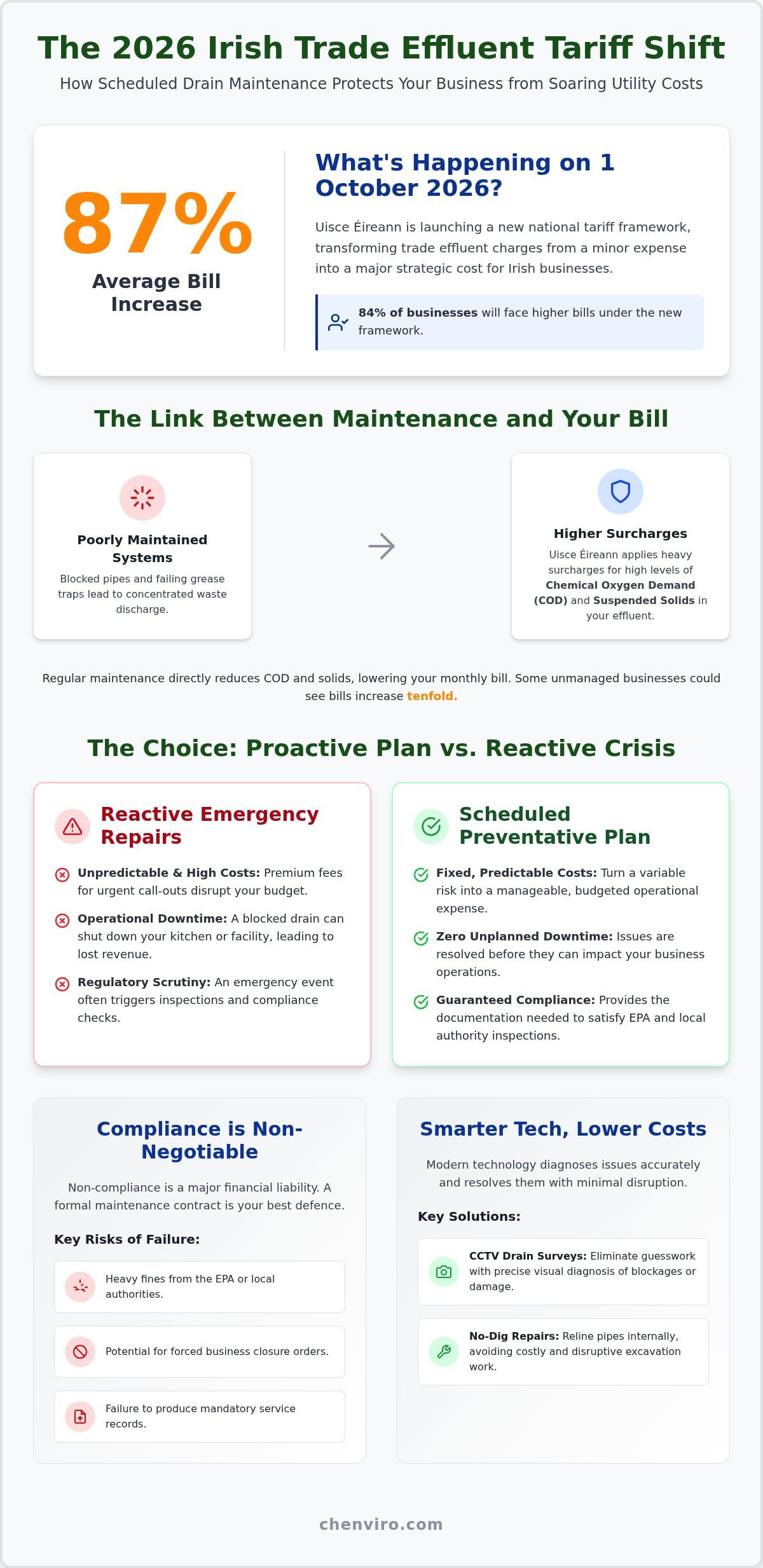
The old "wait and see" approach is now a significant financial gamble. Previously, a blockage was just a repair bill. Today, it's a precursor to regulatory scrutiny and ballooning utility charges. We categorise these costs into three distinct areas: reactive emergency repairs, scheduled preventative maintenance, and mandatory compliance servicing. Understanding how these overlap is the first step toward protecting your bottom line. Reactive costs are always the highest, whilst scheduled plans offer the best return on investment by preventing downtime before it happens.
The 2026 Trade Effluent Factor
On 1 October 2026, Uisce Éireann will implement a new national tariff framework. This isn't just a minor adjustment; it's a total overhaul of how trade effluent is billed across the country. Analysis shows that without transition arrangements, 84 per cent of affected customers would see a bill increase, with the average increase sitting at 87 per cent. Some businesses could even see their bills increase tenfold if their discharge isn't managed correctly.
These new tariffs are heavily influenced by the strength of the waste you discharge. If your system is poorly maintained, your effluent will have higher levels of Chemical Oxygen Demand (COD) and suspended solids. Uisce Éireann applies surcharges based on these levels. Professional cleaning and regular maintenance directly reduce the COD of your waste, meaning a lower monthly bill. Whilst bill capping is available for increases over €750 until 2030, the most effective way to control costs is to ensure your discharge remains within licensed parameters through consistent servicing.
Regulatory Compliance and EPA Fines
Non-compliance isn't just an environmental issue; it's a massive financial liability. The gap between a standard maintenance fee and a fine from the Environmental Protection Agency (EPA) or local authority is vast. Beyond the immediate fine, you risk business closure if your grease traps or interceptors fail to meet standards.
Mandatory record-keeping is now non-negotiable. You must prove exactly when your system was last serviced and where the waste was disposed of. A formal maintenance contract provides more than just clean pipes; it serves as legal proof of diligence. When an inspector walks through your door, having a documented history of professional servicing is your best defence against penalties. It turns a potential crisis into a routine check.
Key Factors Influencing Commercial Drainage Pricing
Pricing for drainage services in a commercial setting isn't a guessing game. It's based on the physical reality of your site. A sprawling industrial estate in Meath has different requirements than a tight, basement-level kitchen in Temple Bar. The primary driver is the size and complexity of your pipe network. Multiple branch lines, manholes, and larger diameter pipes require higher-capacity High-Pressure Water Jetting (HPWJ) units, which influences the total commercial drain maintenance cost Ireland.
Access is the second major factor. Working in Dublin city centre often means navigating narrow lanes or timing visits for 2 AM to avoid peak traffic. Confined space entry also requires specialised training and extra personnel for safety. These logistical hurdles are why we provide tailored quotes after a site assessment rather than generic price lists. If you're unsure about your site's specific needs, you can get a professional assessment to clear up any confusion.
Technical Variables: CCTV and No-Dig Tech
Investing in CCTV drain surveys in Dublin is the most effective way to eliminate "guesswork" billing. Diagnostic cameras allow us to see the exact cause of a problem, whether it's root ingress or a structural collapse. This leads directly to the cost-efficiency of no-dig repairs. Traditional excavation is incredibly disruptive; it involves breaking concrete, digging trenches, and days of downtime. No-dig technology allows us to reline a pipe from the inside. It's faster, cleaner, and significantly reduces the total project spend by removing the need for reinstatement works.
Facility Type and Usage Intensity
Your industry dictates your maintenance frequency. A high-volume restaurant kitchen faces a constant battle with waste. You must strictly adhere to the Fats, Oils and Grease (FOG) regulations to avoid blockages and heavy fines. This usually requires quarterly grease trap servicing. In contrast, an industrial warehouse might only need an annual audit of its surface water drains and silt traps. Peak business hours also play a role. If you need work done whilst your business is closed to avoid operational downtime, labour costs may reflect the unsocial hours. We look at your usage intensity to build a plan that keeps your facility running without unnecessary overheads.
Preventative Maintenance vs. Emergency Call-outs
Reacting to a crisis is always more expensive than preventing one. Emergency call-out fees represent the highest potential spike in your commercial drain maintenance cost Ireland. You're paying for the speed of the solution and the priority response, not just the labour. Standard scheduled visits are billed at a predictable, transparent rate, whilst emergency interventions often involve premium surcharges for rapid mobilisation and unsociable hours.
The hidden costs of a reactive approach are even more damaging. If a main sewer backs up, the result is often an immediate business closure. A restaurant loses its Friday night service; a retail centre loses footfall; a warehouse halts production for health and safety reasons. These periods of downtime result in lost revenue that you can never recover. By switching to a planned maintenance programme, you shift from "crisis management" to "cash flow management." You decide when the work happens, ensuring it never interferes with your peak trading hours.
Think about the "Total Cost of Ownership" for your drainage infrastructure. Pipes that are regularly descaled and cleaned last significantly longer. Severe blockages put immense pressure on joints and seals, often leading to structural cracks or collapses that require expensive repairs. Regular maintenance keeps the system operating at its original capacity, protecting your long-term capital investment.
The ROI of a Facility Maintenance Contract
A formal contract offers more than just a lower hourly rate. It provides priority response times that act as an insurance policy for your property. When you have a dedicated partner, they already understand your site's layout and specific access requirements, which speeds up every visit. This level of oversight is a core part of facility maintenance Dublin, where protecting property infrastructure is a top priority for savvy owners. It extends the life of your assets and ensures your budget remains stable month after month.
Case Study: The Cost of a Blocked Main Sewer
Consider a hypothetical scenario involving a Dublin retail centre. A main sewer line becomes blocked by a build-up of non-flushable items over several months. The resulting flood forces the centre to close for 48 hours for sanitisation and repair. The cleanup costs, lost tenant revenue, and the reputational damage amongst customers total over €20,000. In this instance, a simple €500 CCTV inspection and a scheduled jetting service six months prior would have identified the build-up and cleared it. Proactive maintenance is not an expense; it's a massive saving.
Budgeting for Specific Commercial Drainage Services
Budgeting for commercial drainage requires a granular look at your site’s specific infrastructure. It’s not just about unblocking a sink; it’s about the systems that keep your business compliant and operational. Different assets require different service intervals. For instance, a logistics hub with a large car park must prioritise interceptor maintenance to prevent oil from entering the local watercourse. Similarly, facilities with basement levels often rely on pump stations. These require regular electrical component checks to avoid a catastrophic failure that could flood your lower floors. These variables all feed into your total commercial drain maintenance cost Ireland.
Vermin control is another critical, yet often overlooked, component. Rats use drainage networks as motorways into your building. Integrating biological drain treatments and physical vermin barriers into your maintenance plan prevents costly infestations before they reach your customers. It's a proactive step that protects your brand reputation whilst keeping your pipes clear of organic build-up. Managing these specific needs ensures your facility remains a safe environment for staff and visitors alike.
Grease Management Compliance
For the hospitality sector, grease trap maintenance Dublin is the single most important line item in the budget. Compliance isn't optional. If Fats, Oils, and Grease (FOG) escape into the public sewer, you face significant surcharges from local authorities tasked with clearing "fatbergs". Beyond the cleaning itself, you must budget for the certified disposal of the waste. We provide the necessary paperwork to prove you’ve disposed of FOG legally, which is essential during any council inspection. Regular servicing ensures your trap operates at peak efficiency, keeping your effluent strength within licensed limits.
Large-Scale Environmental Solutions
Rural commercial facilities, such as country house hotels or industrial plants, often operate their own wastewater treatment plants. These systems are complex. They require a strict schedule for septic tank emptying and sludge disposal to prevent system collapse. You must also factor in environmental levies associated with the transport and treatment of commercial sludge. Neglecting these systems leads to environmental damage and massive remediation costs. If you want to ensure your facility is fully prepared for the year ahead, you should book a comprehensive drainage audit to identify potential savings.
Choosing a Maintenance Partner in Dublin and Leinster
Selecting the right contractor involves more than comparing hourly rates. You need a partner who understands the geographical and logistical reality of operating in Leinster. In Dublin city centre, this means a team capable of navigating restrictive traffic zones and narrow access points without delaying your service. In rural Meath or Kildare, it requires a provider with the right fleet to reach isolated wastewater treatment plants. Local knowledge ensures that your commercial drain maintenance cost Ireland doesn't inflate due to travel delays or lack of site-specific preparation.
Compliance is the non-negotiable foundation of any partnership. You must verify that your contractor holds a valid waste collection permit from the National Waste Collection Permit Office (NWCPO). Without this, your business remains legally liable for any waste disposed of incorrectly. Ask for proof of comprehensive insurance and up-to-date health and safety certifications. A "straight-talking" expert won't hesitate to provide this documentation; they understand that your regulatory peace of mind is just as important as the physical work on your pipes.
What to Ask Your Drainage Contractor
Before signing a contract, dig into the technical capabilities of the provider. Do they offer detailed CCTV reporting that you can use for insurance or structural surveys? Are they equipped for no dig drain repair Dublin, or will they default to expensive excavation for every structural fault? You should also clarify their emergency protocols. Understanding exactly how they handle out-of-hours requests ensures you aren't left waiting during a midnight flood when every minute of downtime costs you money.
The CH Enviro Advantage in Leinster
At CH Enviro, we provide specialised drainage and facility management services across Dublin, Meath, Kildare, and the wider Leinster area. We've seen every possible drainage challenge, from historic city centre blockages to large-scale industrial failures. Our approach is built on transparency and fairness. We avoid complex technical jargon in favour of clear, actionable advice. We help you transition from unpredictable emergency fees to a fixed-price maintenance model that fits your 2026 financial goals.
The next step is to move from reactive worry to proactive control. We recommend requesting a comprehensive site audit to evaluate your current infrastructure. This audit identifies potential risks and allows us to build a tailored plan that protects your facility from rising utility tariffs. Contact us today to organise your site assessment and secure your 2026 drainage budget.
Secure Your Commercial Drainage Budget for 2026
Managing your commercial drain maintenance cost Ireland is no longer just about fixing leaks; it's about navigating a complex utility landscape. The 2026 trade effluent tariff hikes mean that poor system performance now carries a heavy financial penalty. By moving to a scheduled maintenance plan, you eliminate the risk of emergency surcharges and ensure your business remains fully compliant with environmental standards. Proactive care is the only way to protect your margins from unpredictable operational shocks.
At CH Enviro, we act as 2026 Trade Effluent Experts, helping businesses across the region avoid bill shock through precise system management. Our use of Specialised No-Dig Technology ensures that structural repairs are handled quickly without the cost and disruption of excavation. With Comprehensive Leinster Coverage, we provide the local knowledge needed to keep your facility running smoothly regardless of your location. It's time to stop worrying about potential blockages and start investing in long-term infrastructure stability.
Ready to take control of your facility management? Contact CH Enviro for a transparent commercial drainage quote and take the first step toward a predictable, compliant 2026. We're here to help you keep your business moving.
Frequently Asked Questions
How much does a commercial drain survey cost in Ireland?
Commercial drain survey costs depend on the complexity of your network and the level of reporting required. For a basic CCTV inspection, prices often start at approximately €170 + VAT. However, larger industrial sites or multi-unit retail centres require more extensive mapping and diagnostic work. You should always request a quote based on a site assessment to ensure the survey covers all branch lines and identifies structural vulnerabilities accurately.
Why are commercial drainage rates higher than domestic ones?
Commercial rates reflect the increased scale and technical demands of the work. Unlike domestic systems, commercial pipes are larger and often handle complex waste like industrial chemicals or high volumes of grease. This requires high-capacity jetting equipment and technicians with specialised training in confined space entry and site safety. The logistical challenges of working in high-traffic areas or during unsocial hours also contribute to the professional fee structure.
What is the standard frequency for commercial grease trap cleaning?
The standard frequency for cleaning a commercial grease trap is typically every three months. However, your specific volume of food preparation determines the actual need. High-output kitchens may require monthly servicing to prevent fats, oils, and grease from entering the public sewer. Regular maintenance is essential for staying within your trade effluent licence parameters and avoiding the "fatberg" surcharges that local authorities apply to non-compliant businesses.
Do I need a maintenance contract for my business drains?
A formal contract is the most effective way to stabilise your commercial drain maintenance cost Ireland. Whilst you can operate on a reactive basis, a contract guarantees priority response times and fixed rates for scheduled visits. Crucially, it provides a documented service history. This paperwork is vital during audits by the EPA or local council, as it serves as legal evidence that you are managing your environmental responsibilities professionally.
Can regular maintenance reduce my trade effluent bills?
Routine maintenance directly impacts your utility overheads by improving the quality of your wastewater. Uisce Éireann calculates trade effluent charges based on the "strength" of the discharge, specifically focusing on suspended solids and Chemical Oxygen Demand (COD). By keeping your interceptors and grease traps clean, you lower these concentrations. This prevents the high-strength surcharges that often lead to significant increases in monthly water and sewerage bills.
What happens if my business fails an EPA drainage inspection?
Failing an inspection leads to immediate financial and operational penalties. You will likely receive a non-compliance notice, which can result in heavy fines or even a temporary closure order until the issue is resolved. The local authority or EPA will require proof of a professional remediation plan, including certified waste disposal records. Maintaining a rigorous service schedule is the only way to ensure your facility passes these unannounced checks without incident.
How does no-dig repair save money for commercial properties?
No-dig technology reduces costs by eliminating the need for traditional excavation. Instead of breaking through concrete floors or digging up car parks to replace a damaged pipe, we use structural relining to fix the issue from the inside. This process is significantly faster and removes the expensive requirement for surface reinstatement and structural repairs. It's a cleaner, more efficient solution that ensures your facility remains open whilst repairs are carried out.
Are there extra costs for emergency drainage call-outs in Dublin?
Emergency call-outs in Dublin usually involve additional fees due to the urgency and logistical difficulty involved. Rapid mobilisation requires dedicated personnel and equipment to be ready at all times. Furthermore, navigating Dublin city traffic or working through the night to minimise your business disruption involves higher labour costs. Choosing a maintenance plan often includes reduced emergency rates, providing a financial safety net against the high cost of unexpected system failures.


Comments