
What Causes Drains to Keep Blocking? Solving Recurring Drainage Issues in 2026
- chenviro2
- 2 days ago
- 12 min read
If you've reached for the plunger three times this month, the problem isn't your sink; it's likely a structural failure you can't see. It's incredibly frustrating to spend your weekends and hard-earned Euro on chemical cleaners only for that familiar, slow gurgle to return days later. You aren't alone in this cycle of temporary fixes. Many homeowners across Dublin, Meath, and Kildare struggle with recurring issues because they haven't identified the actual root cause. Knowing when to call a professional for a blocked drain is the difference between a messy, expensive headache and a permanent solution for your property.
We understand the stress that comes with the threat of internal flooding and those persistent, foul smells that ruin your home's comfort. This guide is designed to help you break that cycle once and for all. You'll discover the structural, behavioural, and environmental reasons your drains block repeatedly and, more importantly, how to fix them for good. We will examine the impact of tree root intrusion, the importance of CCTV surveys, and how the 2026 building regulations affect your drainage standards. By the end, you'll have a clear, no-nonsense plan to restore your pipes to full health.
Table of Contents
Understanding the Cycle of Recurring Blocked Drains
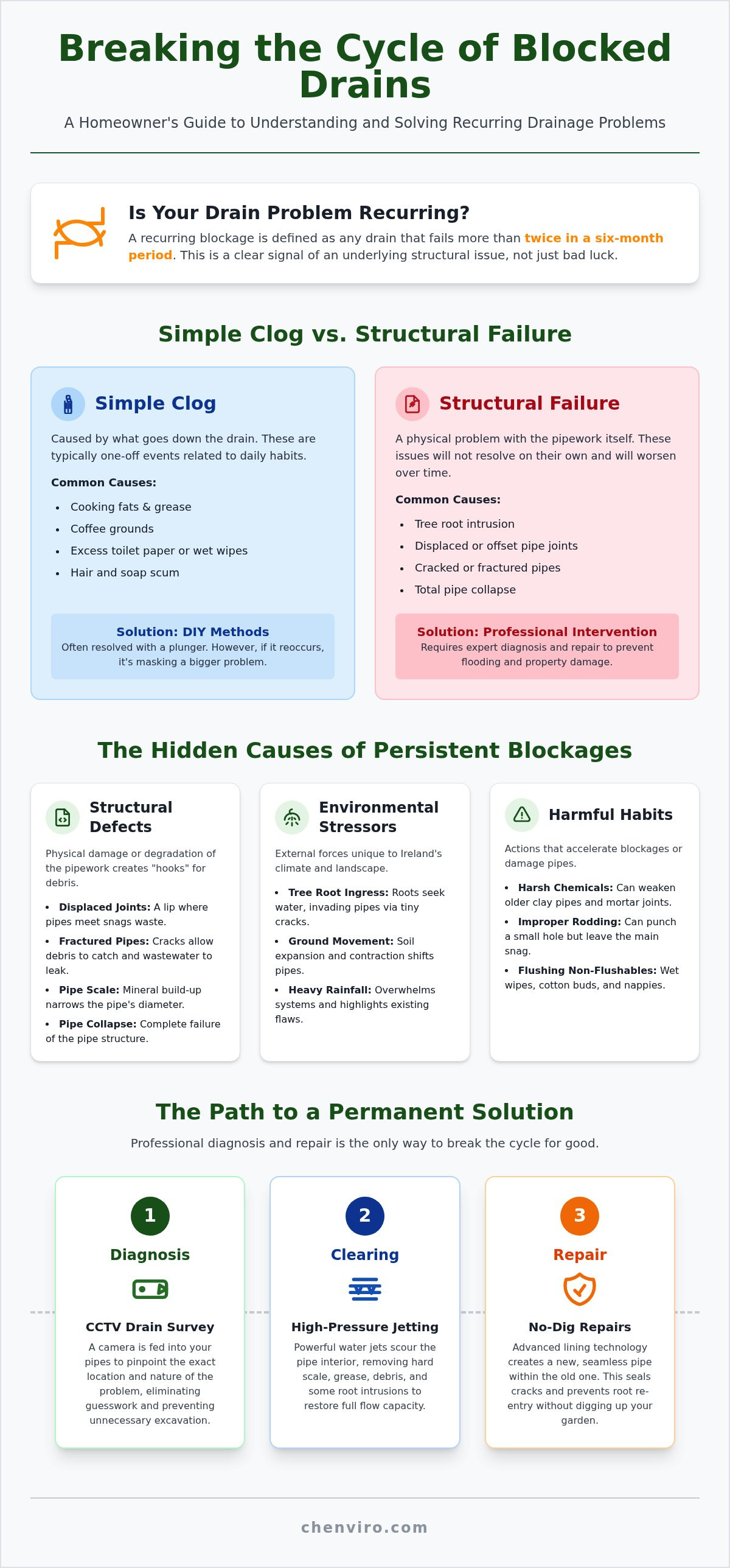
Many homeowners in Dublin and Meath find themselves in an exhausting cycle. You clear a sink or toilet on Saturday, only for it to back up again by the following month. We define a recurring blockage as any drain that fails more than twice in a six-month period. This isn't just bad luck; it's a clear signal that the underlying cause hasn't been addressed. Knowing when to call a professional for a blocked drain is essential when DIY methods provide only a few weeks of relief.
Recurring issues often stem from a snowball effect. A minor defect in the pipe, such as a tiny crack or a slightly displaced joint, acts as a hook. Over time, hair, grease, and debris catch on this point. Even if you flush the main mass away with a plunger, the "hook" remains. It starts collecting debris immediately, leading to another total blockage shortly after. This clear and repeat cycle is one of the most common frustrations for Irish homeowners, leading to wasted money on supermarket unblockers that never solve the actual problem.
The Difference Between a Clog and a Structural Failure
It's helpful to distinguish between a soft clog and a hard structural failure. Clogs are typically behavioural. They're caused by what we put down the sink, like cooking fats, coffee grounds, or wet wipes. A structural failure is a physical problem with the pipework itself, such as a collapse, a sag, or root ingress. While a plunger can shift a clog, it will never fix a pipe that has shifted or broken under your driveway. If the pipe is physically compromised, the water will eventually stop flowing regardless of how much force you apply.
Why Temporary Fixes Often Mask Larger Problems
Reaching for a set of drain rods or a bottle of chemical cleaner is a common first response. However, these often create a false sense of security. Rods might punch a small hole through the blockage, allowing water to drain, but they rarely remove the snagging point entirely. Additionally, high-strength chemical cleaners can be incredibly harsh. In many older Dublin properties, the drainage systems consist of clay pipes. Excessive use of chemicals can actually weaken these pipes or damage the mortar joints, turning a simple blockage into a costly repair job. If you find yourself unblocking the same pipe repeatedly, it's a sign that the temporary fix isn't reaching the root of the problem.
Structural Defects: The Hidden Reasons Drains Block Repeatedly
A recurring blockage is rarely an accident. While a one-off clog might be caused by too much toilet paper, a drain that fails every few months usually has a physical defect. Structural issues are "hard" problems. They won't go away with chemicals or plunging because the pipe's internal geometry has changed. Common culprits include heavy pipe scale, where minerals build up and narrow the passage, or fractured sections that allow wastewater to seep into the surrounding soil. When the pipe wall is no longer smooth, it becomes a magnet for debris.
The most severe structural issue is a total collapse. This often happens in older pitch fibre or clay pipes that have reached the end of their lifespan. Once a section of pipe caves in, no amount of jetting will restore the flow. The water simply has nowhere to go. Identifying these issues early is vital to prevent internal flooding and the high costs of emergency excavation.
Tree Root Ingress in Older Properties
In mature Dublin suburbs like Rathmines or Dun Laoghaire, tree roots are a primary cause of drainage failure. Roots are highly efficient at finding moisture. A tiny, hair-thin root can enter a pipe through a microscopic crack or a loose joint. Once inside, it feasts on the nutrient-rich wastewater and expands rapidly. This creates a literal net across the pipe. It catches grease, hair, and paper, leading to a total blockage. Cutting the roots out provides temporary relief, but they will grow back stronger. This is exactly when to call a professional for a blocked drain, as specialist equipment is needed to clear the intrusion and seal the entry point.
Ground Movement and Displaced Joints
Ireland's soil often expands and contracts with the seasons. This movement puts immense pressure on older clay pipes, which were common in Victorian-era construction. Over decades, these pipes can shift, leading to displaced joints. Even a 5mm "lip" at a joint creates a shelf where solids can snag. Once the first piece of debris catches, a blockage is inevitable. If your drains are backing up in the exact same spot regardless of what you flush, you likely have a displaced joint. A professional CCTV drain survey is the only way to see these hidden shifts without digging up your garden or driveway.
Behavioural Habits and Environmental Stressors in Ireland
While structural defects are often to blame for chronic issues, our daily habits and the unique Irish climate play a massive role in how often your pipes fail. Many homeowners inadvertently contribute to the "Fatberg" phenomenon. This happens when Fat, Oil, and Grease (FOG) are poured down the kitchen sink. Even if you use hot water and soap, these substances eventually cool and solidify deep within the pipework. They create a waxy, impenetrable wall that traps other debris, leading to a systemic issue that a simple bottle of drain unblocker won't touch.
Sometimes, the problem is baked into the property's design. Inadequate pipe gradient, or "flat drains," means the pipes don't have enough of a slope for gravity to do its job. In many housing developments across Kildare and Meath, these low-gradient pipes allow solids to settle rather than being washed away. This is exactly when to call a professional for a blocked drain, as we can use high-pressure equipment to clear the build-up that your standard plumbing simply can't move on its own.
The Impact of Heavy Rain and Storms
Ireland’s weather is a significant stressor for drainage systems. In older parts of Dublin and Wicklow, many properties rely on combined sewer systems that handle both wastewater and surface water. During a typical Irish downpour, these systems become rapidly overwhelmed. Heavy rain washes silt, grit, and garden debris into external gullies, which then settle in the main lines. You might notice your toilets acting strangely during a storm; heavy rain can force air back through traps, causing gurgling and foul odours to enter your home. If these symptoms persist after the rain stops, the system is likely partially restricted by washed-in debris.
Common Household Culprits in the Kitchen and Bathroom
The biggest myth in modern plumbing is the "flushable" wipe. Despite the marketing, these wipes do not break down like toilet paper. Instead, they snag on any internal roughness and become the foundation for massive blockages. In the kitchen, the cumulative effect of coffee grounds and "micro-fats" from plates creates a sludge that narrows the pipe's bore over time. In the bathroom, hair and soap scum act as a binding agent. Together, they form a reinforced plug that is incredibly difficult to shift without professional intervention. Changing these small behaviours can extend the life of your drainage system, but once the "plug" has formed, mechanical cleaning is usually the only permanent solution.
How to Diagnose a Persistent Drainage Problem for Good
Guessing is the most expensive way to manage a property. If you keep paying for emergency unblocking, you are essentially paying for a temporary bypass rather than a solution. One comprehensive diagnostic session is almost always more cost-effective than five separate emergency call-outs. Knowing when to call a professional for a blocked drain is about recognising that if the water stops flowing twice for the same reason, you need to see what is happening underground. A professional CCTV drain survey in Dublin removes the guesswork by providing a clear, visual record of your pipework's health.
A high-quality drainage report is more than just a video. It should include high-definition footage, a detailed site map of your drainage layout, and precise fault-finding data. We look for specific markers like water levels that indicate a sag in the pipe or "witness marks" that show where sewage has previously backed up. This data allows us to provide a fixed-price solution rather than an open-ended hourly rate for "trying" to clear a stubborn block.
What Happens During a CCTV Drain Survey?
The process is non-invasive and highly efficient. We use specialised high-definition cameras and, for larger lines, remote-controlled crawler units that travel through the system. This technology allows us to identify the exact location and depth of a fault, often to within a few centimetres. This level of precision is essential before buying a new home in Kildare or Meath. Many older properties have "inherited" issues that only a camera can spot. A survey ensures you aren't buying a collapsed pipe along with your new house.
Interpreting the Results: Is it a Blocked Drain or a Collapsed Pipe?
Once the footage is captured, we distinguish between simple debris and structural damage. If the camera reveals a mass of wet wipes or grease, a high-pressure clean is the answer. However, if we see a jagged edge or a wall of soil, we know the pipe has collapsed. A professional survey prevents unnecessary excavation by pinpointing the exact spot that needs attention, often allowing for a trenchless repair instead of digging up your entire driveway. After we have identified the root cause, we can move directly to a permanent fix. Book a CCTV survey today to stop the cycle of recurring blockages.
Professional Solutions: Breaking the Blockage Cycle with CH Enviro
Once a CCTV survey has identified the root cause of your drainage issues, the focus shifts to a permanent resolution. We don't believe in "quick fixes" that only last a few weeks. For many homeowners, the first step is high-pressure water jetting. This isn't just a standard power wash; it involves specialised nozzles that strip the internal pipe walls back to their original bore. This process removes years of accumulated scale, grease, and debris that traditional rodding simply cannot touch. For commercial property owners, investing in regular facility maintenance in Dublin is significantly cheaper than dealing with the fallout of a major sewer backup during business hours.
CH Enviro organises long-term drainage solutions for clients across Leinster, from the busy streets of Dublin to residential estates in Meath and Kildare. We understand that a blocked drain is a high-stress event. Our goal is to provide a straight-talking assessment and a fix that ensures you won't need to call us back for the same issue next month. Knowing when to call a professional for a blocked drain is the first step toward reclaiming your property's infrastructure.
No-Dig Repair: The Modern Alternative to Excavation
If the camera reveals a crack or a displaced joint, you don't necessarily need to dig up your garden. We specialise in no-dig drain repair in Dublin, a trenchless technology that creates a new pipe inside the old one. We insert a felt liner impregnated with a high-strength resin into the damaged section. Once cured, this liner forms a seamless, structurally sound pipe that is often stronger than the original. It is the favourite choice for Dublin driveways and landscaped gardens because it involves zero mess and zero excavation. These resin liners have a lifespan of several decades, effectively ending the cycle of recurring structural failures.
Preventative Maintenance and Expert Advice
After we have restored your flow, keeping it that way requires a few simple habit changes. Avoid flushing anything other than the "three Ps" (pee, poo, and paper). Even wipes labelled as flushable should go in the bin. For our commercial clients, particularly in the hospitality sector, regular grease trap maintenance is non-negotiable to prevent systemic blockages. If you're tired of temporary fixes and want a solution that lasts, contact CH Enviro for a professional drain unblocking service in Dublin. We have the technology and the local expertise to fix your drains for good.
Take Control of Your Home’s Drainage Today
Living with the constant threat of a backup is a stress no homeowner deserves. We have seen how simple clogs often hide deeper structural failures like root ingress or displaced joints. These issues don't fix themselves; ignoring them only leads to more expensive emergency repairs and potential internal flooding. By choosing a permanent solution over a temporary patch, you protect your property's infrastructure for years to come. Knowing when to call a professional for a blocked drain is the first step toward a clear, functioning system.
At CH Enviro, we use advanced CCTV technology for 100% accuracy in our diagnosis. As no-dig repair specialists, we have spent years serving communities across Dublin, Meath, and Kildare with reliable, trenchless solutions. You don't have to settle for unreliable quick fixes or the mess of traditional excavation. It's time to break the cycle and restore your peace of mind with a straight-talking assessment you can trust. Get a professional drain diagnosis from CH Enviro today and enjoy a home that flows exactly as it should.
Frequently Asked Questions
Why does my outside drain keep overflowing when it rains?
Outside drains typically overflow during heavy rain because of silt build-up or a combined sewer system that cannot handle the volume. Rainfall washes grit and garden debris into the gullies, which then settle and restrict the flow. If your drain gurgles or spills over only during storms, it suggests a partial restriction. You should clear external gullies regularly to prevent this debris from entering the main line and causing a total failure.
Can I use caustic soda to clear a recurring blockage?
You should avoid using caustic soda for recurring blockages as it can cause serious damage to your health and your pipework. While it might shift a minor grease clog, it won't fix structural issues like roots or displaced joints. In older Dublin properties, these chemicals can actually weaken the mortar in clay pipe joints. It's often safer and more effective to seek a professional mechanical clearing instead of relying on harsh chemicals.
How do I know if my drain has collapsed or is just blocked?
A collapsed drain typically results in a total blockage that returns almost immediately after being cleared. You might see soil, stones, or jagged debris in the wastewater, which are clear indicators of structural failure. Unlike a simple clog, a collapse will not be resolved by a plunger or chemicals. Knowing when to call a professional for a blocked drain is vital here, as a camera survey is the only definitive way to distinguish a collapse.
Are tree roots in drains a common problem in Dublin?
Tree root ingress is a very common issue in mature Dublin suburbs where large trees grow near older clay drainage systems. Roots hunt for the nutrient-rich water inside your pipes and enter through tiny cracks or loose joints. Once inside, they expand and act as a net for grease and paper. We frequently see this in established gardens, where the only permanent solution is specialist root cutting followed by a no-dig resin liner.
What is the most common cause of kitchen sink blockages?
The most common cause of kitchen blockages is the accumulation of Fat, Oil, and Grease (FOG). These substances look like liquids when hot but solidify into a waxy mass once they reach the cooler underground pipes. When mixed with food scraps or coffee grounds, they form an impenetrable plug. Using a grease trap and scraping plates into the bin is the best way to prevent these systemic issues from developing in your kitchen pipework.
Is Uisce Éireann responsible for my blocked driveway drain?
Uisce Éireann is generally not responsible for drains located within your property boundary that serve only your house. Homeowners in Ireland are typically responsible for the maintenance and repair of their own private drainage pipes. Uisce Éireann only takes over once the pipe leaves your boundary or joins a shared public sewer. If the blockage is located under your driveway or garden, it is almost certainly your responsibility to organise a repair.
How much does a CCTV drain survey usually cost in Ireland?
The cost of a CCTV drain survey in Ireland depends on the property type and the length of the drainage run being inspected. Most professionals offer a transparent rate for a standard domestic survey, which includes a full report and high-definition footage. While rates vary between providers, it remains the most cost-effective way to stop the cycle of recurring blockages. It's a small investment that prevents the much higher costs of unnecessary digging.
What items should I never flush down the toilet?
You should never flush anything other than the "three Ps": pee, poo, and paper. Items like "flushable" wipes, cotton buds, and sanitary products are leading causes of modern blockages because they do not break down in water. Even if a product is marketed as flushable, it often snags on internal pipe roughness and starts a build-up. Keeping a bin in the bathroom for these items is the simplest way to avoid a costly drainage emergency.


Comments