
Rats in Drains: How to Get Rid of Them in Dublin
What if the quickest way to deal with a rat near a drain is to establish whether it’s using the drain at all? If you’re searching for “rats in drains how to get rid of them Dublin”, it’s understandable to want an immediate fix. But scratching, smells or recurring blockages can raise concern without proving a rat is entering your home through the pipework.
Guesswork can waste time, and improvised treatments may create hazards or fail to address the source. Don’t handle suspected rats or put chemicals, bait or other materials into a drain. Note where and when you’ve seen activity, and keep people and pets away from the area.
This guide explains which observations may suggest a drain-related issue and what they can’t confirm. You’ll learn when a CCTV drain survey can help assess pipework, when vermin control is appropriate, and how drainage repairs can form part of the response if an access point is found. The aim is to help you choose a safe, proportionate next step in Dublin, rather than treating a suspected drain route as certain.
Table of Contents
Rats in Dublin drains: what signs suggest a drain-related problem?
A rat seen beside a drain can be alarming, but the sighting alone doesn’t show that it came from the pipework. It may have reached the spot by another route, so look for a pattern rather than drawing a conclusion from one moment. If you’re asking “rats in drains how to get rid of them Dublin”, start by recording what happened and where.
Suspected drain-related rat activity is a pattern of rodent signs repeatedly observed close to a drain or access point, not proof that a rat travelled through the pipework. The brown rat, also called the Brown rat (Rattus norvegicus), is commonly associated with drains and sewers. Identifying a likely species still won’t establish an individual animal’s route.
Separate what you notice indoors from activity outdoors. Inside, note where you hear noises, notice an odour or see signs of rodents, and whether they recur in the same room or near a particular fitting. Outside, record sightings near gullies, drain covers or other openings, as well as any visible activity around the property. These clues help describe the issue, but none confirms a damaged drain on its own.
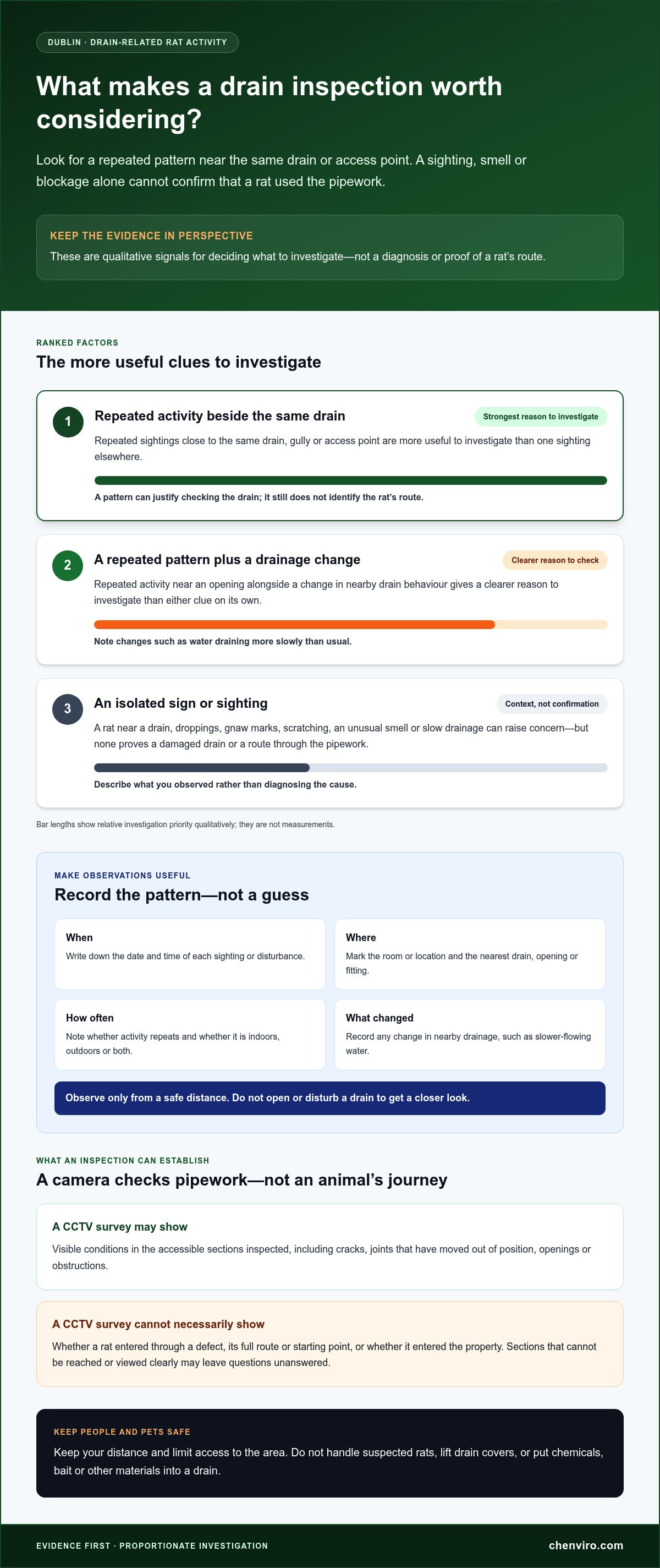
Write down the date and time of each sighting or disturbance.
Mark the location, including the nearest drain, opening or room.
Note whether activity repeats and whether it appears indoors, outdoors or both.
Record changes in drainage, such as water draining more slowly than usual.
Which signs make a drain inspection worth considering?
Repeated rat activity close to the same drain, gully or access point is more useful to investigate than a single sighting elsewhere. A recurring pattern may justify checking whether the drain could be contributing, but it still doesn’t identify the route. A rat outdoors could have arrived from a garden, neighbouring area or another opening. Note dates, exact locations and any changes in how nearby drains behave.
Be specific in your notes. “Rat near drain” is less helpful than “seen beside the rear yard gully at dusk on three evenings this week”. If you can observe safely from a distance, record which opening is nearby and whether activity appears to move towards or away from it. Don’t open or disturb a drain to get a closer look.
What can look like a drain problem without proving one?
Droppings or gnaw marks may indicate rodent activity nearby, but they don’t show that a rat used the drain. Scratching noises inside a home can have other causes, while an unusual smell may need separate investigation. Slow drainage can point to a blockage or another drainage issue, but it doesn’t by itself connect that issue to a rat.
Report what you’ve actually observed rather than diagnosing a cracked or displaced pipe from symptoms alone. Repeated activity near an opening alongside a change in drain behaviour gives a clearer reason to investigate than either clue in isolation. An inspection can assess pipe condition; observation alone can’t confirm it.
How rats may enter drains, and what a Dublin drain survey can establish
A defect or unsealed opening in drainage pipework may create a route between a drain and the surrounding area. Cracks, displaced joints or redundant lines left open are examples an inspection may look for. They are possibilities, not proof that rats have used a particular pipe. A rat spotted at ground level cannot show whether the drain is damaged or how the animal reached the spot.
A suspected drain route is an unconfirmed possibility; a route is supported by inspection evidence only when findings in the surveyed pipework point to a relevant opening or defect. Those findings need to be considered alongside where activity has been reported and which sections of the system could be inspected.
What drainage defects might an inspection look for?
A CCTV survey can examine accessible sections for visible issues such as cracks, joints that have moved out of position, openings or obstructions. These findings may help explain a drainage concern or identify a possible access point. They don’t automatically prove that a rat entered through it. Not every rat sighting is linked to defective drainage, so inspection should be guided by the reported symptoms rather than an assumption.
What can be seen depends on the condition and access of the pipework, as well as the scope of the survey. A section that can’t be reached or viewed clearly may leave questions unanswered. Before an inspection, describe the location of repeated activity and any changes in drainage so the investigation can focus on relevant areas.
What CCTV inspection can and cannot tell you
A camera survey provides a view of the pipe interior along the section inspected. It can show visible internal conditions and help identify defects that may need further attention. The footage is evidence about the pipework in view, not a record of an animal’s journey. It won’t necessarily establish the rat’s full route, its starting point or whether it has entered the property.
Think of the survey as one part of the investigation. If footage shows a relevant defect, drainage repair may be considered alongside vermin control when rodent activity is also evident. If the inspected section appears intact, that finding applies only to the area viewed; it doesn’t rule out another route elsewhere. This is why matching the survey scope to the reported location matters.
For people researching rats in drains how to get rid of them Dublin, the practical question is whether there’s enough reason to investigate the pipework, not whether a nearby sighting proves a drain defect. CH Enviro’s CCTV drain surveys help assess visible pipe conditions and inform the next step based on the findings.
Rat control or drain repair in Dublin: which response fits the evidence?
The right response depends on what’s been observed. Vermin control focuses on rodent activity; a CCTV drain survey investigates the condition of accessible pipework. These approaches address different parts of the problem, and both may be relevant if there’s evidence of activity as well as a drainage defect. Match the work to the findings rather than assuming every rat has come through a drain.
When is vermin control the immediate priority?
Repeated sightings or other rodent signs inside a home or business call for attention to the activity itself, especially if it is affecting occupied areas. CH Enviro’s vermin control service assesses reported rodent activity and provides targeted action. Don’t handle an animal, poison or traps yourself. If activity is also concentrated near a drain, record that detail so drainage investigation can be considered too.
Baiting alone doesn’t necessarily resolve an underlying route. If an inspection identifies a defect that may be contributing to access, treating rodent activity without addressing that defect could leave a possible entry point in place. Equally, finding a defect doesn’t automatically prove rats are using it. Let the evidence guide whether one response or both are appropriate.
When should drainage investigation or repair be considered?
Recurring drain-related signs, changes in drainage or a suspected pipe defect can make investigation worthwhile. A CCTV survey can help establish whether an accessible section has a visible obstruction or defect. If there’s a blockage, CH Enviro’s drain unblocking service may be relevant; repair is considered when inspection identifies a defect that needs attention. Unblocking clears an obstruction, but it isn’t a substitute for repairing damaged pipework.
For the question “rats in drains how to get rid of them Dublin”, think in terms of evidence and distinct tasks: vermin control addresses rodent activity, while a survey examines pipe condition. Where both findings matter, coordinating these responses can address the animal activity and a potential contributing drainage issue. The reported signs and inspection findings determine the suitable next step.
Suspected Rats in Drains: A Safe Step-by-Step Plan
Stay calm and keep your distance. You don’t need to identify the rat’s route or inspect the drain yourself. A clear record of what you’ve noticed can help an assessment focus on the right location and whether the concern is mainly rodent activity, drainage, or both.
Keep people and pets away. Don’t approach, touch or try to capture a rat. If there are signs inside, keep children and pets out of the affected area.
Record what you see and hear. Note the date, time and exact location of each sighting or disturbance. Include whether activity is indoors, outdoors or close to a particular drain opening, and whether it has happened more than once.
Limit access without disturbing the drain. Keep clear of the area and don’t lift or move drain covers, enter drainage infrastructure, or try to block an opening yourself.
Avoid improvised treatments. Don’t pour chemicals into drains or toilets, or place poison or bait in the drainage system. These actions can create additional hazards and won’t establish or fix a possible access route.
Arrange an assessment. Share your observations so the response can be matched to the reported signs. Repeated activity inside a home or business, or a situation that presents an immediate safety concern, warrants prompt professional help.
What should you do before professional help arrives?
Keep the affected area clear and observe only from a safe distance. If the rat disappears, don’t follow it into a confined space or try to locate it by opening a drain. You can note visible changes, such as water draining differently or an overflow, without touching the area. Don’t use household chemicals, flush bait or poison down a toilet, or interfere with a drain cover.
What information helps the initial assessment?
Give a practical account, not a diagnosis. Say whether the property is residential, commercial or part of a managed building, and describe where and when the activity occurred. Mention whether it has recurred and whether it was seen near an indoor fitting, an outdoor gully or another opening. If you know of a blockage, overflow or visible damage, include that too, but treat it as an observation rather than proof of a rat route.
For anyone searching “rats in drains how to get rid of them Dublin”, these notes help distinguish a one-off sighting from a recurring concern and give an assessment a useful starting point. If you’ve recorded repeated activity or have a drainage concern, arrange a vermin control or drainage assessment to identify a proportionate next step.
How CH Enviro Investigate Rats in Drains in Dublin
Suspected rat activity beside a drain needs a practical assessment, not an assumption about where the animal came from. CH Enviro provides vermin control and drainage services in Dublin, Meath, Louth, Kildare, Wicklow and Wexford. The next step depends on the signs you report and what any inspection identifies.
The process starts with the details of the concern: where activity has occurred, how often it has happened, and whether there are related drainage symptoms. Repeated rodent activity may call for vermin control. If the location or symptoms suggest the pipework should also be examined, a CCTV drain survey can assess visible conditions in the section inspected. The findings help determine whether further drainage work is relevant.
How drainage and vermin control can work together
Rodent activity and a drainage defect are different issues, so they may need separate but coordinated responses. Vermin control focuses on the reported rodent activity; drainage investigation looks at pipe condition. If the evidence indicates both are relevant, addressing each can help avoid treating activity alone whilst overlooking a possible drainage concern.
A CCTV survey may identify an obstruction or visible defect in the inspected section. Drain unblocking is relevant when a blockage is affecting flow. If inspection identifies a defect that needs repair, a no-dig repair may be considered where appropriate. These aren’t automatic steps: the reported symptoms and inspection findings guide what work is suitable. CH Enviro’s drainage services include investigation and repair options matched to the issue found.
What to include when you get in touch
Useful details help set the assessment in the right direction. Share the property location in Dublin, Meath, Louth, Kildare, Wicklow or Wexford, where near the drain activity was noticed, and whether it happened once or repeatedly. Include any related symptoms, such as recurring blockages or changes in drainage, and say whether the property is residential, commercial or managed. These observations guide the discussion; they don’t, by themselves, confirm a rat route or damaged pipe.
If you’re unsure whether the concern calls for vermin control, a drain survey or both, explain what you’ve seen rather than trying to diagnose it. An assessment can focus on the reported signs and identify a proportionate next step. The aim is to establish what the evidence supports and choose the relevant service.
For help with suspected rats in drains how to get rid of them Dublin, contact CH Enviro and describe the drain concern. A clear account of the location, timing and any drainage symptoms is a useful place to start.
Take the next step towards a clear answer
Uncertainty can be more stressful than the sighting itself. You don’t need to work out the rat’s route before seeking help. Start with what you know: where activity occurred, whether it has happened again, and what you’d like assessed. That gives the conversation a practical starting point and helps keep the next step proportionate to the evidence.
If you’re still asking “rats in drains how to get rid of them Dublin”, focus on finding out whether the concern needs vermin control, drainage work, or both. CH Enviro provides these services, with CCTV surveys to investigate pipe condition and unblocking or no-dig repairs where relevant.
Contact CH Enviro about suspected rats in your drains and share what you’ve observed. A clear assessment can replace guesswork with a practical way forward.
Frequently Asked Questions
Can rats come up through a toilet in Dublin?
It’s possible for a rat to enter a building through a drainage route, but a rat seen near a toilet doesn’t prove it came up through the bowl. If you see one in a bathroom, keep away, close the room off if safe to do so, and don’t try to catch or flush it. Record where it was seen and whether there are signs elsewhere, then arrange an appropriate assessment.
Does pouring bleach down a drain get rid of rats?
No. Bleach won’t reliably remove a rat or establish how it entered the drainage system, and pouring chemicals into a drain can create a separate hazard. Never mix bleach with other cleaners, as some combinations can release dangerous fumes. If you’ve already poured a product down the drain, don’t add anything else; follow the product label and keep people away from any fumes or splashes.
Can rats chew through drain pipes?
Rats can gnaw materials, and damaged pipework may show signs of gnawing, but that doesn’t mean every pipe can be chewed through or that a nearby rat caused the damage. Pipe material and condition matter. If you notice visible damage or recurring drainage problems, avoid handling the area and arrange an inspection. A CCTV survey can show visible conditions inside the section examined.
Will unblocking a drain get rid of rats?
Not necessarily. Unblocking clears an obstruction that is affecting drainage, but it doesn’t automatically remove a rat or repair a defect that might provide access. For example, if water flow improves after a blockage is cleared but rat activity continues, the two concerns may need separate assessment. The answer to “rats in drains how to get rid of them Dublin” depends on whether evidence points to rodent activity, a drainage issue, or both.
Who is responsible for a drain or sewer problem in Dublin?
It can’t be determined from the location alone. The relevant responsibility may depend on where the affected pipe is and how the property’s drainage is arranged. If you rent or live in a managed building, report the issue to your landlord or property manager and share the location and symptoms. For other properties, establish which section is affected and seek guidance from the relevant owner or authority before arranging work.
Should I put rat poison down a drain?
No. Don’t put poison or bait down a drain or toilet. It may not reach the animal, can create risks for wildlife or other animals, and won’t identify or repair a possible access point. Rodenticide use is subject to controls in Ireland, so don’t improvise with products or place them where animals or children could reach them. Keep clear of the drain and arrange a safe assessment.


Comments