
Commercial Drainage Maintenance in Dublin: A 2026 Buying Guide
A drainage plan should reflect how your premises are used, not just list standard call-outs. For commercial drainage maintenance, Dublin businesses need an approach that accounts for their drainage assets, site activity and access arrangements. A blockage or recurring fault can disrupt staff, customers and daily operations, while a quote may not make clear what prevention, inspections or repairs actually cover. This guide focuses on commercial drainage maintenance Dublin businesses can plan around.
It’s reasonable to want fewer surprises and a clear response when something goes wrong. This guide explains how planned maintenance differs from reactive support, what a useful service scope can include and how to match inspections and cleaning to your premises. You’ll also learn how CCTV drain surveys can help identify issues and inform decisions about cleaning or repair, including no-dig options. The aim is a practical, site-specific plan with a clear scope and a sensible path from early warning signs to remedial work.
Table of Contents
Why commercial drainage maintenance in Dublin needs a planned approach
How to assess drainage assets and maintenance risks at your Dublin site
How to compare commercial drainage maintenance services in Dublin
How to build a practical drainage maintenance plan for your Dublin premises
How CH Enviro supports commercial drainage maintenance in Dublin
Why commercial drainage maintenance in Dublin needs a planned approach
A drainage fault can do more than slow a sink. It may affect access, create hygiene concerns or interrupt work while staff deal with a blocked drain or wastewater issue. Planned maintenance helps businesses organise inspection and routine care around the site, rather than relying only on a call-out once a problem becomes disruptive.
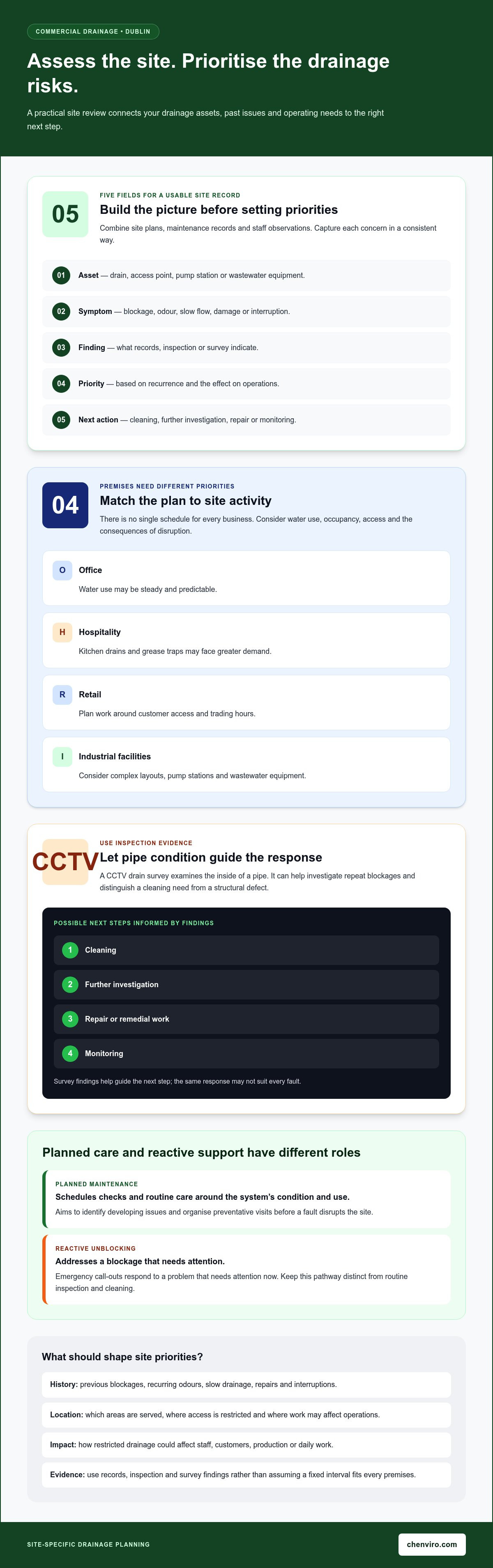
Reactive unblocking has a clear purpose: it addresses a blockage that needs attention. Planned maintenance is different. It schedules checks and care according to the drainage system’s condition and use, with the aim of identifying developing issues. For a general introduction to how water is collected and moved, see these drainage principles.
What planned drainage maintenance is designed to do
A useful plan starts with an understanding of the drains and related equipment serving the premises. Review past blockages, slow drainage, odours, repairs and interruptions, then decide whether inspection, cleaning or further investigation is appropriate. A CCTV drain survey can help assess underground pipes and investigate recurring problems. Its findings can inform the next step, rather than treating every issue as a simple blockage.
Preventative visits check and care for drainage before a fault disrupts the site; emergency call-outs respond to a problem that needs attention now. A plan should make both pathways clear. It should also set out the tasks included, how work and findings are recorded, who receives updates, and how urgent issues are reported and prioritised.
Which Dublin commercial premises may need tailored planning
There’s no single schedule that suits every business. An office may have steady, predictable water use, whilst a hospitality site can place greater demand on kitchen drains and grease traps. Retail premises may need work arranged around customer access and trading hours. Industrial facilities can have more complex layouts, pump stations or wastewater equipment to consider.
Occupancy, water use, the type of activity on site and the consequences of restricted operations all help shape priorities. The drainage layout matters too: access points, pipe routes and equipment locations affect what can be inspected and maintained efficiently. A site with recurring blockages may need a different scope from one with no known issues. Let the evidence guide the approach rather than assuming a fixed interval will suit every premises.
For commercial drainage maintenance Dublin businesses can manage effectively, define the scope around actual site needs. Record the assets, relevant history, planned tasks and inspection findings. Review the plan when operations change or new drainage issues appear. This gives facilities teams a practical basis for deciding what needs attention and when.
How to assess drainage assets and maintenance risks at your Dublin site
A useful maintenance plan starts with a clear picture of what the site contains and where problems have occurred. Map known drains, inspection chambers and access points, along with pump stations and wastewater equipment. Note which business areas each asset serves, where access is restricted and which parts of the premises would be hardest to operate if drainage were interrupted.
What to include in a commercial drainage asset review
Use available site plans, maintenance records and staff observations to build the picture. Record previous blockages, recurring odours, slow drainage, repairs and operational interruptions. Include where and when symptoms appeared, what action was taken and whether the issue returned. This history can help distinguish a one-off blockage from a recurring problem that needs closer investigation.
Mark sensitive areas such as kitchens, customer facilities, production spaces or busy access routes. Their importance depends on the work carried out at the premises: an issue affecting a staff washroom may have different operational consequences from one affecting a process area or customer entrance. Consider access arrangements and operating schedules when planning inspection or cleaning, so the work can be organised with disruption in mind.
When a CCTV drain survey can inform the plan
A CCTV drain survey examines the inside of a pipe and can help investigate repeat blockages or other drainage concerns. It provides evidence about pipe condition, helping distinguish a cleaning need from a structural defect that may require repair. Findings can guide whether the next step is cleaning, remedial work or monitoring, rather than assuming the same response will suit every fault. Read more in this CCTV drain survey guide for Dublin.
Keep the assessment usable. For each concern, capture:
Asset: drain, access point, pump station or wastewater equipment.
Symptom: blockage, odour, slow flow, damage or interruption.
Finding: what records, inspection or survey indicate.
Priority: based on recurrence and the effect on operations.
Next action: cleaning, further investigation, repair or monitoring.
This simple record gives facilities teams a practical basis for prioritising commercial drainage maintenance at Dublin sites and reviewing decisions as new findings emerge. CH Enviro provides drainage support informed by site conditions. Explore CH Enviro’s commercial drainage services.
How to compare commercial drainage maintenance services in Dublin
A useful comparison looks beyond the visit itself. Check what the proposed scope covers, how the condition of the drains will be assessed, what records you’ll receive and how findings can lead to further work. These details help distinguish planned cleaning and inspection from a separate unblocking call-out or structural repair.
What a useful service scope should make clear
The scope should identify the drainage assets and tasks included for your site, rather than rely on a generic description. It should also set out relevant access arrangements, operating constraints and how work will be organised to limit disruption. Keep inspection recommendations distinct from work completed during the visit: a survey may identify a repair need, but that doesn’t mean the repair is part of routine maintenance.
Scope: Which drains, access points and related equipment are covered, and which tasks are included?
Inspection method: Is the visit based on visual checks, a CCTV survey or another stated method suited to the issue?
Reporting: What findings, actions taken and follow-up recommendations will be recorded?
Scheduling: How will planned work fit the site’s access needs and operating hours?
Remedial pathway: How are additional cleaning, unblocking or structural repairs identified and handled?
Compare like with like. Routine cleaning, investigation of recurring symptoms, an urgent response and structural repair address different needs. Treating them as interchangeable can make a quote hard to assess. For wider property-care context, see the Dublin facility maintenance guide.
How to compare reporting and follow-up
Clear records make the service useful after the visit is over. Look for an understandable account of the assets inspected, the condition observed, work completed and recommended next steps. This gives facilities teams a basis for prioritising follow-up, tracking recurring faults and updating maintenance records.
Where a CCTV survey identifies a defect, the findings can help inform whether further investigation or repair is appropriate. Depending on the condition and location, a no-dig repair may be considered to address pipe damage without excavation. The evidence should guide that decision; a camera inspection is not itself a repair.
Agree response times and service-level commitments for the specific arrangement rather than assuming them from a general service description. CH Enviro connects survey findings with relevant cleaning or remedial work for commercial drainage maintenance at Dublin premises. Explore CH Enviro’s drainage services.
How to build a practical drainage maintenance plan for your Dublin premises
Turn your asset review and maintenance records into a working plan. The aim isn’t to apply the same schedule to every site. It’s to decide what needs attention, why it matters and how the work can fit around daily operations.
A site-led sequence for setting maintenance priorities
List the assets. Bring together known drains, access points, pump stations and wastewater equipment, noting which parts of the premises they serve.
Review site history. Record recurring blockages, odours, slow drainage, previous repairs and operational interruptions. Give added weight to issues that have returned or affected important work areas.
Use inspection findings. Where a CCTV survey has been carried out, use its findings to distinguish a cleaning need from pipe damage that may require remedial work. Avoid scheduling a repair based on symptoms alone if further investigation is needed.
Set priorities and tasks. Decide which assets need routine cleaning or inspection, which need a corrective visit and which require further assessment. Base priority on the evidence and the consequences of disruption at your site.
Schedule, record and review. Arrange agreed work, keep a record of what was completed and note recommendations. Review the outcome after the work and decide whether the plan needs to change.
This sequence makes commercial drainage maintenance Dublin premises can act on easier to manage: decisions follow site conditions rather than an unsupported universal visit frequency. If a kitchen is part of the premises, include grease traps and catering drainage in the asset review. The commercial grease trap maintenance guide covers this area in more detail.
Coordinate visits with business operations
Before each visit, document access points, restrictions, operating hours and the relevant site contact. Note which areas may need to remain clear or accessible, and share practical instructions with the people responsible for the premises. This helps organise work around staff, customers, deliveries or production activity, rather than leaving access arrangements to be resolved on arrival.
Afterwards, keep visit records and recommendations with the facilities or property maintenance information. Include completed tasks, findings and follow-up actions, so the next decision can draw on what has already been observed. Review priorities when repairs are completed, new symptoms emerge or the way the premises operates changes.
Find more information about a site-specific approach in CH Enviro’s drainage maintenance services.
How CH Enviro supports commercial drainage maintenance in Dublin
A practical maintenance approach links the condition of the site’s drainage assets to the work they need. CH Enviro provides drainage, plumbing and facility management solutions for commercial and industrial clients in Dublin, Meath, Louth, Kildare, Wicklow and Wexford. Its services include investigation, unblocking and repair, helping businesses choose next steps based on findings rather than treating every issue alike.
Connecting inspection findings with the right drainage work
A CCTV drain survey can investigate recurring symptoms or assess internal pipe condition. Its findings help clarify whether a problem points to a blockage, a need for cleaning or possible pipe damage that warrants further attention.
Each service has a distinct role. Drain unblocking addresses an obstruction affecting flow. A no-dig drain repair may be suitable for certain types of pipe damage, with the appropriate approach depending on the condition identified. Inspection findings can inform that decision, but the right work depends on the site and the issue being addressed.
Other parts of a premises may call for related support. A commercial kitchen may need grease trap cleaning and maintenance, whilst a site relying on wastewater treatment equipment or pump stations may need attention to those assets as part of its wider drainage planning. Include them where they form part of the site’s system and operational needs.
Taking the next step with CH Enviro
To discuss a site-specific approach, start with a short summary of your premises, known drainage assets and recurring concerns. Note any previous blockages or repairs, which areas are most affected by disruption, and any access or operating constraints that could shape a visit. This gives a useful starting point for discussing scope and scheduling around the site.
CH Enviro provides drainage work suited to the premises and the issue identified. The next step may involve a CCTV survey, unblocking, a suitable no-dig repair or maintenance of relevant wastewater equipment. The aim is to connect the work to the site’s assessed needs, making commercial drainage maintenance for Dublin businesses more specific and practical.
Put a site-specific drainage plan into action
A reliable plan starts with your premises, not a standard maintenance timetable. Use site history and inspection findings to set priorities, define what routine visits cover, and agree how urgent issues and follow-up work will be handled. Clear records help facilities teams make informed decisions as conditions or operations change.
For commercial drainage maintenance Dublin businesses can plan around, match the response to the problem: unblocking tackles obstructions, CCTV surveys help investigate pipe condition, and no-dig repairs may address suitable damage. Grease trap maintenance and pump station support can also be relevant where those assets serve the site.
CH Enviro provides drainage and environmental maintenance services for commercial and industrial premises in Dublin, Meath, Louth, Kildare, Wicklow and Wexford. Share a brief outline of your site, known drainage assets and recurring concerns to start a practical discussion about suitable scope and scheduling. Discuss commercial drainage maintenance with CH Enviro and take the next step towards a clearer plan for your premises.
Frequently Asked Questions
What does commercial drainage maintenance include?
Commercial drainage maintenance can include planned cleaning, inspection and follow-up work suited to the premises. The scope may cover drains and access points, with CCTV surveys used to investigate pipe condition or recurring issues. If findings point to an obstruction, unblocking may be needed; identified pipe damage may call for repair. For commercial drainage maintenance in Dublin, define which assets and tasks are included, and how findings and recommendations will be recorded.
How often should commercial drains be maintained?
There’s no single interval that suits every commercial site. The appropriate schedule depends on factors such as the drainage layout, how the premises are used, previous blockages and inspection findings. A site with recurring problems may need a different plan from one without known issues. Review the schedule after work is completed, when conditions change or if symptoms return, rather than relying on an assumed universal frequency.
Can a CCTV drain survey help plan commercial drainage maintenance?
Yes. A CCTV drain survey can show the internal condition of pipes and help investigate recurring blockages, slow drainage or other concerns. The findings can help distinguish a cleaning need from possible structural damage that may require further investigation or repair. A survey can also provide a clearer basis for prioritising follow-up work. It doesn’t replace cleaning or repair; it helps inform which response may be appropriate.
What is the difference between planned maintenance and emergency drain unblocking?
Planned maintenance is scheduled inspection and care based on site needs, whilst emergency drain unblocking addresses an obstruction that requires prompt attention. They serve different purposes. A maintenance visit may identify a developing concern or recurring issue; an unblocking service focuses on restoring flow through an affected drain. A practical drainage plan sets out routine tasks as well as how the business reports urgent problems and organises follow-up work.
How can a Dublin business minimise disruption during drainage maintenance?
Share access instructions, operating constraints and relevant site contacts before work is arranged. Identify areas that need to remain accessible, such as customer routes, kitchens or production spaces, and discuss a suitable time for the visit around site activity. After the work, keep a record of tasks completed, findings and recommendations. Facilities teams can use these notes to coordinate follow-up work and retain useful information between visits.
Should commercial drainage maintenance include grease traps and pump stations?
Include them in the site plan if they’re part of the premises’ drainage or wastewater system. Food service sites may need grease trap cleaning and maintenance, whilst premises with pump stations or wastewater treatment equipment may need those assets considered in their maintenance planning. The scope should reflect the equipment present and how the site operates. CH Enviro provides grease trap maintenance, wastewater treatment services and pump station repairs.
When should a business arrange a CCTV drain survey rather than routine cleaning?
Arrange a CCTV survey when the pipe condition needs investigating, particularly if blockages recur, drainage remains slow after cleaning or there’s a concern about possible damage. Routine cleaning removes build-up; it doesn’t show the full internal condition of a pipe. Survey findings can help determine whether cleaning is sufficient or if further investigation or repair should be considered. CH Enviro serves commercial and industrial premises in Dublin, Meath, Louth, Kildare, Wicklow and Wexford.


Comments