
Expert Pump Station Repair Ireland: Reassuring Solutions for Leinster Facilities
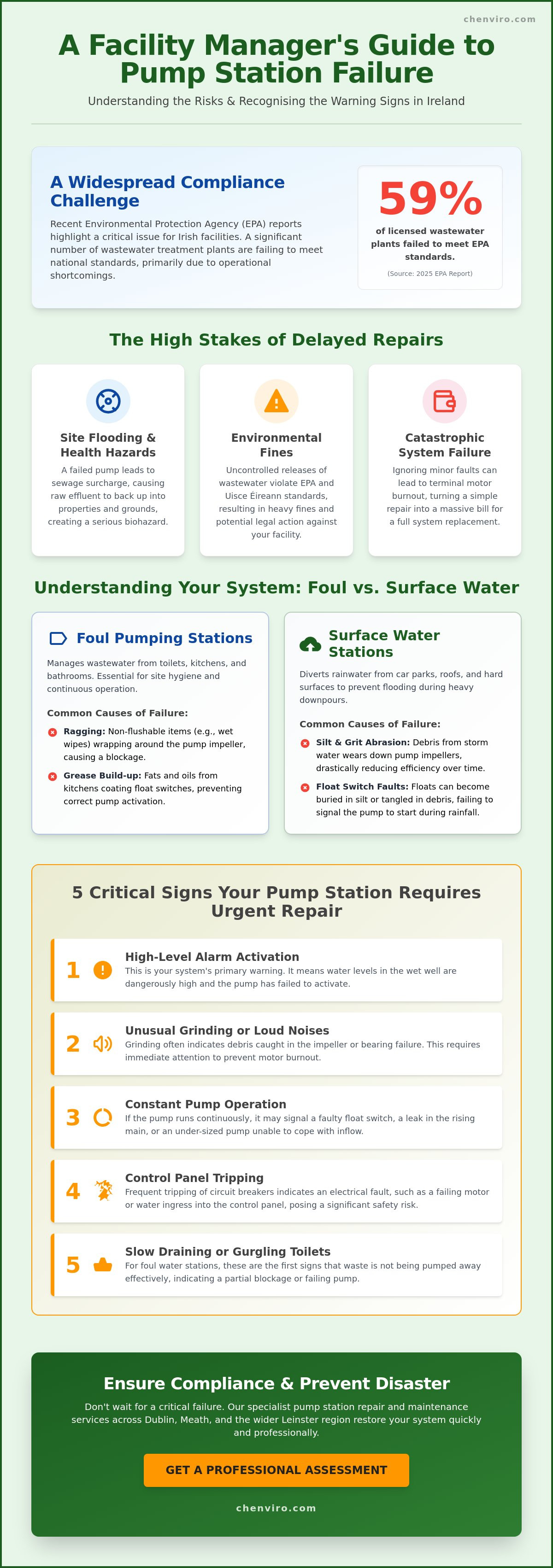
Did you know that 59% of Ireland's licensed wastewater treatment plants failed to meet EPA standards in 2025, largely due to poor operational management? This statistic highlights a critical reality for facility managers across the country. Neglecting your infrastructure leads to failure. If you've heard that high-pitched alarm ringing from your control panel, you already know the sinking feeling of a sudden blockage. You're likely worried about the risk of raw sewage flooding your site or the massive bill that comes with a total system replacement.
Finding reliable pump station repair Ireland shouldn't be a gamble, especially when recent regulations like the March 2026 Small Wastewater Discharge Register demand strict compliance. This guide provides a straight-talking approach to identifying pump station failures and securing professional repairs across Dublin and Leinster without the hidden costs or technical jargon. We'll walk you through the common signs of trouble, how to meet Uisce Éireann standards, and how to restore your wastewater flow quickly and transparently.
Key Takeaways
Learn why ignoring a high-level alarm can lead to costly environmental fines and site flooding.
Understand the differences between foul and surface water stations to better communicate your needs to a specialist.
Identify the five critical warning signs, such as unusual grinding noises or control panel tripping, that indicate you need pump station repair Ireland.
Discover how professional diagnostics, including CCTV surveys and electrical testing, ensure your pump is repaired rather than unnecessarily replaced.
Get insights into securing reliable wastewater management services across Dublin, Meath, and the wider Leinster region.
Table of Contents
Why Pump Station Repair in Ireland Cannot Be Delayed
Think of your wastewater system as a living organism. In this analogy, Pumping stations act as the heart. They are responsible for pushing foul waste and surface water away from your property and into the main sewer network. When this heart stops beating, the entire system fails. Ignoring a high-level alarm or a strange noise from the wet well is a gamble you shouldn't take. Delaying pump station repair Ireland often turns a minor electrical fault into a catastrophic environmental event.
Ireland’s weather plays a significant role in how these systems behave. Our frequent heavy rainfall puts immense stress on storm water pumping systems. Whilst a foul pump handles a relatively consistent flow, a storm pump must be ready to move thousands of litres of water during a sudden downpour. If the pump is sluggish or blocked, you'll see surface water rising in car parks or around foundations almost instantly. There is a clear line between a simple blockage caused by "unflushables" and a terminal mechanical failure. Professional diagnostics identify which one you're facing, saving you from replacing a motor that just needed a clear-out.
The Risk of Sewage Surcharge and Flooding
When a foul pump fails, the waste doesn't just stop; it starts to back up. This leads to immediate issues with toilets not flushing and drains gurgling. If left unaddressed, you face the risk of untreated effluent entering your building or garden. This isn't just a nuisance; it's a genuine health hazard for residents and staff. A sewage surcharge is the point where a system can no longer contain its volume, causing effluent to spill out into the surrounding area. Preventing this through timely repair is far cheaper than the biohazard clean-up costs that follow a major overflow.
Environmental Compliance and EPA Standards
The Environmental Protection Agency (EPA) and Uisce Éireann have strict standards for wastewater management. According to the 2025 EPA reports, 59% of licensed treatment plants failed to meet standards, often due to poor operational management. If your facility causes an "uncontrolled release" because of a faulty pump, you could face heavy fines and legal action. Maintaining a detailed Pump Station Maintenance Log is now a requirement under the Uisce Éireann Code of Practice. Professional repair documentation isn't just a receipt; it's a vital piece of evidence for your next facility management audit, proving you've met your environmental obligations.
Understanding Your System: Foul vs. Surface Water Stations
Identifying whether you are dealing with foul waste or surface water is the first step in effective pump station repair Ireland. Most facility managers only consider their system when the alarm panel starts flashing. But the repair approach for these two systems differs significantly. While both rely on submersible pumps, float switches, and control panels, the liquid they move dictates the specific maintenance strategy required to keep things flowing.
Foul Pumping Stations (Sewage)
Foul stations manage waste from kitchens, bathrooms, and toilets. These systems are critical for hygiene, and any delay in pump station repair Ireland can lead to immediate property damage. In many Irish domestic and commercial setups, macerator pumps are essential to grind solids before they enter the rising main. The most common issue we encounter is "ragging." This occurs when non-flushable items like wet wipes or sanitary products wrap around the pump impeller. Grease build-up from kitchen sinks also presents a major challenge, often coating float switches and preventing them from triggering the pump. If you suspect a blockage is causing your system to back up, a professional CCTV drain survey can pinpoint the obstruction without the need for immediate excavation. We handle these repairs with strict hygiene protocols to manage the risks of untreated effluent.
Surface Water and Attenuation Systems
Surface water stations divert rainwater from car parks, roofs, and hardstanding areas into the local network or attenuation tanks. Unlike foul systems, these stations face high volumes of silt, grit, and stones, especially during intense Irish winter storms. This grit acts as an abrasive, wearing down impellers and reducing pump efficiency over time. The primary cause of storm pump failure is often simple: float switch calibration. If a float becomes buried in silt or tangled in debris, the pump won't activate when the water rises. High-level alarms are your first line of defence here. They provide a critical warning before a heavy downpour turns your car park into a flood zone. Repairing these systems usually involves thorough desilting of the wet well and precise recalibration of the switching gear to ensure reliable performance when the next storm hits.
5 Critical Signs Your Pump Station Requires Urgent Repair
If you're staring at a flashing red light on your control panel, you don't have time for vague advice. You need to know if your system is about to fail. Recognizing the early warning signs of a breakdown can be the difference between a simple component fix and a total system overhaul. Professional pump station repair Ireland often starts with identifying these five common red flags before they escalate into a site-wide emergency.
Persistent high-level alarms: If the "High Level" light stays on, the chamber isn't emptying fast enough.
Unusual noises: Grinding, loud humming, or excessive vibration usually indicates a mechanical struggle.
Foul odours: Lingering smells of sewage around the station covers suggest stagnant waste that isn't being moved.
Slow drainage: If toilets and sinks across the building are sluggish even after pipes are cleared, the pump station is likely the bottleneck.
Visible pooling: Water gathering around the station during dry weather often points to a leak in the rising main or a failed seal.
Many facility managers make the mistake of assuming a noisy pump just needs more time. In reality, a pump that hums without moving water is likely "dead-headed." This means it's running against a blockage or a closed valve. If you don't act quickly, the motor will overheat and burn out, turning a repair job into an expensive replacement project.
Interpreting Control Panel Alarms
Your control panel is the brain of the system. A "High Level" alarm means the water has reached a critical point and the pumps aren't keeping up. A "Pump Fault" or "Trip" light usually means the electrical circuit has cut out to protect the motor. Our straight-talking advice is simple: do not just silence the alarm and walk away. Whilst a single reset might work if a float switch was temporarily stuck, a recurring alarm is a clear cry for help. If the alarm returns within 24 hours, call for pump station repair Ireland immediately to prevent a sewage surcharge.
Mechanical Red Flags in the Wet Well
You can often diagnose a problem just by listening. A healthy pump has a consistent, low-frequency hum. If you hear a high-pitched squeal or a rattling sound like marbles in a tin can, the bearings are likely worn. You can safely check for "ragging" by looking for debris caught around the guide rails or the pump lifting chains without entering the confined space. Worn bearings or a partially blocked impeller put massive strain on the motor. Identifying these mechanical issues early allows us to refurbish the unit on-site, which is far more cost-effective than waiting for the entire unit to seize.
The Professional Repair Process: From CCTV to Component Fixes
Effective pump station repair Ireland requires a methodical diagnostic process. We don't believe in guessing. Pulling a pump from a wet well is a heavy, time-consuming job that isn't always necessary. Our first step is to determine exactly where the failure lies. By starting with the easiest fixes and moving toward complex mechanical work, we ensure you aren't paying for parts or labour you don't actually need. This transparent approach builds trust and keeps your facility running without unnecessary downtime.
Diagnostic CCTV Surveys
Integrating CCTV drain surveys into the standard repair workflow is a game-changer. Often, a "pump failure" isn't a mechanical issue at all. It's frequently a blocked inlet pipe that prevents waste from reaching the wet well in the first place. We use high-definition cameras to verify the path is clear before we touch the electrical components. This diagnostic stage also allows us to inspect the structural integrity of the chamber. Whether it's a concrete ring or a plastic tank, we look for structural cracks or root ingress that might be allowing groundwater to seep in. If your station is constantly running, it might be trying to pump out the local water table through a hairline fracture in the tank wall.
Electrical and Mechanical Restoration
Once we've confirmed the pipes are clear, we move to electrical testing. This involves checking capacitors, contactors, and thermal overloads within the control panel. Replacing float switches is the most cost-effective way to restore a system, yet it's often overlooked by less experienced contractors. These switches are the "eyes" of your pump; if they're coated in grease or tangled, the pump won't know when to start or stop. We also perform a mechanical overhaul if the motor is struggling. This includes removing the pump to clean the impeller or replace worn seals before moisture can enter the motor housing.
We also address a threat that many competitors ignore: vermin damage. Rodents are a common problem in Irish wastewater systems. They find their way into the risers and gnaw through cables, leading to intermittent faults or total power loss. This is why we offer integrated vermin control to protect your electrical investment. Finally, we test the "duty/assist" cycle. This ensures that if you have a twin-pump system, they are alternating correctly to prevent one motor from wearing out while the other sits idle. If you suspect your system is failing, book a professional diagnostic to get a straight-talking assessment of your station's health.
CH Enviro: Specialist Pump Station Services Across Leinster
CH Enviro is a dedicated partner for facility managers and homeowners throughout the Leinster region. We provide reliable pump station repair Ireland with a focus on transparency and functional results. Our team covers Dublin, Meath, Louth, Kildare, Wicklow, and Wexford. We understand that a station failure isn't just a technical glitch; it's a threat to your daily operations and the local environment. Our "straight-talking" approach means we always prioritise fixing your existing equipment. We only suggest a full replacement when it's the most cost-effective long-term solution for your site.
We are fully equipped to handle domestic, commercial, and industrial facility maintenance. This includes everything from single-pump residential units to complex multi-pump industrial setups. Because we know that wastewater issues don't follow a schedule, we maintain emergency availability for critical infrastructure and residential developments. Our goal is to provide a calm, authoritative presence that restores your confidence while we restore your flow.
Local Service for Local Communities
Being a local, independent Irish business allows us to maintain a high level of accountability that larger corporations often lack. We know the specific drainage challenges faced by rural estates in Meath and Kildare, where older systems often struggle with modern demands. Rapid response times across Dublin and the surrounding counties are a core part of our commitment to the region. When you call us for pump station repair Ireland, you're speaking to experts who have seen every possible scenario in the Irish climate and remain unfazed by the challenge.
Comprehensive Facility Management
We don't just fix pumps in isolation. Our team looks at the entire wastewater ecosystem to find the root cause of your trouble. This often involves combining repair work with septic tank cleaning or grease trap care to ensure your system remains clear. We offer custom maintenance contracts designed to catch minor wear and tear before it turns into a site-wide emergency. These proactive checks are the best way to avoid the high costs of total pump failure and ensure you meet all current EPA standards. Contact the CH Enviro team today for a pump station assessment to get your facility back on track.
Secure Your Facility’s Wastewater Future
Managing a wastewater system doesn't have to be a source of constant stress. By recognising the early warning signs of mechanical struggle and responding immediately to control panel alarms, you protect your property from the high costs of environmental contamination. We've seen how a diagnostic-first approach, using CCTV surveys and precise electrical testing, ensures that repairs remain targeted and transparent. Whether you're dealing with a foul waste blockage or a silted storm water system, the goal is always functional, reliable flow.
CH Enviro provides specialised pump station repair Ireland with a focus on accountability and efficiency. Our expertise across Dublin, Meath, and Kildare means we understand the local infrastructure challenges inside and out. We aren't just pump technicians; we're specialists in both foul and storm water systems who offer integrated vermin and drainage solutions to safeguard your entire network. Don't wait for a high-level alarm to turn into a site-wide emergency. Get a Professional Pump Station Quote from CH Enviro today and keep your facility moving forward with confidence.
Frequently Asked Questions
How much does a pump station repair cost in Ireland?
The cost of repairs depends entirely on the components that have failed and the complexity of your specific site. Factors that influence the final price include the type of pump, the depth of the wet well, and whether the issue is electrical or mechanical. We provide a transparent breakdown of parts and labour after an initial diagnostic visit to ensure you only pay for the work required to restore your system.
Can I repair a sewage pump myself?
Repairing a sewage pump yourself is not recommended due to significant health and safety risks. Pumping stations are classified as confined spaces and often contain hazardous gases like methane and hydrogen sulphide. Furthermore, the electrical systems involve high-voltage components that require professional handling to prevent motor burnout or injury. It is always safer to hire a specialist who understands Irish safety standards and wastewater regulations.
What is the most common cause of pump station failure in Dublin?
The most common cause of failure in Dublin urban areas is "ragging" caused by non-flushable items like wet wipes and sanitary products. These materials bind the pump's impeller, causing the motor to struggle and eventually trip the control panel. In older parts of the city, grease build-up from kitchens and root ingress into the tank are also frequent issues that lead to constant pump activity and eventual mechanical breakdown.
How often should a commercial pump station be serviced?
Commercial pump stations should generally be serviced every six to twelve months to ensure they remain compliant with the Uisce Éireann Code of Practice. High-usage facilities, such as restaurants or large office blocks, often require more frequent quarterly inspections to manage grease build-up. Regular servicing is the best way to catch worn bearings or faulty float switches before they lead to a site-wide emergency and costly environmental fines.
What should I do if my pump station alarm is sounding?
If your alarm is sounding, check the control panel for a "High Level" or "Pump Fault" light immediately. You should stop using water in the building to prevent the chamber from overflowing. Whilst you can try to reset the panel once, a recurring alarm is a clear sign of a mechanical or electrical fault. Contacting a specialist for pump station repair Ireland is essential to resolve the underlying issue before a sewage surcharge occurs.
Does CH Enviro offer 24/7 emergency pump repairs in Kildare?
CH Enviro provides rapid emergency support for critical infrastructure and residential developments across Kildare, including Naas and Newbridge. We understand that a pump failure can happen at any time and requires an immediate response to prevent flooding. You should contact our team directly to confirm our current availability for out-of-hours care. We prioritise urgent call-outs to ensure your wastewater flow is restored as quickly as possible.
Will a CCTV survey help find the problem with my pump station?
Yes, a CCTV survey is an invaluable tool for identifying the root cause of a system failure without unnecessary digging. It allows us to see if the problem is an inlet blockage or a structural crack in the chamber wall. Integrating this technology into your pump station repair Ireland ensures that we don't just treat the symptoms. We provide a clear visual record of the issue, allowing for a more accurate and cost-effective repair plan.
How long does a typical pump station repair take?
A typical repair usually takes between two and six hours depending on the nature of the fault. Simple tasks like replacing a float switch or clearing a minor blockage are often completed quickly. More complex mechanical work, such as pulling a submersible pump for a seal replacement or repairing rodent-damaged cabling, may take longer. Our goal is always to complete the restoration in a single visit whenever possible to minimise disruption to your facility.


Comments