
How Long Does No Dig Drain Repair Last? Lifespan and Durability Guide (2026)
Digging up a pristine driveway or garden patio is rarely the best way to fix damaged underground drainage. If you are dealing with recurring blockages or cracked clay pipes, it's completely natural to ask: how long does no dig drain repair last, and is it a genuine permanent fix? You probably dread the chaos of heavy excavation, yet you don't want to pay for a modern resin sleeve only to find invasive tree roots breaching the line again in five years.
You can set those worries aside. Under current British and European engineering standards, structural cured-in-place liners are built for a minimum service life of 50 years, routinely outlasting traditional segmented pipes by removing vulnerable joints altogether. In this guide, we explore the proven durability of modern resin technology, compare localised patch repairs against full relining, and explain what guarantees a flawless cure beneath your property.
Table of Contents
Understanding the Lifespan of Modern No-Dig Drain Repairs
When property owners face structural pipe damage, their immediate concern centres on durability: exactly how long does no dig drain repair last compared to traditional replacement? Under rigorous testing standards such as BS EN ISO 11296-4, professionally installed trenchless liners carry a designated design life of at least 50 years. In non-corrosive domestic environments, high-grade structural liners frequently remain functional for up to a century.
Rather than acting as a temporary seal, trenchless methods insert an entirely new composite pipe directly inside the compromised clay, iron, or PVC host line. This creates a jointless barrier that resists soil movement, biological decay, and aggressive chemical cleaners. However, achieving this multi-decade performance isn't accidental. It relies on precise diagnostics, meticulous resin saturation, and careful thermal or ambient control during curing.
Expected Lifespan by Trenchless Repair Method
Lifespan expectations vary based on whether you require localized point reinforcement or a continuous sleeve:
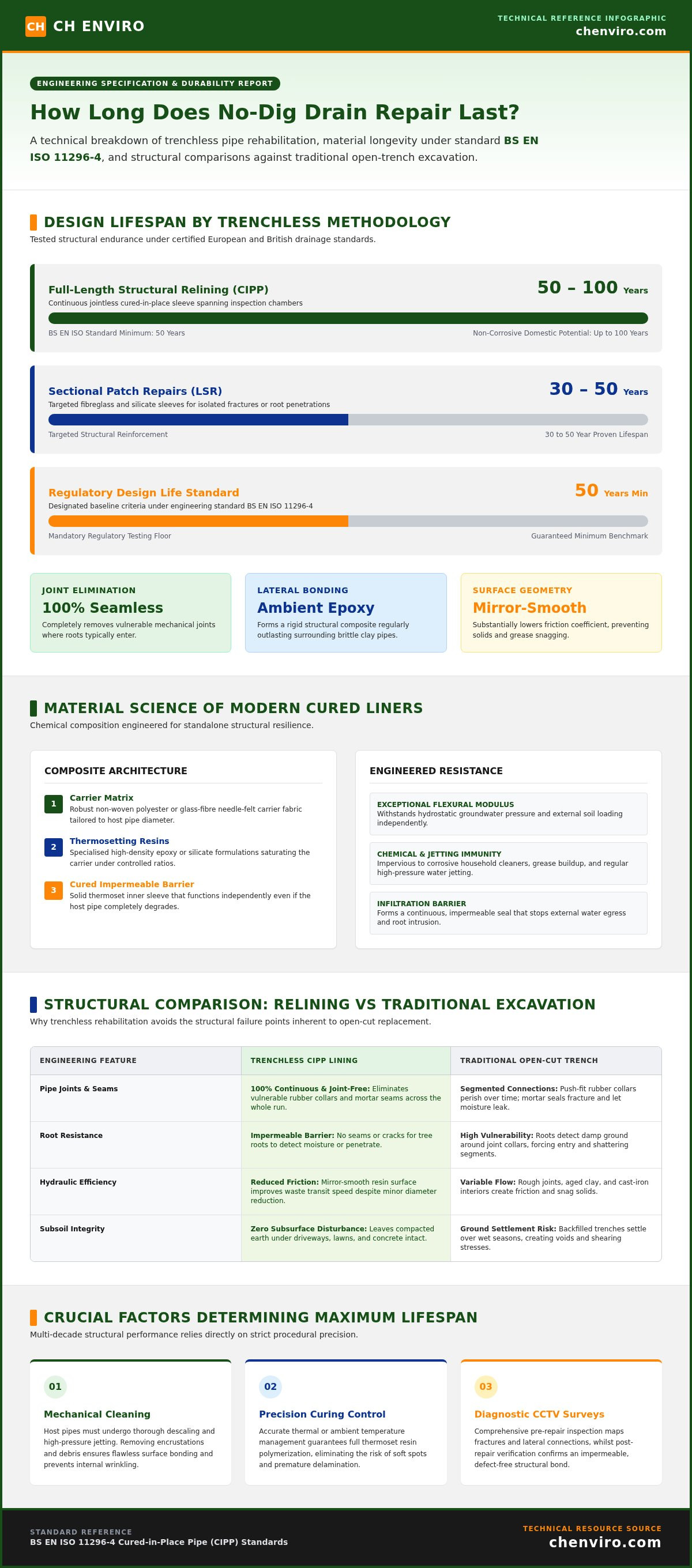
Full-Length Structural Relining: Continuous cured-in-place pipe (CIPP) lining runs between inspection chambers, creating an unbroken run designed to last between 50 and 100 years. By removing every joint, it permanently excludes ground water infiltration and aggressive roots.
Sectional Patch Repairs (LSR): Short fibreglass and silicate sleeves target isolated fractures or localized root penetrations. These patches deliver 30 to 50 years of structural strength, sealing specific damage without relining healthy sections.
Ambient-Cured Epoxy Systems: Ideal for domestic lateral connections, these systems form a rigid structural bond within existing host pipes, regularly outlasting the brittle clay sections surrounding them.
The Material Science Behind Drain Relining Durability
The longevity of modern no-dig technology stems directly from its chemical composition. Advanced liners combine a robust non-woven polyester or glass-fibre needle-felt carrier with specialized thermosetting resins. When cured, this saturated fabric forms an impenetrable, high-density thermoset sleeve.
Unlike old pitch-fibre or unglazed clay, epoxy and silicate formulations are impervious to corrosive household chemicals, grease accumulation, and standard high-pressure water jetting. They possess exceptional flexural modulus ratings. This structural rigidity allows the relined inner tube to withstand hydrostatic ground water pressure and heavy soil loads independently, even if the outer host pipe deteriorates entirely over time.
Trenchless Relining vs Traditional Excavation: Durability and Performance
Homeowners often assume that digging a trench and laying brand-new pipework provides a more permanent result than lining an existing drain. In truth, understanding how long does no dig drain repair last compared to traditional excavation comes down to structural mechanics. While a newly excavated PVC pipe carries decades of material integrity, the open-trench installation method introduces distinct points of long-term failure that no-dig methods completely avoid.
Eliminating Vulnerable Structural Pipe Joints
Traditional drainage lines are laid in short individual segments connected by rubber-collared push-fit joints or mortar seals. Over time, normal ground settlement causes these joints to displace. Rubber seals perish, creating tiny gaps where moisture escapes into surrounding subsoil. Root systems inevitably locate these damp seams, forcing their way inside and shattering the joint collars. Trenchless lining creates an unbroken, joint-free conduit along the entire span, eliminating the structural weak points where roots strike.
Hydraulic Efficiency and Friction Reduction
A lined pipe typically outperforms aged clay or rough-cast iron in waste transit speed. Even though a cured liner slightly reduces the pipe's internal diameter by a few millimetres, its mirror-smooth resin interior significantly reduces friction. Waste solids, sanitary items, and grease glide through without snagging, which dramatically lowers the risk of standing water and chronic blockages. Read our guide on no dig drain repair in Dublin for full structural comparisons.
Subsoil Stability and Ground Settlement
Open-cut excavation destabilises the compacted earth beneath paved driveways, pristine lawns, and concrete slabs. Recompacting backfilled soil to match the surrounding ground density is notoriously difficult. Over successive wet seasons, backfilled trenches settle, leaving subsurface hollows that put shearing pressure on rigid pipe connections. By engineering liners in accordance with ASTM F1216 design standards, trenchless repairs leave the surrounding subsoil completely undisturbed. The cured resin tube flexes slightly under heavy driveway traffic without cracking.
If you are weighing the disruption of trenching against a lasting trenchless solution, speaking with the local drainage team at CH Enviro can clarify the best repair route for your specific ground conditions.
Crucial Factors Influencing How Long Your Drain Lining Lasts
Quality materials mean very little if subterranean installation conditions are neglected. The real determinant of how long does no dig drain repair last isn't just the raw resin chemistry, but how thoroughly the host pipe is prepared and cured. When installed carelessly, even structural-grade sleeves can suffer premature delamination or internal deformities within a few seasons.
Preparation, Descaling, and CCTV Inspection
A resin liner cannot adhere properly to thick grease, heavy limescale, or crumbling clay fragments. Before inserting any felt sock, specialist crews use high-pressure water jetting and mechanical descaling flails to strip the internal walls down to clean substrate. Robotic milling cutters grind down intrusive taproots and smooth displaced joints. Booking a comprehensive CCTV drain survey in Dublin beforehand confirms the host pipe retains at least 80% of its original structural profile, verifying that the line is suitable for lining rather than past the point of collapse.
Environmental Conditions and Curing Accuracy
Underground environments present challenging variables. Active groundwater infiltration can dilute or chill uncured resin if unmanaged, while fluctuating ground temperatures alter curing speeds. Technicians must calibrate catalyst mixtures precisely to achieve full chemical crystallisation without causing brittleness. Using the correct calibration bladder ensures uniform wall thickness across every bend. As highlighted in the EPA trenchless rehabilitation fact sheet, strict quality control during underground installation is essential for trenchless systems to achieve their multi-decade performance targets.
Maintenance Practices and Chemical Exposure
Day-to-day drainage habits also dictate how well a liner ages. While cured epoxy handles typical household wastewater effortlessly, pouring concentrated caustic drain cleaners into sinks produces intense exothermic reactions that can soften or weaken resin matrices over time. Mechanical maintenance matters too. When clearing stubborn clogs, operators should avoid using aggressive rotary snakes fitted with serrated cutting blades that gouge composite liner walls. Regulated water jetting and professional unblocking clear waste smoothly without compromising the structural barrier.
Signs an Aged or Poorly Installed Drain Repair Requires Attention
When assessing how long does no dig drain repair last, poor workmanship is the primary culprit behind premature failures. While a properly cured sleeve performs reliably for half a century, flawed installations show warning signs within months. Recognising these indicators early prevents minor defects from developing into messy ground collapses beneath your driveway or garden.
Identifying Physical and Hydraulic Warning Indicators
Failing subterranean repairs produce clear household symptoms before complete blockage occurs:
Gurgling Fixtures: Air bubbling back through toilet bowls or plugholes indicates waste water is fighting downstream flow restrictions.
Persistent Smells: Sewage odours escaping near inspection chambers suggest resin sleeves failed to seal cracked pipe shoulders, allowing gas to vent outward.
Recurring Localised Snags: If waste constantly backs up at the exact same point despite frequent plunging, materials are snagging on a structural flaw underground.
Surface Depressions: Damp patches or slight paving dips along the drain route point to wastewater washing away bedding gravel outside an unsealed joint.
Internal Liner Defects Revealed via Diagnostics
Optical inspection cameras reveal the underlying causes of hydraulic failure. The most common defect is internal wrinkling, or "finning". This occurs when an oversized felt calibration tube bunches up inside a smaller host pipe, creating permanent resin ridges that catch toilet paper and wet wipes. Delamination represents another severe issue; if scale and silt were not jetted away beforehand, the cured liner separates from the clay walls like peeling paint. In severe cases, external groundwater pressure collapses the delaminated sleeve inward, severely choking flow capacity.
Remedial Actions and Professional Re-Lining
Discovering a compromised liner doesn't automatically mean bringing in diggers. Specialised lateral milling cutters can enter the pipe via existing manholes to grind flat protruding wrinkles and trim ragged branch connections. If a short section has blistered or cracked, technicians can insert a localized patch repair directly inside the existing liner to re-establish an impermeable seal. Prompt intervention by professional drainage services halts subterranean water erosion before surrounding foundation soil washes away completely.
If recurring blockages or foul odours persist across your system, contact CH Enviro to inspect your drainage system with high-resolution CCTV before structural damage worsens.
How to Maximise the Lifespan of Your No-Dig Drain Repair
Maximising the operational life of an underground liner requires a deliberate mix of professional workmanship and sensible day-to-day management. You now understand how long does no dig drain repair last under ideal conditions, but reaching that half-century milestone depends entirely on keeping the cured composite free from avoidable mechanical stress and chemical aggression.
Selecting Certified Drainage Contractors and Verified Materials
Never treat structural relining as a casual handyman task. Work exclusively with specialists trained in inversion CIPP systems and sectional patch techniques. Reputable contractors use certified thermosetting resins and industrial-grade glass-fibre carriers designed specifically for structural rehabilitation. Always insist on recorded camera footage before and after the cure; this visual sign-off proves the liner bonded flush against the host line without folds. Local Dublin specialists covering Meath, Kildare, and neighbouring Leinster counties understand regional soil movement and older drainage quirks, ensuring proper equipment calibration from day one.
Adopting Protective Waste Disposal Habits
Even the toughest structural epoxy can be disrupted if foreign matter continuously enters the system. Simple household adjustments keep your newly lined pipework running freely:
Dispose of Wipes in Bins: Unwoven wet wipes and sanitary items do not dissolve; they snag on any natural line bend, accumulating into heavy obstructions.
Contain Fats and Cooking Oils: Pour warm kitchen grease into sealable jars rather than down plugholes, preventing solidified fat deposits along the composite surface.
Minimise Caustic Solvents: Avoid pouring concentrated sulphuric acid or boiling chemical solutions down sinks, which can thermally stress resin matrices over time.
Scheduling Routine Inspections and Maintenance
Catching drainage problems early prevents costly structural emergencies. Schedule a diagnostic camera survey every three to four years to verify that tree roots haven't shifted surrounding earth and that junction seals remain impermeable. If bathroom fixtures drain slowly or water pools in outdoor gulleys, engage professional drain unblocking services straight away. Certified specialists use regulated water pressure to clear stubborn blockages without scratching the mirror-smooth resin interior.
Taking care of these core maintenance tasks guarantees your trenchless liner performs as a seamless, reliable conduit for decades. If you suspect an issue or want straight-talking advice on protecting your underground drainage assets, contact CH Enviro to discuss your options.
Restore Your Drainage Without the Disruption of Excavation
Choosing trenchless rehabilitation gives you the reassurance of a brand-new drainage network without destroying your property in the process. When considering how long does no dig drain repair last, modern thermosetting resins and seamless, joint-free installation reliably deliver over 50 years of structural resilience. By skipping open excavation, you protect driveways and garden landscaping from heavy machinery while permanently locking out invasive tree roots.
Subterranean longevity always depends on proper diagnostic verification. Our rapid-response teams provide comprehensive pre- and post-installation CCTV camera inspection records, ensuring your relined pipe cures cleanly without internal wrinkles or flow restrictions. If recurring blockages or damaged pipes are disrupting your home or commercial premises across Dublin, Kildare, Meath, or Wicklow, work with local specialists who solve the problem properly. Contact CH Enviro today for expert no-dig drain repairs across Dublin and Leinster and secure lasting underground drainage performance.
Frequently Asked Questions
How many years does cured-in-place pipe (CIPP) lining typically last?
Cured-in-place pipe lining typically lasts between 50 and 100 years when installed using certified thermosetting resins. Engineered in line with BS EN ISO 11296-4 standards, these composite liners form a seamless pipe-within-a-pipe. When property owners ask how long does no dig drain repair last, field testing demonstrates that non-corrosive domestic settings routinely see liners maintain full structural performance long past their fifty-year design benchmark.
Can tree roots penetrate or damage a newly lined drain pipe?
No, tree roots cannot penetrate a properly cured seamless resin liner. Roots enter traditional clay or concrete pipework by seeking water through deteriorated mortar joints and displaced rubber seals. Trenchless lining creates an unbroken, joint-free composite sleeve that eliminates these entry points entirely. As long as surrounding lateral connections are precisely cut and sealed, root intrusion is permanently blocked.
Does no-dig drain repair significantly reduce the internal pipe diameter?
No, the reduction in internal pipe diameter is minimal, typically taking up only 3 to 4.5 millimetres around the pipe wall. While cross-sectional diameter decreases slightly, overall hydraulic flow usually improves. The mirror-smooth resin interior significantly lowers friction compared to aged, rough cast iron or salt-glazed clay, allowing wastewater and solids to move faster through the line without catching.
Is a patch repair as durable as full-length drain relining?
Yes, individual patch repairs offer comparable structural durability, with lifespan expectations reaching thirty to fifty years. The main difference lies in coverage rather than material quality. A patch repair uses identical silicate or epoxy resins reinforced with fibreglass mats to seal localised fractures. If the rest of the host pipe remains structurally sound and joint-sealed, a patch delivers long-lasting protection without the expense of full lining.
What causes an underground drain liner to fail prematurely?
Premature failure is almost always caused by poor installation technique rather than material defects. When considering how long does no dig drain repair last, improper descaling is the leading threat; residual grease or scale prevents the resin from bonding cleanly, causing delamination. Other common failure factors include incorrect resin-to-hardener mixing ratios, groundwater infiltration during curing, and failing to smooth out internal wrinkles before inflation bladders cure.
Can you reline a drain pipe that has already fully collapsed?
No, fully collapsed drain pipes cannot undergo trenchless relining. For cured-in-place pipe technology to work successfully, the host pipe must retain at least 80% of its original structural circumference. If the line has flattened completely or suffered major offset breaks greater than 20 degrees, winches and bladders cannot pass through safely. In these severe scenarios, localised excavation or pipe bursting becomes necessary to re-establish flow.
Does insurance cover no-dig trenchless drain repairs in Ireland?
Most standard building insurance policies in Ireland cover trenchless repairs if the underlying issue stems from sudden accidental damage, such as root intrusion or ground movement. However, policies generally exclude gradual wear, corrosion, or pre-existing installation defects. Drainage specialists across Leinster can carry out recorded CCTV diagnostic surveys and provide detailed technical reports to submit directly to your insurer or loss assessor during claims.


Comments