
How to Improve a Septic Tank Drainage Field: A Practical Guide
Could the quick fix you’re considering make a failing drainage field harder to diagnose? If you’re searching for how to improve septic tank drainage field performance, it’s understandable to want a clear answer, especially when drains are slow, there’s an unpleasant smell or the ground above the percolation area is wet. These signs can have different causes, and the problem may be in the tank, connecting pipes or drainage field.
Improvement starts with finding the cause, not guessing at a remedy. This guide explains which warning signs to look for, what everyday steps may help reduce strain on the system and which repairs should be left to a qualified professional. It also explains why tank cleaning can be useful maintenance but won’t necessarily fix a blocked, saturated or damaged drainage field. The aim is to help you make an informed decision and avoid actions that could worsen the problem or delay a proper assessment.
Table of Contents
How to improve a septic tank drainage field: identify the cause first
How a septic tank drainage field works and why it may stop draining
Which septic tank drainage-field remedies may help and what they cannot fix
How to improve a septic tank drainage field safely: practical steps
When to arrange septic tank or drainage-field professional help in Ireland
How to improve a septic tank drainage field: identify the cause first
A septic tank drainage field, also called a percolation area, is the part of a wastewater system where liquid leaving the tank is distributed through pipes into the ground for further treatment. In simple terms, the soil helps filter and treat the wastewater. You can read more about how a septic tank drainage field works.
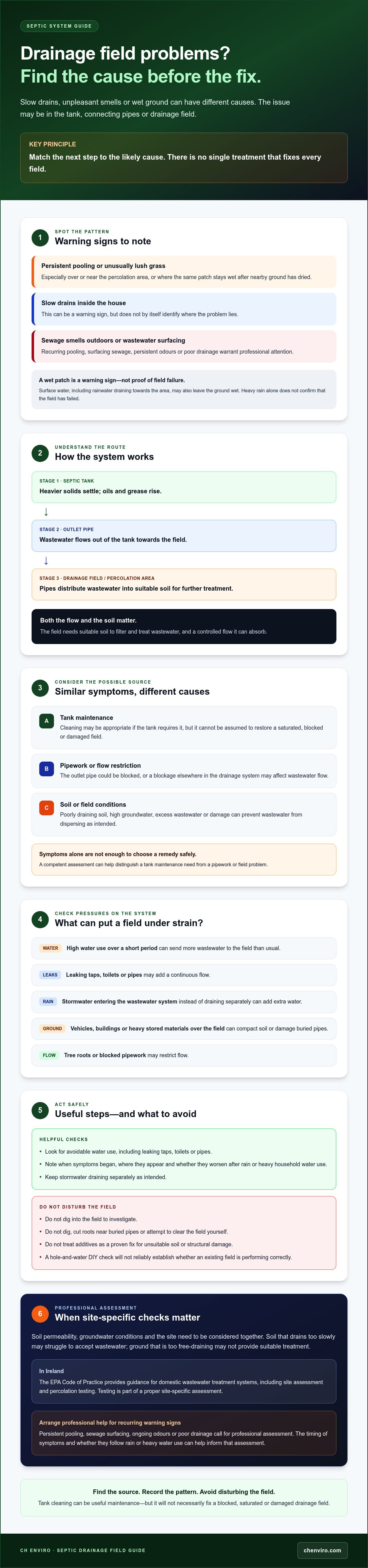
Knowing how to improve septic tank drainage field performance starts with identifying what has changed. There’s no single treatment that fixes every field. A maintenance issue in the tank calls for a different response from a blocked outlet pipe, poorly draining soil or damage to the field. Wet ground can be a warning sign, but it isn’t proof on its own. Surface water, including rainwater draining towards the area, may also leave the ground wet.
What signs suggest a drainage field is not working properly?
Look for persistent pooling or unusually lush grass over or near the percolation area, especially if the same patch stays wet after the surrounding ground has dried. Slow drains inside the house, sewage smells outdoors or wastewater surfacing also warrant attention. These signs can point to a problem, but they don’t confirm where the fault lies.
Note when each symptom began, where it appears and whether it gets worse after rain or heavy household water use. This record can help a professional assess whether the pattern relates to rainfall, a system issue or both. Don’t dig into the field to investigate.
Could the problem be elsewhere in the septic system?
Yes. The tank may need maintenance, the outlet pipe could be blocked, or the fault may lie in the percolation area itself. A blockage elsewhere in the drainage system can also affect wastewater flow. Because these problems can produce similar signs, symptoms alone aren’t enough to choose a remedy safely.
A competent assessment can help distinguish a tank maintenance need from a pipework or field problem. Septic tank cleaning may be appropriate if the tank requires it, but cleaning alone can’t be assumed to restore a saturated, blocked or damaged drainage field. For more on tank upkeep, see this guide to septic tank cleaning and maintenance in Ireland.
How a septic tank drainage field works and why it may stop draining
Inside the septic tank, heavier solids settle and oils and grease rise, leaving wastewater to flow out through an outlet pipe. It then enters the drainage field, where pipes distribute it into suitable soil for further treatment. Both parts need to work properly: wastewater needs suitable soil to filter and treat it, and a controlled flow that the field can absorb.
If the soil drains poorly, groundwater is high or more water reaches the field than it can handle, wastewater may not disperse as intended. Heavy rain can also affect a site, but wet ground after a downpour doesn’t, by itself, prove the field has failed. Site conditions and the timing of symptoms matter.
How soil and site conditions affect a percolation area
Soil permeability describes how readily water moves through the ground. Soil that drains too slowly may struggle to accept wastewater, while ground that is too free-draining may not provide suitable treatment. That’s why land characteristics and groundwater conditions need to be considered together, rather than judged by appearance alone.
In Ireland, the EPA Code of Practice provides guidance for domestic wastewater treatment systems, including site assessment and percolation testing. Testing is part of a proper site-specific assessment, not a quick DIY check. Digging or pouring water into a hole won’t reliably establish whether an existing field is performing correctly. Ask a competent professional to assess the conditions and check current EPA guidance where relevant.
Common pressures that can overload or damage the field
Even a suitable field can be put under strain if too much water enters the system or wastewater can’t flow freely. Look for practical contributors such as:
High water use over a short period, which can send more wastewater to the field than usual.
Leaking taps, toilets or pipes, which may add a continuous flow.
Stormwater entering the wastewater system instead of draining separately as intended.
Vehicles, buildings or heavy stored materials over the field, which can compact soil or damage buried pipes.
Tree roots or blocked pipework may also restrict flow. Don’t dig, cut roots near buried pipes or attempt to clear the field yourself. A professional investigation can help establish whether a pipe blockage or physical damage is involved. The US Environmental Protection Agency also outlines general practical steps to improve your septic system, including managing water use. Use Irish EPA guidance for local requirements.
To work out how to improve septic tank drainage field performance, start with the cause, not a treatment product or guesswork. If you’re unsure whether symptoms point to tank maintenance or a drainage issue, you can discuss septic tank cleaning and wastewater treatment options with CH Enviro.
Which septic tank drainage-field remedies may help and what they cannot fix
The right response depends on what an assessment finds. Routine maintenance can support a septic system, and reducing excess water may ease pressure on it. Neither can repair every drainage-field fault. A blocked pipe, damaged component or soil that cannot accept wastewater may need a different response, so be wary of products or services promising a universal fix.
When maintenance or reducing water load may help
Keeping the tank properly maintained helps it separate and retain solids as intended. If it needs cleaning, arranging that work may address a tank maintenance issue, but it won’t necessarily restore a saturated or damaged field. CH Enviro provides septic tank cleaning. Find more information in this guide to septic tank cleaning and maintenance.
At home, fix leaking taps or toilets and, where practical, avoid running several water-intensive appliances at once. These are sensible ways to limit avoidable water entering the system, not a guaranteed repair. The US Environmental Protection Agency’s EPA guide to septic system care also discusses everyday practices such as managing water use and protecting the drainfield. For Irish requirements, check current Irish EPA guidance.
When products, repairs or replacement need careful assessment
Judge a product claim against the diagnosed cause, not its marketing. An additive shouldn’t be treated as a proven remedy for unsuitable soil, a collapsed pipe or other structural damage. Don’t pour chemicals into the system or excavate the field without qualified advice. Either action could cause harm or make the fault harder to assess.
This comparison can help set expectations, but it isn’t a diagnosis:
If the tank needs routine maintenance: septic tank cleaning may be appropriate, but it can’t be assumed to repair a failed drainage field.
If excess water is entering the system: fix leaks and reduce avoidable water use, but remember these steps won’t correct damaged pipework or unsuitable soil.
If pipework may be blocked or damaged: seek professional investigation and a suitable repair. Tank cleaning alone won’t resolve the fault.
If the field or site conditions are the concern: arrange a site-specific assessment before choosing remedial work. A generic additive or guessed-at treatment may not address the cause.
Repair or replacement should follow inspection and site-specific findings, not guesswork. Understanding how to improve septic tank drainage field performance means choosing a response that matches the fault, and recognising that maintenance may help one part of the system without correcting another.
How to improve a septic tank drainage field safely: practical steps
You can take useful first steps without opening the tank or disturbing buried pipes. The aim is to reduce avoidable strain and give an assessor a clearer picture, not to diagnose or repair the field yourself.
Reduce avoidable water load. Fix obvious leaks and spread out water-intensive household tasks where practical.
Record the symptoms. Note where pooling or odours occur, when they started, whether drains are slow, and how conditions change after rainfall or increased water use.
Look for surface-water sources. From a safe distance, check whether rainwater appears to run towards the field or enter the wastewater system. Don’t lift covers or inspect chambers.
Seek appropriate advice. Share what you’ve observed and check current EPA Ireland guidance and local-authority requirements for site-specific next steps.
Keep people and pets away from sewage, wastewater and persistently wet ground that may be contaminated. Don’t enter a chamber, handle effluent or dig into the percolation area. Keep vehicles, construction materials and additional water discharge away from the field. Avoid changes to planting or landscaping until you’ve checked what’s suitable for your system.
What can a homeowner check without disturbing the system?
Look for visible plumbing leaks and observe whether rainwater from roofs, paved areas or slopes seems to flow towards the system. Record odours, standing water, slow drainage, weather conditions and recent changes in household water use. Leave covers closed. These observations can guide an assessment, but they can’t confirm whether the fault is in the tank, pipework or field.
What information should you give an assessor or service provider?
Gather any system or site records you have, along with the tank maintenance history and your symptom notes. Mention recent building work, landscaping, flooding or changes in how many people are using the property. Specific timing helps, such as whether pooling follows heavy rain or slow drains persist in dry weather. If the evidence suggests a drainpipe issue, a CCTV drain survey may help investigate pipework, but it won’t assess soil suitability by itself.
To decide how to improve septic tank drainage field performance safely, start with observations and get advice before committing to work. Discuss septic tank cleaning or wastewater treatment options with CH Enviro, and confirm service availability for your address.
When to arrange septic tank or drainage-field professional help in Ireland
Arrange an assessment if wastewater repeatedly pools over the percolation area, sewage surfaces, unpleasant odours persist or drains remain slow despite reducing avoidable water use. These signs deserve attention, particularly if they recur after rainfall or appear alongside other changes in the system. Keep people and pets away from wastewater and persistently wet ground that may be contaminated, and don’t try to open the tank or investigate underground components yourself.
A professional familiar with domestic wastewater systems can help establish whether the issue may relate to tank maintenance, a blocked or damaged pipe, or the drainage field and site conditions. That distinction matters: the appropriate next step depends on the findings, and a service aimed at one part of the system may not resolve a fault elsewhere.
When is septic tank cleaning relevant to a drainage-field concern?
Septic tank cleaning is a maintenance service for the tank. It may be relevant if the tank requires cleaning, but it doesn’t guarantee that a poorly draining field will recover. Tell the service provider about any pooling, odours, sewage surfacing or slow drains when you ask about cleaning. This gives them useful context and helps avoid assuming that tank maintenance alone will solve the symptoms.
How to choose the right next step in Ireland
Choose a suitably qualified professional with experience of domestic wastewater systems and the site conditions involved. Ask what the assessment is intended to establish, and whether the symptoms suggest tank maintenance, pipework investigation or a drainage-field concern. Check current Irish EPA guidance and any relevant local-authority requirements for site-specific advice before agreeing to remedial work. Requirements can depend on the circumstances, so don’t rely on a general online description as a substitute.
For homeowners, deciding how to improve septic tank drainage field performance should start with a clear understanding of the problem, not a promised outcome from cleaning or a quick-fix product. CH Enviro provides septic tank cleaning and wastewater treatment services, and serves Dublin, Meath, Louth, Kildare, Wicklow and Wexford. Confirm service availability for your address when making an enquiry.
If tank cleaning may be appropriate, contact CH Enviro about septic tank cleaning and explain the symptoms you’ve noticed. That conversation can help clarify whether cleaning is relevant or whether a further assessment may be needed.
Take the next step with a clearer diagnosis
Improving a drainage field starts with understanding why it isn’t working as expected. Symptoms such as persistent pooling, odours or slow drains are useful clues, but they don’t identify the cause on their own. The practical answer to how to improve septic tank drainage field performance is to avoid guesswork: note what you’re seeing, reduce avoidable water use and seek advice if the problem continues or worsens.
Tank maintenance may be appropriate, but cleaning doesn’t guarantee that a blocked, saturated or damaged field will recover. An assessment can help clarify whether the issue relates to the tank, pipework or percolation area, so you can discuss a suitable next step with better information.
CH Enviro provides septic tank cleaning and wastewater treatment services in Dublin, Meath, Louth, Kildare, Wicklow and Wexford. Confirm service availability for your address, then contact CH Enviro to discuss septic tank cleaning and the symptoms you are seeing. With the right information and advice, you can move towards a safer, more appropriate solution.
Frequently Asked Questions
Can you improve a septic tank drainage field without replacing it?
Yes, depending on the cause, a field may not need replacement. Reducing avoidable water entering the system or addressing a tank maintenance need may help relieve some pressure, but neither will correct unsuitable soil or damaged pipework. The best way to decide how to improve septic tank drainage field performance is to identify the fault first. A professional assessment can help determine whether maintenance, repair or more extensive work may be appropriate.
What are the signs that a septic tank drainage field is failing?
Recurring wet or unusually lush ground above the percolation area, persistent sewage odours, wastewater surfacing and continued slow drainage can be warning signs. They don’t confirm that the field itself has failed, as tank or pipework issues can cause similar symptoms. Note where and when the signs appear, including whether they follow heavy rain or increased water use. Keep people and pets away from sewage or potentially contaminated wet ground.
Will septic tank cleaning fix a blocked or saturated drainage field?
No, cleaning the tank doesn’t guarantee that a blocked, saturated or damaged drainage field will recover. It may be appropriate maintenance if the tank needs cleaning, but a restriction in an outlet pipe or a problem with the field requires a different response. Explain all symptoms when asking about cleaning, including pooling, odours and slow drains. An assessment can help clarify whether tank maintenance is relevant or whether another issue needs attention.
Do septic tank additives improve a drainage field?
Don’t rely on additives as a proven fix for a drainage field problem. A product can’t be assumed to repair damaged pipework, restore unsuitable soil or resolve every cause of poor drainage. Check what condition the product claims to address and seek professional advice before adding chemicals or other treatments to the system. Matching any proposed remedy to the diagnosed fault is safer than choosing one based on broad marketing claims.
Can heavy rain affect a septic tank percolation area?
Yes, heavy rain can leave a percolation area wetter, particularly if surface water flows towards it or groundwater is already high. Wet ground after rainfall alone doesn’t prove the field is failing. Record whether pooling or slow drainage clears as conditions dry, or continues between periods of rain. If symptoms recur, sewage surfaces or odours persist, arrange an assessment rather than digging into the field or opening the tank.
How do you know whether the problem is the septic tank or drainage field?
You usually can’t tell from symptoms alone. Slow drains, odours and wet ground can relate to the tank, an outlet pipe, a blockage or the drainage field. Note where the symptoms occur, when they began and whether weather or household water use affects them. A professional familiar with domestic wastewater systems can investigate the likely source. Don’t open the tank or handle wastewater to try to diagnose the issue yourself.
Who should assess a septic tank drainage field in Ireland?
Ask a suitably qualified professional with experience in domestic wastewater systems and site conditions to assess persistent symptoms. Check current Irish EPA guidance and any relevant local-authority requirements for your circumstances. CH Enviro provides septic tank cleaning and wastewater treatment services in Dublin, Meath, Louth, Kildare, Wicklow and Wexford. Cleaning may support tank maintenance, but it isn’t a guaranteed field repair. Confirm service availability for your address when making an enquiry.


Comments