
Is Drain Relining a Permanent Solution? The Truth About No-Dig Repairs
What if you could fix a cracked underground pipe forever without lifting a single paving slab or ruining your garden? For many homeowners across Dublin and the surrounding counties, the cycle of unblocking the same stubborn drain feels like a losing battle. You're likely tired of the recurring call-out fees and the looming dread that a digger might eventually need to tear up your driveway. It's natural to ask: is drain relining a permanent solution, or are you just paying for a temporary fix that will fail in a few years?
We understand that uncertainty. You want a repair that actually lasts, not a "no-dig" gimmick that lacks structural strength. This article explains why modern cured-in-place pipe technology is actually a structural upgrade that often outlasts the original host pipe. We'll show you how high-grade liners are engineered for a 50-year design life and why they're now the preferred choice for permanent repairs in Ireland. You'll discover how professional CCTV diagnostics ensure a perfect fit and why choosing trenchless technology can save you significant stress and reinstatement costs compared to traditional excavation.
Table of Contents
What is Drain Relining and is it Truly Permanent?
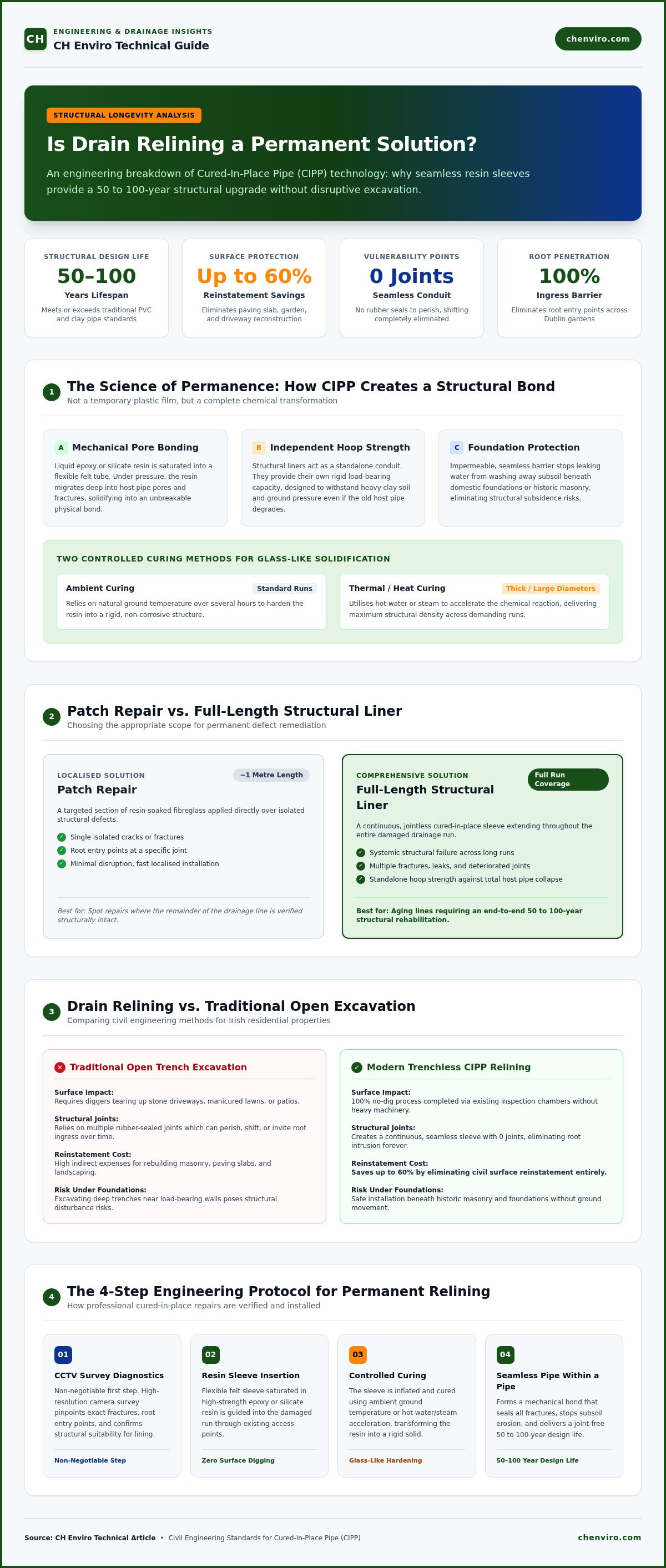
Drain relining is a trenchless, "no-dig" method used to repair damaged pipes from the inside. It creates a new, structural pipe inside your old, compromised one. We use a flexible sleeve saturated with high-strength epoxy or silicate resin. This sleeve is pulled into place and then "cured" until it hardens into a rigid, waterproof conduit. This process effectively seals cracks and stops leaks without the need for a single shovel hitting the ground.
For many homeowners in Dublin and Kildare, the main concern is whether this is a long-term fix. To answer the question, is drain relining a permanent solution, we look at international civil engineering standards. Cured-in-place pipe (CIPP) liners are designed for a minimum service life of 50 years. In many cases, these liners can last up to 100 years. They effectively match or exceed the lifespan of traditional PVC or clay pipes. This makes it a favoured choice amongst locals who want to protect their gardens or expensive stone driveways from the destruction of heavy machinery.
The Difference Between a Patch and a Full Liner
Not every drainage issue requires a full-length liner. A localised patch repair involves a shorter section of resin-soaked fibreglass, usually around one metre long. This is a permanent fix for isolated cracks or root ingress at a single joint. However, if your pipe has multiple fractures or is structurally compromised along its entire length, a full-length liner is necessary. Modern liners provide their own hoop strength, meaning they can support the weight of the soil even if the original pipe eventually crumbles away.
Patch Repairs: Best for single cracks, isolated holes, or root entry points.
Full Liners: Necessary for systemic structural failure or multiple leaks across a long run.
Structural vs Non-Structural: We use structural liners that act as a standalone pipe, ensuring the drain remains open even under ground pressure.
Why Searchers Question the Longevity of No-Dig Repairs
It's common to feel skeptical about a repair you can't see. Some assume that "sleeving" a pipe is like putting a thin plastic film inside it. This is a misconception. Modern resin technology creates a seamless, jointless pipe that is incredibly tough. Unlike traditional pipes that rely on rubber seals at every joint, a relined pipe has no joints. This eliminates the most common failure points where leaks and root ingress usually start. While some prefer the idea of seeing a new physical pipe being buried, the structural bond formed by the resin is often more durable than the original installation. A no dig drain repair Dublin homeowners trust is a permanent, high-tech upgrade, not a temporary patch.
The Science of Permanence: How Relining Creates a Structural Bond
To understand why we consider this a long-term fix, you have to look at the chemistry behind the process. It isn't just a sleeve sitting inside a pipe; it's a total chemical transformation. We insert a flexible felt tube saturated with liquid resin into the damaged run. Once in position, the curing process begins. This is a controlled reaction that turns the resin from a liquid into a hard, glass-like solid. The result is a new pipe that is physically bonded to the old one, sealing every crack and fracture along the way.
The resin doesn't just coat the surface. It migrates into the pores and joints of the host pipe, creating a mechanical bond that is incredibly difficult to break. This process is vital for stopping leaks and preventing water from washing away the soil around your foundations. Traditional pipes often fail at the joints where rubber seals perish or shift. Relined pipes are entirely seamless. Because there are no joints, tree roots have no entry point, which eliminates the primary cause of recurring blockages in Dublin gardens. If you're unsure about the current state of your joints, a CCTV drain survey Dublin residents rely on can pinpoint these vulnerabilities before they cause a collapse.
The "set" of the liner is achieved through either ambient curing or heat curing. Ambient curing uses the natural temperature of the ground to harden the resin over several hours. Heat curing uses hot water or steam to accelerate the reaction, which is often necessary for thicker liners or larger diameter pipes. Both methods result in a permanent, rigid structure that is designed to withstand the heavy clay soil and ground pressure common across Kildare and Meath.
Material Matters: Epoxy vs. Polyester Resins
We prioritise high-grade epoxy resins for domestic drainage because they offer superior durability. Epoxy has a much lower shrinkage rate than cheaper polyester alternatives, ensuring a tighter fit against the host pipe. It's also highly resistant to the harsh chemicals found in modern household detergents and oils. This material flexibility allows the liner to handle slight ground movements and the thermal expansion caused by boiling water from sinks and washing machines without cracking.
Structural Integrity and Flow Rates
A common concern is that adding a liner will make the pipe too small. While the liner adds a few millimetres to the pipe wall, the internal surface is significantly smoother than old vitrified clay or cast iron. This "smooth-bore" effect actually improves the hydraulic flow, meaning waste moves faster even with a slightly reduced diameter. Structural relining is a repair that supports the ground load independently.
Drain Relining vs. Excavation: A Lifespan Comparison
When you face a drainage failure, the traditional response was always to dig. While excavation physically replaces a section of pipe, it often creates new vulnerabilities. Every time you join two pipes together, you create a potential point of failure. Modern trenchless technology avoids this entirely by creating a continuous run. When homeowners ask, is drain relining a permanent solution, they should consider that a relined pipe has no joints for roots to penetrate or for soil to wash into. You are essentially removing the weak points that caused the initial problem.
Traditional clay or PVC pipes are reliable, but they rely on rubber seals that can degrade over time. In contrast, cured-in-place pipe (CIPP) liners are engineered for a minimum 50-year operational life. Technical standards like ASTM F1216 confirm that these liners can remain functional for up to 100 years. Beyond durability, there is a major "disruption factor" to consider. Excavation projects in Dublin often take between 4 and 7 days. This is due to the time needed to break concrete, dig trenches, and reinstate landscaping. Relining is usually finished in a single day. By choosing a no-dig repair, you avoid the 40% to 60% in extra costs typically spent on repairing driveways or gardens after a dig.
Durability Against Tree Root Ingress
Tree roots are naturally drawn to the moisture escaping through tiny gaps in pipe joints. In Dublin's older, leafy suburbs like Drumcondra or Clontarf, root ingress is a leading cause of structural damage. Traditional excavation replaces the pipe, but the new joints remain a target for thirsty roots. Because relining creates a jointless, seamless barrier, it acts as a permanent shield. Roots simply cannot find an entry point. This makes it the favourite choice for properties with large trees where recurring blockages have become a costly nuisance.
The 50-Year Design Life Explained
In civil engineering, "design life" refers to the period a structure is expected to function without major repair. For a high-grade epoxy liner, this is a conservative 50-year estimate. The liner often outlasts the original host pipe it protects because it is immune to the corrosion that affects iron or the cracking that affects clay. The only factor that might shorten this lifespan is poor installation or lining over a pipe that has already collapsed. This is why we use precise diagnostics to ensure the host pipe can support the process. If the pipe is suitable, the resulting composite structure is often stronger than a brand-new standalone pipe.
When is Relining NOT a Permanent Fix?
While trenchless technology is transformative, it isn't a universal cure for every drainage failure. For the question is drain relining a permanent solution to result in a "yes," the underlying pipe must still be structurally viable. If a pipe has completely pancaked or collapsed under the weight of a driveway, a liner cannot pass through the blockage. In these cases, the only permanent fix is traditional excavation and replacement to restore the pipe's shape and flow.
A professional CCTV drain survey Dublin homeowners book is the only way to determine if your system is a candidate for relining. This is particularly important in older Dublin suburbs where "pitch fibre" pipes were common in the mid-20th century. These pipes often become oval-shaped or blistered over time. They require intensive mechanical re-rounding before a liner can be installed. If the deformation is too severe, the pipe may fracture during the re-rounding process, making excavation unavoidable.
The Importance of Pre-Lining Preparation
A liner is only as good as the surface it bonds to. We use high-pressure water jetting to remove years of accumulated scale, grease, and debris before the resin-soaked sleeve is inserted. Relining over a dirty or greasy pipe prevents the resin from forming a proper mechanical bond with the host pipe. This leads to premature failure, sagging, or "delamination" where the liner pulls away from the wall. After the installation, a post-lining CCTV inspection is essential to verify that the liner is wrinkle-free, fully sealed, and compliant with drainage standards.
Identifying Total Pipe Failure
There are moments when "no-dig" simply isn't a viable option. If your drainage system has suffered a severe "belly" or a negative fall where water stands still, relining won't fix the slope. It will only create a smooth, waterproof dip that continues to collect silt and debris. Similarly, if the pipe has sheared off entirely due to significant ground movement, a sleeve cannot bridge that gap safely. Relining requires a "host" structure to be successful.
Low-quality "DIY" kits or installers who skip the cleaning phase often provide a false sense of security. These repairs usually fail within a few years because they lack the structural bond required for a 50-year lifespan. If you aren't sure whether your pipes are suitable for a permanent trenchless repair, you should request a professional diagnostic survey to avoid wasting money on an unsuitable fix.
Choosing a Permanent Solution for Your Dublin Drainage
Selecting the right repair method requires a balance between modern technology and local knowledge. In Dublin, Kildare, and Meath, the unique combination of heavy clay soils and aging Victorian infrastructure means that off-the-shelf solutions often fall short. We focus on ensuring that every repair meets Irish building regulations and local authority standards. When you ask, is drain relining a permanent solution, the answer depends entirely on the accuracy of the initial diagnosis and the quality of the resin used. We don't guess; we use high-definition cameras to verify every inch of the pipe before recommending a fix.
Our approach at CH Enviro centres on transparency. We combine a no dig drain repair Dublin homeowners can rely on with precise structural diagnostics. This ensures that the liner is not just a sleeve, but a permanent structural upgrade. When reviewing a service provider, always look for a guarantee that covers both the material integrity and the installation quality. A professional installation should be backed by a clear warranty, typically ranging from 10 to 25 years, giving you peace of mind that your drainage system is secure for the next few decades.
Expert Drainage Services Across the Greater Dublin Area
Our team provides specialised environmental maintenance across Louth, Wicklow, and Wexford, serving both residential homeowners and commercial property managers. We often integrate structural relining into broader facility maintenance Dublin contracts to prevent emergency failures before they happen. Straight-talking advice is at the heart of what we do. If a pipe is too badly damaged for a liner, we'll tell you immediately. We prefer to offer a realistic, permanent resolution rather than a temporary patch that will fail when the ground shifts.
Getting a Quote for No-Dig Repairs
We organise our surveys to be as efficient as possible. By using CCTV technology first, we can provide fixed-price solutions that eliminate the "hidden extras" often associated with traditional digging. Whether you need a simple drain unblocking service Dublin wide or a full structural reline, our goal is to restore your system with minimal fuss. We understand the stress of recurring drainage issues. Our process is designed to be mess-free, fast, and fundamentally reliable. If you're tired of temporary fixes and want a drain that works perfectly for decades, contact CH Enviro today for a permanent drainage resolution.
Secure Your Drainage Infrastructure for the Long Term
Fixing your drainage system shouldn't involve the constant stress of recurring blockages or the mess of a dug-up garden. We've explored the technology behind trenchless repairs to answer the fundamental question: is drain relining a permanent solution? With an engineering design life that reaches 50 years and a seamless structure that blocks tree roots, modern relining is a definitive structural upgrade. It provides a jointless barrier that often outlasts the original clay or iron pipes it protects.
Choosing the right partner is vital for ensuring this longevity. Our REAS certified professionals provide expert no-dig repairs across Dublin and Leinster, backed by full CCTV diagnostic reports that verify the integrity of every job. We don't believe in temporary patches. Instead, we offer a straight-talking approach that prioritises the health of your property's infrastructure. If you want to move past the cycle of unblocking and secure a fix that lasts for decades, we're ready to help. You deserve the peace of mind that comes with a perfectly functioning home.
Book your CCTV Drain Survey with CH Enviro today and take the first step toward a worry-free drainage system.
Frequently Asked Questions
How long does drain relining actually last?
Drain relining typically lasts between 50 and 100 years. International engineering standards, such as ASTM F1216, design these cured-in-place liners for a minimum half-century service life. In the Dublin market, this makes it a highly durable alternative to traditional pipe replacement. Because the resin forms a structural bond with the host pipe, it effectively creates a new, high-strength conduit that resists corrosion and ground pressure better than original clay installations.
Can tree roots grow through a relined drain pipe?
Tree roots cannot grow through a properly relined pipe because the finished repair is entirely jointless. Most root ingress in Irish gardens occurs at the vulnerable joints of old clay pipes where seals have failed. By creating a continuous, seamless sleeve from one access point to another, you remove the entry points that roots seek. This makes relining the most effective long-term deterrent for properties in leafy areas like Clontarf or Rathgar.
Is drain relining cheaper than digging up my driveway?
Relining is almost always more cost-effective than excavation, particularly when pipes run beneath driveways or patios. While the technical process has an upfront cost, you avoid the massive expense of reinstating concrete, tarmac, or landscaping. In many Dublin projects, homeowners save between 40% and 60% on the total project cost by choosing a no-dig repair. It eliminates the need for heavy machinery and days of manual labour.
What happens if the relining fails after installation?
If a liner is installed correctly after a professional CCTV survey, the risk of failure is extremely low. Most reputable contractors in Ireland provide installation warranties ranging from 10 to 25 years, while the materials themselves are rated for much longer. We always perform a post-installation camera check to ensure the liner is smooth and fully bonded. This verification process ensures that the answer to is drain relining a permanent solution remains a firm yes.
Is drain relining suitable for all types of pipes in Ireland?
Relining is suitable for almost all common Irish pipe materials, including vitrified clay, cast iron, and modern PVC. It is also a vital tool for rehabilitating mid-century pitch fibre pipes found in many Dublin estates, provided they haven't flattened completely. The key requirement is that the original pipe must still have enough structural form to act as a host for the resin-soaked sleeve during the curing process.
How long does the relining process take to complete?
The entire relining process is usually completed within a single working day. Once the pipe is cleaned and the liner is inserted, the curing phase takes anywhere from a few hours for ambient sets to just minutes for UV-cured systems. This is a significant advantage over traditional excavation, which often leaves your property in a state of disruption for a week or more while trenches are dug and refilled.
Can you reline a drain that has already collapsed?
You cannot reline a drain that has completely collapsed or "pancaked." The liner requires an open bore to pass through and a host structure to press against while it hardens. If the pipe is totally crushed, the only permanent resolution is to dig up the damaged section and replace it. A professional diagnostic survey will identify if a pipe is too far gone for trenchless technology before any work begins.
Do I need to move out of my house whilst the drains are being relined?
There is no need to move out of your home whilst the work is being carried out. The process is non-invasive and takes place entirely underground via existing manholes or access points. We usually ask residents to limit their water usage for a few hours during the curing phase, but your daily routine remains largely unaffected. It is a much cleaner and quieter alternative to the noise and dust of a full-scale excavation.


Comments