
Mortgage Retention Drain Survey Ireland: The 2026 Buyer's Guide to Loan Release
A drainage inspection ceases to be routine maintenance the moment a bank freezes your drawdown; it becomes a critical legal instrument standing between you and your new front door. Facing a mortgage retention drain survey Ireland lenders require can abruptly stall your purchase, leaving you stranded just days before your expected closing date.
You have already spent months managing paperwork, valuation reports, and solicitor enquiries, so discovering that hidden pipework is holding up your loan release is intensely frustrating. It is natural to worry about confusing lender standards, costly delays, or the threat of garden excavation. Fortunately, clearing this hurdle is straightforward when handled methodically. Discover how to secure an accredited CCTV drain survey to resolve lender retention conditions, safeguard your Irish property purchase, and verify whether trenchless repairs can fix any underlying defects. Here is your definitive guide to satisfying underwriter requirements and getting your mortgage funds released on schedule.
Table of Contents
Understanding Mortgage Retention and Why Irish Lenders Demand Drain Surveys
What Irish Mortgage Lenders Require from a Certified CCTV Drain Survey
How to Choose the Right Drain Survey Provider in Ireland: A Buyer's Checklist
Resolving Identified Drainage Defects to Clear Your Loan Retention
Booking Your Pre-Purchase Drain Survey Across Dublin and Leinster
Understanding Mortgage Retention and Why Irish Lenders Demand Drain Surveys
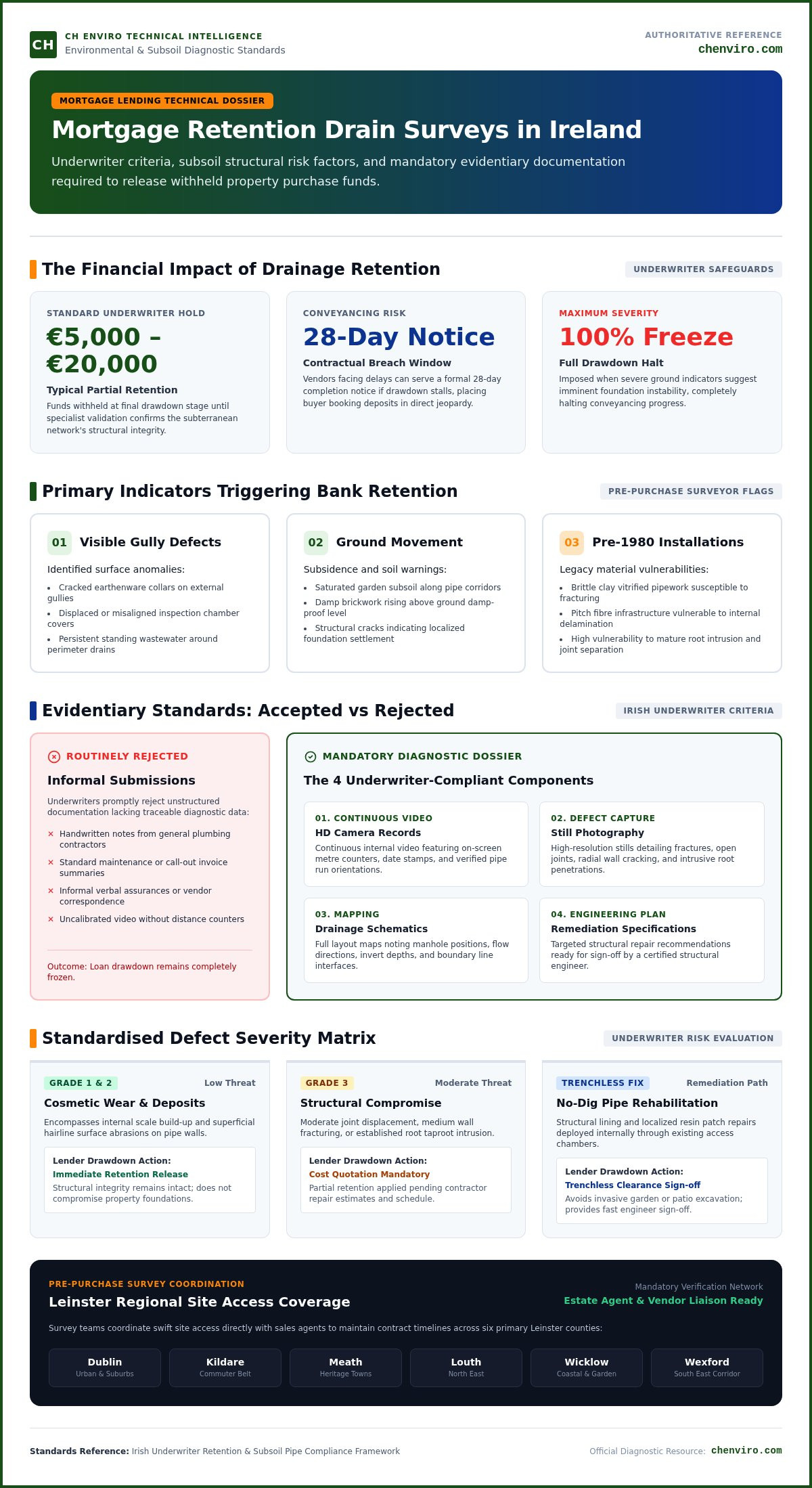
A mortgage retention occurs when an Irish retail bank approves your home loan but withholds a portion of the funds at final drawdown. Lenders enforce this measure whenever a pre-purchase valuation surveyor identifies potential structural or environmental defects. Because hidden subsoil pipework directly affects foundation stability, banks will not release the balance until a specialist validates the integrity of the drainage network. Deploying specialised CCTV drain survey technology gives underwriters the verifiable visual proof they require to clear the property for drawdown.
What Triggers a Drainage Retention Clause in Ireland?
Surveyors cannot see underground, but they easily spot the surface warning signs of subsoil drainage failure. An underwriter will trigger a mandatory mortgage retention drain survey Ireland buyers must commission when an inspection report highlights specific structural risks:
Visible gully defects: Cracked earthenware collars, displaced inspection covers, or persistent standing wastewater around exterior gullies.
Ground movement indicators: Saturated garden subsoil, damp brickwork above ground level, or structural cracks linked to localized settlement.
Age of the drainage installation: Properties constructed prior to 1980 that typically feature brittle clay or legacy pitch fibre pipework, both of which are notoriously prone to delamination and root intrusion.
The Financial Impact on Your Property Purchase and Loan Drawdown
A retention clause immediately disrupts the legal completion process. Underwriters usually impose a partial retention, withholding anywhere from €5,000 to €20,000 until drainage works or clearance reports arrive. In severe instances, they issue a full retention, halting drawdown completely.
This financial hold creates three distinct risks for the buyer:
Closing delays: Your conveyancing solicitor cannot draw down the funds, putting you at risk of missing the contractual closing date agreed with the vendor.
Threat of rescinded contracts: Vendors facing strict timelines may serve a 28-day completion notice if delays drag on, placing your booking deposit in jeopardy.
Latent repair liabilities: Proceeding without verifying underground conditions leaves you fully liable for concealed collapses that can destabilise garden patios and load-bearing walls.
What Irish Mortgage Lenders Require from a Certified CCTV Drain Survey
Irish lending institutions enforce strict evidentiary standards before lifting financial conditions. Underwriters routinely reject handwritten plumber notes, invoice descriptions, or verbal assurances from sellers. When an underwriter requests a mortgage retention drain survey Ireland buyers must submit an engineer-standard diagnostic dossier. The report must objectively demonstrate that the subsoil asset is structurally sound and free from immediate collapse risks.
Essential Components of an Underwriter-Compliant Drainage Report
Bank risk assessors look for concrete technical evidence rather than vague summaries. To satisfy lending underwriters, your inspection package must include:
High-definition video records: Continuous internal footage displaying accurate on-screen metre counters, date stamps, and pipe run orientations.
Defect photography: High-resolution captures detailing fractures, open joints, radial cracking, or root penetrations.
Drainage schematics: Clear site mapping showing manhole positions, flow directions, invert levels, and the property boundary interface.
Engineering recommendations: Actionable remediation plans specifying exact repair methodologies suitable for structural engineers to sign off.
Drainage Defect Classification and Severity Grades
Lenders rely on standardised grading systems to separate cosmetic wear from genuine structural threats. Understanding these classifications helps predict how an underwriter will react:
Grade 1 and 2: Minor issues like scale build-up or hairline surface abrasions. These do not affect structural capability and rarely cause loan retentions.
Grade 3: Moderate joint displacement, established root taproots, or medium fracturing. Lenders may request quotations for scheduled remediation before signing off.
Grade 4 and 5: Critical structural failure, including crushed pipe sections, missing pipe invert, or complete collapses. These trigger mandatory retentions that freeze drawdown until full repairs occur.
Pre-Purchase Surveys Versus Standard Maintenance Drain Checks
Homebuyers often mistake standard unblocking visits for pre-acquisition compliance. Emergency rodding clears standing water, but it fails to document pipe integrity. A mortgage underwriter does not care if the water is flowing today; they need proof the pipe will not collapse tomorrow.
When assessing different types of property surveys in Ireland, standard building inspections typically stop at ground level. A dedicated CCTV survey maps the buried network from gullies to main sewer junctions. If you face imminent mortgage drawdown deadlines, booking a certified CCTV drain survey delivers the verifiable proof underwriters demand to release retained purchase capital promptly.
How to Choose the Right Drain Survey Provider in Ireland: A Buyer's Checklist
Selecting the right contractor is just as critical as commissioning the inspection itself. A superficial check from an uncertified tradesperson will be rejected by bank risk assessors, sending you back to square one. Securing a compliant mortgage retention drain survey Ireland underwriters will accept requires an insured specialist with advanced diagnostic tools, conveyancing awareness, and regional Leinster coverage.
Crucial Credentials and Equipment Standards to Verify
Verify that your drainage contractor operates professional-grade camera technology rather than domestic drain scopes. Basic push-rod units work well for standard 100mm domestic pipes, while larger shared runs require steerable crawler cameras. Confirm these core standards before booking:
Self-levelling camera heads: Keeps the footage upright so surveyors can correctly identify crown cracks and invert erosion.
Integrated sonde transmitters: Emits radio signals that allow technicians to trace the exact depth and location of buried pipe defects from ground level.
Comprehensive liability cover: Protects the vendor's property during testing, manhole lifting, and high-pressure washing.
These capabilities ensure your report evaluates whether the pipework meets recognized benchmarks, including official drainage system requirements and structural standards.
Comparing Dedicated Drainage Specialists Against General Surveyors
General building surveyors provide essential evaluations of a home's superstructure, but their visual scope stops at the gully grate. They cannot see underground collapses, tree root chokes, or compromised joints. Engaging a dedicated drainage specialist eliminates ambiguity. A specialist inspects the entire network, classifies defects accurately, and provides workable remediation recommendations. This direct expertise avoids conflicting opinions between independent building surveyors and bank valuers.
Turnaround Time and Communication with Your Conveyancing Solicitor
Time is your biggest enemy when a retention clause threatens completion. Mortgage loan offers often carry strict expiration dates, meaning that legal stalls can expose you to revised lending terms or higher interest rates.
Always ask your contractor about digital delivery turnaround. Reputable specialists operating across Dublin, Meath, Louth, Kildare, Wicklow, and Wexford should turn around digital footage and engineer-ready documentation within 24 to 48 hours of site access. Direct file transmission to your conveyancing solicitor removes administrative bottlenecks, keeping your loan release on track.
Resolving Identified Drainage Defects to Clear Your Loan Retention
Discovering underground damage does not mean abandoning your property purchase. By following a structured five-step roadmap, you can rectify faults and satisfy lender requirements without jeopardising closing dates:
Step 1: Review defect codes: Examine the survey footage alongside your conveyancing solicitor and engineer to pinpoint the exact locations of structural failure.
Step 2: Obtain fixed-scope quotations: Secure transparent remediation costings to submit to underwriters as proof of financial control.
Step 3: Execute targeted repairs: Commission an experienced environmental drainage contractor to carry out targeted structural repairs.
Step 4: Conduct verification inspections: Run a secondary CCTV pass to generate undeniable visual proof of the restored pipe bore.
Step 5: Submit completion sign-off: Forward the final sign-off documentation and updated footage to the lender valuer to authorise full drawdown.
Addressing Common Red Flags: Root Ingress, Fractures, and Collapses
A mortgage retention drain survey Ireland underwriters review usually flags three specific subterranean defects. Mature tree root masses often exploit joint voids in older clay pipes, expanding until the surrounding pipe walls crack. Ground settlement and driveway vehicle traffic can trigger radial fractures or shear cracks that leak wastewater into foundation subsoils. In mid-century developments, pitch fibre pipework frequently blisters and buckles, creating oval deformation that prevents smooth wastewater transit.
No-Dig Trenchless Relining vs Disruptive Excavation
Traditional pipe replacement requires digging up paved driveways, manicured lawns, or internal concrete floor slabs. This process is noisy, slow, and messy. Modern trenchless technology avoids this upheaval entirely. By installing an internal resin liner inside the damaged run, technicians create an impenetrable, seamless pipe within a pipe. The repair cures within hours, restoring structural strength without surface excavation. For properties across Leinster, opting for specialist no dig drain repair Dublin services ensures rapid rehabilitation that fits inside tight conveyancing deadlines.
Submitting Remediation Proof to Valuers and Bank Engineers
Underwriters release retention funds only after reviewing verified completion evidence. Once repairs finish, your contractor compiles the initial survey, the post-rehabilitation camera footage, and a formal certificate of completion into a single digital package.
Your conveyancing solicitor then submits this evidence to the bank valuer. The valuer reviews the updated diagnostic files, confirms the mortgage retention condition has been satisfied, and instructs the bank to transfer the withheld funds. If your pre-purchase inspection uncovered urgent pipe damage, contact CH Enviro today to execute accredited, underwriter-approved repairs and secure your loan release without delay.
Booking Your Pre-Purchase Drain Survey Across Dublin and Leinster
Commissioning an inspection promptly keeps your conveyancing process moving. While organising access to a property you do not yet own feels tricky, liaising clearly with estate agents ensures technicians can complete the site assessment quickly. When an underwriter conditions your loan approval on a mortgage retention drain survey Ireland buyers must act methodically to avoid unnecessary re-inspection fees.
Preparing the Property: Access Points and Estate Agent Coordination
A successful survey requires unhindered physical and operational access. Before the survey crew arrives on site, confirm these essential arrangements through the selling agent or vendor:
Verify running water: Ensure the mains water supply remains active. Technicians need water to wash camera lenses, flush lines, and run continuous hydraulic flow checks.
Locate and clear inspection chambers: Request that garden planters, heavy patio furniture, or overgrown turf covering manhole covers be moved beforehand.
Determine the discharge network: Identify whether the property connects to public mains or an independent treatment setup. If you are purchasing a rural Leinster home with an off-mains system, arrange professional septic tank cleaning Ireland regulations demand to establish baseline compliance.
Securing Bank Sign-Off with CH Enviro's Rapid Survey Solutions
Navigating bank retention clauses demands a responsive drainage contractor who understands conveyancing deadlines. CH Enviro coordinates directly with selling agents, keyholders, and auctioneers across Dublin, Kildare, Meath, Louth, Wicklow, and Wexford to arrange site visits without delay.
Our engineers produce detailed digital diagnostics specifically formatted to meet underwriter scrutiny. Each survey package pairs high-definition video runs with certified defect mapping and clear remediation scopes. If the inspection uncovers severe blockages or silt buildups preventing full camera progression, our on-site teams resolve them immediately via dedicated drain unblocking service Dublin equipment. By managing everything from initial diagnostic recording to accredited trenchless repairs, we provide the verifiable evidence necessary to satisfy bank underwriters, protect your agreed closing timeline, and ensure the prompt release of your retained mortgage capital.
Secure Your Loan Drawdown with Certified Drainage Diagnostics
A bank retention notice can feel like a daunting setback, but it is ultimately an opportunity to protect your property investment before exchange. Commissioning an accredited mortgage retention drain survey Ireland underwriters accept transforms lender hesitation into swift drawdown clearance. Comprehensive digital video reporting gives risk assessors the objective evidence they require, while modern trenchless no-dig repairs mean even severe underground fractures can be resolved without tearing up gardens or driveways.
Whether you are purchasing a period property or a newer suburban home across Dublin, Meath, Louth, Kildare, Wicklow, or Wexford, acting promptly keeps your legal completion on schedule. You don't have to let underground pipework delay your moving plans. Organise your lender-approved CCTV drain survey with CH Enviro today to satisfy bank retention clauses, secure your loan release, and step into your new home with complete confidence.
Frequently Asked Questions
What is a mortgage retention drain survey in Ireland?
It is a specialised underground inspection required by a bank before releasing mortgage drawdown funds. An accredited mortgage retention drain survey Ireland underwriters demand uses high-definition push-rod or crawler cameras to verify pipe integrity. Technicians assess internal surfaces for fractures, root ingress, or collapses, generating a formal digital report and defect map that reassures risk assessors that the property's subsoil infrastructure is structurally sound.
Why do Irish mortgage lenders hold back money for drainage issues?
Lenders hold back funds to protect their financial security against hidden structural liabilities. If an underground pipe collapses or leaks continually, escaping water can wash away subsoil and compromise building foundations. Retaining a portion of your loan ensures capital remains available to fix severe defects before legal closing, guaranteeing the bank isn't financing a property with unresolved environmental or structural hazards.
How long does a pre-purchase CCTV drain survey take to complete?
A standard residential inspection takes between one and two hours on site. The exact duration depends on the size of the property, the length of the pipe runs, and accessibility to inspection chambers. If lines contain heavy debris that requires high-pressure washing before cameras can pass, it may take slightly longer. Digital reports and video files are typically delivered within 24 to 48 hours.
Will my bank accept a standard plumber's report instead of a CCTV survey?
No, Irish retail banks and underwriters will reject informal plumber letters or handwritten invoices. Lenders require objective, verifiable proof complying with professional surveying standards. This means you must provide continuous high-definition video footage with visible metre counters, calibrated defect coding, and a site layout map. A standard visual check cannot establish whether buried pipes have cracked or shifted beneath the ground.
What happens if the drain survey reveals a collapsed underground pipe?
If serious structural collapse is detected, your surveyor flags it as an urgent defect requiring remediation. You can share the report with your conveyancing solicitor to renegotiate the purchase price or demand vendor repairs before closing. Most localised collapses can be rectified rapidly using modern no-dig resin lining without excavating gardens, allowing you to submit re-inspection footage and clear your mortgage retention drain survey Ireland conditions quickly.
How much notice is required to book a pre-purchase drain survey in Dublin?
Most drainage specialists across Dublin and the wider Leinster region can schedule an inspection within two to three working days. You simply need to coordinate with the selling estate agent to ensure access to manholes and confirm the water supply is active. If your mortgage offer has an imminent expiration date, contacting the provider early ensures survey teams can fit into tight conveyancing windows.
Can a seller refuse to let me conduct a CCTV drain survey?
A vendor can technically refuse access since they own the home until closing, but doing so creates major complications. Because mortgage lenders make the survey a mandatory condition of drawdown, refusing inspection prevents loan release and effectively stalls the sale. Most sellers gladly accommodate accredited drainage contractors once they understand the buyer cannot draw down mortgage funds or exchange contracts without clear technical sign-off.


Comments