
Septic Tank Maintenance Plan Ireland: A Practical 2026 Guide
A septic tank maintenance plan Ireland homeowners can follow should reflect the system and how the property is used, rather than rely on a fixed date that may not suit every tank. A practical routine helps you record changes and arrange advice before a concern develops into persistent odours, wastewater backing up or other disruption.
It can be difficult to know how often a tank needs attention, what counts as routine maintenance and when professional cleaning is appropriate. The answer depends on the property and system, so a one-size-fits-all timetable may not be suitable.
This guide explains how to organise routine observations, service records and professional support. It also compares self-managed checks, one-off septic tank cleaning and possible recurring support, and outlines what to ask before arranging work. Check current Irish guidance for your system, and use the steps below to build a routine that fits your circumstances.
Table of Contents
What Should a Septic Tank Maintenance Plan in Ireland Cover?
How to Build a Septic Tank Maintenance Schedule for Your Property
One-Off Cleaning or Ongoing Support: Comparing Septic Tank Maintenance Options
Irish Septic Tank Checks, Records and Compliance: What to Confirm
Choosing Septic Tank Maintenance Support in Ireland: Your Next Steps
What Should a Septic Tank Maintenance Plan in Ireland Cover?
A septic tank maintenance plan Ireland homeowners can use is a property-specific routine for noting visible changes, keeping service records and arranging professional attention where appropriate. It should take account of the system’s design and how the property is used, rather than assume that every tank needs the same work at the same interval.
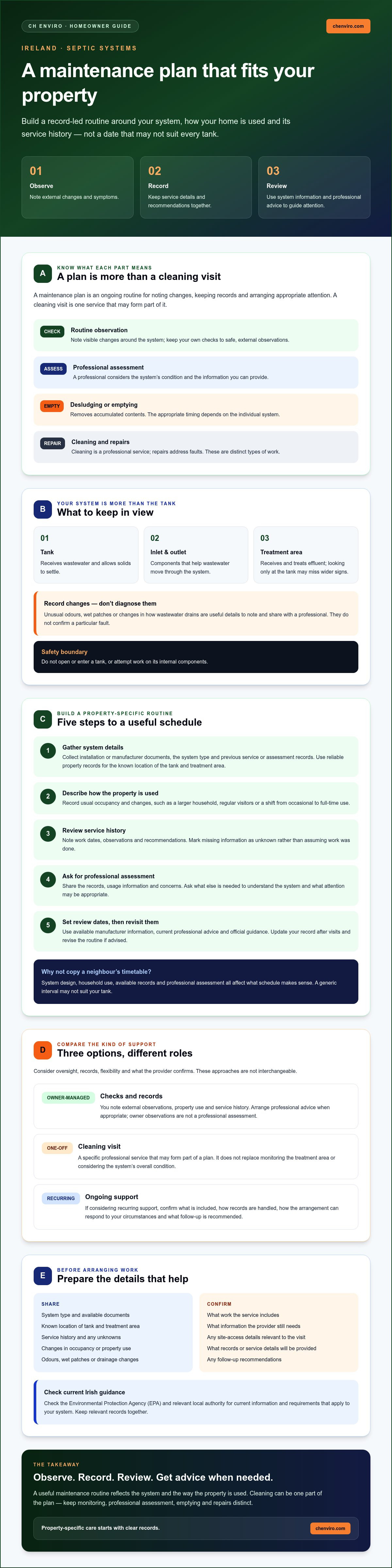
A maintenance plan is an ongoing, record-led routine for a particular property; a tank-cleaning visit is one service that may form part of it. The terms are not interchangeable. Routine observation means noting changes around the system. An assessment looks at its condition. Desludging or emptying removes accumulated contents, while cleaning is a professional service. Repairs address faults and are a separate type of work.
Which parts of a septic system need attention?
The tank receives wastewater and allows solids to settle. Its inlet and outlet components help wastewater move through the system, while the treatment area receives and treats the effluent. The treatment area matters too: looking only at the tank may miss signs that the wider system is not performing as expected. For a foundational overview of what a septic tank is, see Wikipedia.
Limit your own checks to safe, external observations. Note unusual odours, wet patches or changes in how wastewater drains. These signs do not confirm a particular fault, but they are useful details to record and share with a professional. Do not open or enter a tank, or attempt work on its internal components.
Why does a planned routine matter for Irish properties?
Regular oversight can help you notice changes, but it cannot guarantee that every fault will be prevented. A home with more occupants, frequent visitors or changing water use may place different demands on its system than a property used occasionally. Record changes in occupancy or use alongside service dates and symptoms. This gives a professional useful context when discussing appropriate attention.
System design, household use, available records and professional assessment all affect what schedule makes sense. Do not choose an emptying interval solely from a neighbour’s experience or a generic timetable. Check current Environmental Protection Agency (EPA) and relevant local authority guidance for information and requirements that apply to your property.
A useful plan brings together what you observe, the work carried out and what needs checking next. Keep the record simple and update it after professional visits. CH Enviro provides septic tank cleaning and wastewater treatment services, which may form part of a wider maintenance routine. Cleaning is one component, not a substitute for monitoring the treatment area or assessing the system’s overall condition.
How to Build a Septic Tank Maintenance Schedule for Your Property
A useful schedule starts with facts about your system, not a generic emptying interval. To put a septic tank maintenance plan Ireland property owners can follow into practice, set review dates using the system’s documents, household use and service history. Revisit the schedule if a professional assessment or current guidance indicates that it should change.
Maintenance frequency should be set for the individual system because design, household use and condition vary from property to property. A neighbour’s routine may prompt useful questions, but it is not a reliable timetable for your tank.
Gather system details. Collect any installation or manufacturer documents, details of the system type and previous assessment or service records. Use reliable property records to note the known location of the tank and treatment area rather than guessing.
Describe how the property is used. Record usual occupancy and changes, such as a larger household, regular visitors or a shift from occasional to full-time use. This helps put service history in context.
Review the records. Note dates and details of previous work, observations and recommendations. If information is missing, mark it as unknown instead of assuming the system has been checked or emptied.
Ask for a professional assessment. Share available documents, usage information and concerns with a service provider. Ask what else they need to understand the system and what type of attention may be appropriate.
Set review dates and revisit them. Use manufacturer information where available, alongside current professional advice and official guidance. The EPA’s EPA National Inspection Plan is a useful starting point for inspection information. Note when to review the schedule again, particularly after a change in occupancy or system use.
Do not treat observation, assessment and emptying as the same task. A review date is a reminder to check records and conditions. It does not automatically mean the tank needs cleaning or emptying. Record the reason for each visit or task so the next decision is based on the available information, not habit.
Which events should trigger an earlier review?
Persistent odours, slow drainage, wet ground near the treatment area or an unusual change in the system’s behaviour are reasons to seek an assessment before your planned review. They do not identify a specific fault or prove that the tank needs emptying. Explain what has changed, when it began and whether it is continuing.
Take sewage backing up or suspected wastewater discharge seriously and seek professional help promptly. Avoid disturbing the system while waiting for advice. To discuss your system history or whether septic tank cleaning may be relevant, contact CH Enviro and describe what you have observed. Cleaning is only one possible part of a wider maintenance routine.
One-Off Cleaning or Ongoing Support: Comparing Septic Tank Maintenance Options
There are three practical ways to organise attention for a system: keep your own observation records, arrange professional cleaning when a need is identified, or ask a provider whether recurring support is available. Each serves a different purpose. A cleaning visit covers the work agreed for that visit; it does not automatically provide ongoing oversight or cover the whole wastewater treatment system.
Use this comparison to identify what you can manage and what you need to confirm. No option can promise that every fault will be prevented.
A recurring arrangement is not a confirmed CH Enviro offering. Ask the provider directly rather than assuming it is available or included with a cleaning visit.
When can one-off septic tank cleaning be appropriate?
A one-off visit may suit a tank-cleaning need identified from the system’s history or a professional assessment. Treat it as one task, not a replacement for a wider routine. Before booking, ask what the service covers, what findings will be reported and whether any recommendations fall outside the agreed scope. A guide to septic tank cleaning in Ireland can also help explain how cleaning fits into broader care.
What should you ask before choosing professional support?
Get clear answers before arranging work. Ask:
What work is included, and what access is needed at the property?
How will waste be handled, and what documentation will be provided afterwards?
Does the service cover the treatment area, or only tank-related work?
How will recommendations reflect your system and usage rather than a standard interval?
CH Enviro provides septic tank cleaning and wastewater treatment services. To discuss whether either service suits your requirements, visit CH Enviro’s septic tank cleaning service and confirm the scope directly with the team. A clear discussion helps you understand what the visit may address and what could need separate attention.
Irish Septic Tank Checks, Records and Compliance: What to Confirm
A maintenance routine helps you keep track of your system, but it does not replace checking your legal obligations. Requirements can depend on the system and property, so an old checklist or general maintenance advice cannot confirm that you are compliant. Keep routine care and official requirements as separate parts of your septic tank maintenance plan Ireland records.
Which Irish requirements should property owners verify?
Start with current EPA guidance for domestic wastewater treatment systems. Check that the information applies to your system and circumstances, and contact your relevant local authority to confirm whether registration, inspection or remediation requirements apply to the property. If you are unsure, ask the authority which current guidance to follow. Do not assume another property’s status or an earlier answer applies to your situation.
For more detail on the legal checklist, consult a septic tank compliance guide alongside official sources. This section provides practical maintenance guidance, not a definitive statement of Irish law. Confirm current obligations directly with the EPA or your local authority before acting on them.
What records belong in a maintenance file?
Keep one digital or paper file so the system’s history is easy to follow. Include available system plans and installation information, service dates, reports, observations and follow-up recommendations. After a visit, record the work carried out and whether anything remains to be checked. A clear timeline can help you and a service provider distinguish a new concern from a recurring one.
System plans, installation documents and available manufacturer information.
Dates and details of cleaning, inspections or other professional work.
Written findings, recommendations and any follow-up actions.
Changes in household occupancy or use, plus observations between visits.
Before arranging work, ask the provider what written completion details or records they can supply. Check that the information identifies the work performed and any recommendations, rather than simply recording that a visit took place. Keep documents together and update the file when the property’s use changes.
CH Enviro provides septic tank cleaning and wastewater treatment services. If you are arranging cleaning, discuss your septic tank cleaning needs and ask what service information will be provided afterwards. Confirm the scope directly with the provider. A cleaning visit does not replace checking your property’s current obligations with official sources.
Choosing Septic Tank Maintenance Support in Ireland: Your Next Steps
Before contacting a provider, gather details that will help them understand your property and what you need. You do not need to know the cause of a symptom or the technical details of every component. Clear, accurate information is a useful starting point for deciding what to discuss.
What should you have ready when requesting septic support?
Property location: Give the county so the provider can confirm whether the service is available at your address.
System information: Describe what you know about the system and its location. Include any plans or documents you have, but do not guess if a detail is unknown.
Service history: Note previous cleaning or other work, approximate dates if known, and any recommendations you received.
Current concerns: Explain symptoms such as persistent odours, slow drainage or wet ground. Say when they began and whether they are ongoing.
Changes in use: Mention changes in household occupancy or how the property is used, as these may help explain a change in system behaviour.
Ask whether the information is enough to discuss the service or whether an additional assessment may be needed before agreeing to particular work. This helps set clear expectations and avoids treating a reported symptom as a confirmed diagnosis.
What should you confirm before booking?
Check the proposed work and practical arrangements before you commit. Confirm the service scope, how the provider will access the tank, what findings they will report and whether you will receive written records. Ask whether any recommendations will consider the treatment area as well as tank-related work, and what follow-up may be appropriate. If a recurring arrangement is discussed, confirm its terms directly. Do not assume it is included in a one-off visit.
A septic tank maintenance plan Ireland homeowners can rely on is based on the property’s actual needs. Professional cleaning may be one part of the routine, but it is not the same as an assessment or a complete maintenance plan.
How can CH Enviro help with septic maintenance needs?
CH Enviro provides septic tank cleaning and wastewater treatment services for domestic, commercial and industrial clients. These are services to discuss if they suit your system’s needs. The available information does not confirm a formal maintenance-plan contract or inspection package, so ask directly what work can be arranged and what it covers.
Have your system details and questions ready, then discuss septic tank cleaning and wastewater support with CH Enviro. You do not need to have every answer before making an enquiry. Explain what you know, describe any concerns and confirm the next step that makes sense for your property.
Make Your Next Maintenance Step Clear
A practical septic tank maintenance plan Ireland property owners can follow starts with the details of their system, how the property is used and what service records show. There is no single schedule for every household. Keep routine observation, professional assessment and tank cleaning distinct, and check current requirements with the EPA or your local authority.
When arranging support, be ready to describe your system, service history and any changes or warning signs. Confirm the work’s scope, access needs, what findings will be shared and whether follow-up is recommended. This gives you a clearer basis for deciding what happens next.
Listed coverage includes Dublin, Meath, Louth, Kildare, Wicklow and Wexford; confirm availability for your location. To discuss your property’s needs, discuss septic tank cleaning and wastewater support with CH Enviro. A clear conversation is a sensible first step towards a routine that fits your system.
Frequently Asked Questions
How often should a septic tank be maintained in Ireland?
There is no single maintenance interval that suits every septic tank in Ireland. The right schedule depends on system design, household occupancy, water use, service history and professional assessment. Check any manufacturer information you have, and ask a service provider to suggest suitable review dates based on your property. Treat warning signs such as persistent odours or slow drainage as reasons to seek advice sooner, not as proof that emptying is needed.
Is septic tank cleaning the same as a maintenance plan?
No. Septic tank cleaning is one service, while a maintenance plan is an ongoing routine for monitoring the system, keeping records and arranging appropriate professional attention. Cleaning may be suitable when a tank-related need has been identified, but it does not automatically assess the whole system or treatment area. Before arranging a visit, confirm what work is included, what findings will be reported and whether follow-up is recommended.
What happens if a septic tank is not maintained?
Without regular oversight, changes such as persistent odours, slow drainage or wet ground may go unnoticed. If a fault develops, wastewater could back up or escape into the surrounding area, causing property disruption and possible environmental concerns. These outcomes are not inevitable, and symptoms do not identify a specific fault. Record changes and seek professional advice, especially if sewage is backing up or wastewater discharge is suspected.
Do I need a septic tank inspection to create a maintenance plan?
Not always, but an assessment can help a professional understand the system’s condition and discuss a suitable routine. Start with any system documents, previous service records, household-use details and symptoms. An assessment for maintenance planning is distinct from any official inspection or other requirement that may apply. Check current EPA guidance and confirm your property’s obligations with the relevant local authority rather than assuming one type of inspection covers both purposes.
Can I maintain a septic tank myself?
You can manage safe, external observations and record-keeping, such as noting changes in drainage, odours or ground conditions and logging professional visits. This does not replace professional assessment or tank-related work. Do not open or enter a tank, or attempt work on internal components. If you notice a change, note when it began and whether it continues, then share those details with a suitable service provider.
How do I choose a septic tank maintenance service in Ireland?
Confirm the proposed service scope, site access needs, how waste is handled, what written records you will receive and whether the treatment area will be considered. Ask how recommendations will reflect your system and property use rather than rely on a generic interval. If you are in Dublin, Meath, Louth, Kildare, Wicklow or Wexford, confirm current availability for your location.


Comments