
Sewage Treatment Plant Maintenance in Ireland: A Practical Guide
A sewage treatment plant can appear to be working while a fault develops in one part of the treatment chain. Odours, unusual noises, poor drainage or wastewater backing up are signs to take seriously, but it isn’t always clear what to check or when to arrange help. If you’re looking for guidance on sewage treatment plant maintenance Ireland, start with the whole system, not just the tank.
It’s easy to confuse a treatment plant with a conventional septic tank. Both manage household wastewater, but a treatment plant has additional components that need attention. This guide explains the main parts and routine checks, highlights warning signs that may need prompt investigation, and sets out when professional wastewater maintenance can help. You’ll also learn how to respond if odours, poor treatment or a backup suggest something isn’t right, so you can support reliable operation and protect the wider wastewater system at your property.
Table of Contents
Why sewage treatment plant maintenance matters for Irish properties
How an Irish sewage treatment plant works and what needs attention
Warning signs: when an Irish sewage treatment plant needs attention
A practical sewage treatment plant maintenance checklist for Ireland
When to arrange professional sewage treatment plant maintenance in Ireland
Why sewage treatment plant maintenance matters for Irish properties
A sewage treatment plant is part of a property’s wider wastewater system. It relies on the treatment unit, connected pipework, controls and discharge route working as intended. Routine observation and appropriate servicing can help identify changes early and support reliable operation. They can also help distinguish a plant concern from a drainage issue elsewhere on the property.
Across Ireland, these systems serve settings ranging from individual rural homes to commercial and industrial premises. The right maintenance approach depends on the plant installed, how the property uses it and the manufacturer’s instructions. There isn’t one checklist or service interval that suits every model. Good sewage treatment plant maintenance Ireland starts with understanding your system and following its documentation, rather than applying assumptions from another property.
What does sewage treatment plant maintenance include?
Maintenance means observing the system for changes, arranging appropriate servicing and responding to alarms or other signs of a fault. The exact checks and service tasks depend on the make and model, so use the manufacturer’s manual for guidance. Keep a record of recurring issues to help explain what you’ve noticed. Leave electrical or mechanical work to a suitably trained wastewater professional.
How is a treatment plant different from a septic tank?
A conventional septic tank mainly allows solids to settle and separates them from wastewater. A treatment plant includes additional treatment processes, which may involve equipment such as pumps or aeration components, depending on its design. Systems vary, so check your documentation before identifying parts or deciding what needs attention. For related but separate emptying advice, see the septic tank cleaning guide.
Understanding the difference matters because a treatment plant may need attention beyond tank emptying. Maintenance should account for the full treatment process and the system’s designed discharge route, not just the tank. For a foundational overview of how sewage treatment works, including common treatment stages, see the linked reference. Your plant’s manual remains the guide to its specific components and care.
How an Irish sewage treatment plant works and what needs attention
Although layouts differ, wastewater generally flows from the property’s inlet through one or more treatment stages, then out through the system’s designed discharge route. The stages may include settlement and further treatment to reduce pollutants before the treated wastewater reaches its intended outlet or percolation area. The precise process depends on the plant, so its manual and installation records are the best guides to how the system is meant to operate.
The EPA guidance on wastewater provides Irish context on wastewater systems and the regulator’s role. Use current EPA information and applicable local-authority guidance for relevant requirements. For day-to-day care, start with the documentation for your installed plant instead of assuming another system’s layout or maintenance schedule applies.
Which parts of a treatment plant may need routine attention?
A system may include a tank, treatment chamber and controls, but these aren’t universal fittings. Depending on its design, it may also use a pump to move wastewater, a blower to support treatment, or alarms to flag a change in operation. Where fitted, these components need checks suited to the model. Don’t open electrical equipment or attempt mechanical repairs yourself.
Look beyond the plant unit. The outlet and designed discharge or percolation area form part of the overall wastewater system. A change there, such as water appearing where it hasn’t before, is worth recording and assessing. It can have several causes and doesn’t, by itself, confirm a plant fault.
Why manufacturer instructions and site conditions matter
Maintenance planning depends on the system type and how the property uses it. Household size, occupancy patterns and the wastewater load at a commercial or industrial site can affect what needs attention. Site features also matter: soil conditions, drainage layout and access to the plant may shape how servicing is approached.
There’s no safe universal interval for every model. Follow the manufacturer’s instructions for routine checks and servicing, and seek professional guidance if documents are missing or a change in site use raises questions. This is the practical basis of sewage treatment plant maintenance Ireland: understand the plant, its route for treated wastewater and the conditions around it.
If a concern involves the plant and the wider wastewater setup, CH Enviro’s wastewater treatment service can provide professional support to investigate it.
Warning signs: when an Irish sewage treatment plant needs attention
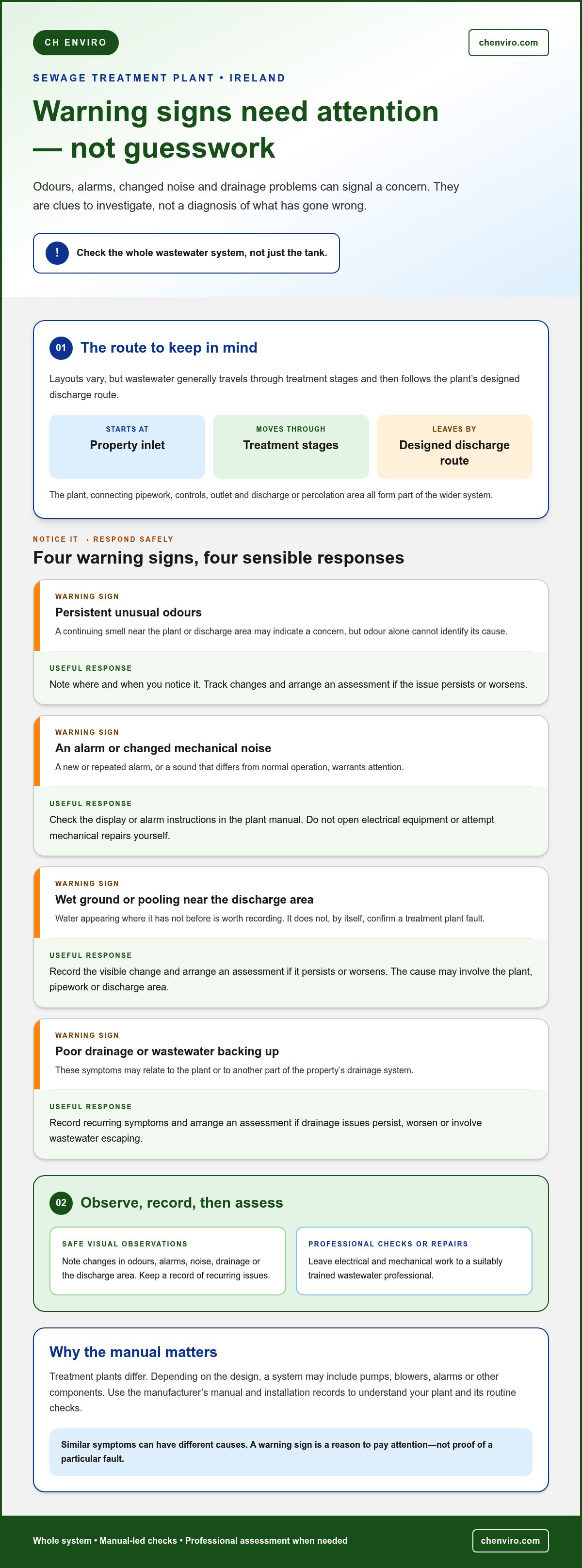
A change in how the plant sounds, smells or drains is a reason to pay attention, not proof of a particular fault. Similar symptoms can arise from issues in the plant, connecting pipework or discharge area. Note what you observe and arrange an assessment if the issue persists, worsens or involves wastewater escaping.
Which warning signs should you look for?
Persistent unusual odours: A continuing smell near the plant or discharge area may indicate a concern, but odour alone can’t identify its cause.
Alarms or changed noise: Check the display or alarm instructions in the manual. A new or repeated alarm, or a mechanical sound that differs from normal operation, warrants attention. Don’t open equipment to investigate.
Visible changes outside: Wet ground, pooling or visible overflow near the system or its discharge area should be investigated promptly. Keep people and pets away from wastewater or potentially contaminated ground.
Repeated drainage symptoms: Slow toilets or drains and recurring backups may relate to the treatment plant, but could also involve a blockage or another part of the drainage system.
No single sign confirms that a plant has failed or identifies a particular component as the cause. Look for patterns, such as an alarm occurring alongside slower drainage, and share those details during an assessment.
What should you do if the plant appears to be failing?
Stay clear of unsafe areas. Don’t touch wastewater, remove covers, enter a tank or chamber, or attempt electrical or mechanical repairs. These tasks can expose you to hazards and should be left to a trained wastewater professional.
Before seeking support, make a clear record:
Note when the issue began and whether it is constant or intermittent.
Write down displayed alarm or error messages, and describe any change in noise or odour.
Record where you see wet ground, pooling or overflow, without approaching it.
If wastewater is visibly backing up or overflowing, reduce avoidable water use where practical, for example by postponing laundry or other non-essential use. This may limit additional loading while you arrange help, but it won’t resolve the underlying issue. Recurring drainage trouble may need investigation across the connected pipework as well as the plant. Clear observations help guide sewage treatment plant maintenance Ireland towards the right assessment without guessing at a diagnosis.
A practical sewage treatment plant maintenance checklist for Ireland
A useful routine is straightforward: check the manufacturer’s instructions, observe the system from a safe position, record anything that has changed, then arrange servicing or assessment where needed. This keeps everyday observation separate from technical work. The right maintenance plan depends on the installed plant, so don’t apply a schedule or checklist intended for a different model.
What can a property owner check safely?
Use the manual to identify which features you can monitor without opening equipment or approaching wastewater. From a safe external position, note visible alarms, unusual sounds, persistent odours and changes around the plant or discharge area. Keep access routes clear so the system can be reached for appropriate servicing, but don’t remove sealed covers or enter chambers.
Keep checks observational. Don’t handle wastewater, touch electrical components or try to reset, dismantle or repair equipment unless the manufacturer’s instructions explicitly identify a safe user action. If you’re unsure whether a check is safe, leave it to a trained wastewater professional.
How should you plan and record maintenance?
Gather the plant manual, model details and any installation or service records in one place. Follow the manufacturer’s servicing guidance and any advice from the professional responsible for the system. Avoid choosing a fixed interval based on a general rule, as requirements can differ between designs and site conditions.
A brief log makes changes easier to explain and provides a useful record for future servicing. Include:
Service dates and the work completed.
Alarms, unusual sounds, odours or visible changes, with the date they were noticed.
Changes in how the property is used that could affect wastewater loading.
Any follow-up advice or work still to be arranged.
For a commercial site, include plant records in wider facility maintenance planning. This helps relevant staff see reported issues and completed work alongside other site maintenance, rather than treating the wastewater system as an isolated unit.
For Irish domestic wastewater guidance, consult current EPA and relevant local-authority information. Keep this separate from model-specific care: regulatory guidance and the manufacturer’s maintenance instructions serve different purposes.
Use this sequence as the basis for sewage treatment plant maintenance Ireland: follow the manual, observe safely, keep clear records and arrange professional attention for technical work or persistent concerns. Arrange wastewater treatment support to investigate a plant concern as part of your property’s wider wastewater maintenance.
When to arrange professional sewage treatment plant maintenance in Ireland
Arrange a professional assessment if an alarm keeps returning, an unusual odour persists, wastewater is visible around the plant or discharge area, or household drainage symptoms recur. These signs don’t confirm a particular fault. The cause could involve the treatment unit, connected pipework or another part of the wastewater system, so explain what you’ve observed rather than guessing.
Don’t wait for several warning signs to appear together. A repeated alarm or a worsening change is enough reason to seek advice, particularly if drainage is backing up or wastewater is escaping. Professional assessment can investigate the concern and identify which part of the system needs attention.
What information helps a maintenance visit run smoothly?
Before arranging a visit, gather the plant’s make and model, its manual and any available service records. A short, factual description is useful: note when the symptom began, how often it occurs and whether it has changed. Include the exact alarm message if there is one.
Also describe access to the plant and any relevant observations around the discharge area, such as visible pooling or changes in the ground. Don’t approach an unsafe area to collect details. Clear information helps the professional understand the reported issue and consider the system as a whole.
How CH Enviro supports wastewater maintenance
CH Enviro provides wastewater treatment services as part of its wider environmental maintenance work for domestic, commercial and industrial clients in Ireland. The service supports investigation of concerns across the treatment plant and wider wastewater setup. An alarm, odour or drainage problem can have more than one possible cause, so assessment should consider the connected drainage and wastewater infrastructure as well as the plant.
CH Enviro works across Dublin, Meath, Louth, Kildare, Wicklow and Wexford. Whether you manage a home, business or industrial site, clear records and a description of the changes you’ve noticed are a practical starting point for sewage treatment plant maintenance Ireland.
Discuss wastewater treatment maintenance with CH Enviro to arrange support for your system.
Keep your treatment system on a clear maintenance plan
Reliable care starts with knowing how your plant is designed to work. Follow its manufacturer’s instructions, keep service and symptom records together, and treat persistent odours, alarms, visible discharge or repeated drainage trouble as reasons to seek an assessment, not as proof of a particular fault. The whole wastewater system matters, including the connected pipework and discharge route.
A steady routine makes it easier to spot changes and explain them clearly. That’s the practical value of sewage treatment plant maintenance Ireland: observe safely, avoid DIY work on electrical or mechanical parts, and arrange professional support when an issue persists or needs investigation.
CH Enviro provides wastewater treatment services for domestic, commercial and industrial clients. Its environmental maintenance work also includes septic tank cleaning and related wastewater services. To discuss a concern about your system, contact CH Enviro about wastewater treatment maintenance.
Frequently Asked Questions
How often should a sewage treatment plant be serviced in Ireland?
Follow the servicing schedule in your plant’s manual or the guidance provided for its specific model. There isn’t one interval that suits every system. Sludge emptying is a separate task: desludging is commonly recommended every one to three years for most households, though the need can vary. Regular professional servicing and emptying are not interchangeable, so use the relevant guidance for each.
What maintenance does a domestic sewage treatment plant need?
A domestic plant needs checks and servicing suited to its design. This may include observing alarms and unusual changes, arranging maintenance for fitted components, and addressing sludge or other servicing needs as directed by the manufacturer. The discharge area is part of the overall system too. Check the manual for the plant’s specific requirements, and arrange professional attention for technical checks or recurring concerns.
Can I maintain a sewage treatment plant myself?
You can carry out safe visual observations, such as noting an alarm, unusual noise or change around the discharge area. Follow the manual, keep access clear and record what you notice. Don’t open sealed covers, enter tanks or chambers, handle wastewater, or attempt electrical or mechanical repairs. These tasks can expose you to hazards and should be handled by a trained wastewater professional.
What happens if a sewage treatment plant is not maintained?
Without appropriate upkeep, a developing issue may go unnoticed and the plant may not operate as intended. Depending on the problem, you could notice persistent odours, alarms, poor drainage, visible discharge or wastewater backing up. These outcomes aren’t inevitable, and symptoms don’t confirm a specific fault. Follow the manufacturer’s maintenance guidance and arrange an assessment if concerns persist or worsen.
How can I tell if my sewage treatment plant is not working properly?
Possible warning signs include recurring alarms, a new or abnormal mechanical sound, persistent unusual odours, wet ground or visible wastewater near the plant or discharge area. Repeated slow drains or backups also deserve attention, but may have a cause elsewhere in the drainage system. Note when symptoms began and whether they’re getting worse. Keep away from wastewater and unsafe areas while arranging advice.
Is a sewage treatment plant the same as a septic tank?
No. A conventional septic tank mainly allows solids to settle and separates them from wastewater. A sewage treatment plant uses additional treatment processes, with components and stages that vary by model. Both are part of a property’s wastewater system, but their maintenance needs aren’t identical. Check your system documentation to understand its design, and follow the appropriate guidance for servicing or emptying.
Who can arrange sewage treatment plant maintenance in Ireland?
A wastewater treatment professional can assess reported concerns and arrange appropriate maintenance for the system. CH Enviro provides wastewater treatment services for domestic, commercial and industrial clients, alongside environmental maintenance such as septic tank cleaning. Its service coverage includes Dublin, Meath, Louth, Kildare, Wicklow and Wexford. For sewage treatment plant maintenance Ireland, share the plant details, service records and a clear description of the symptoms.


Comments